


History
The Boxer was developed in Munich in the 1890s from the Bullenbeisser, a German hunting mastiff, crossed with English bulldogs. The FCI standard traces the line to the small Brabant Bullenbeisser, which huntsmen used to seize and hold game until the hunter arrived. Breeders selected for wide jaws, widely spaced teeth, a broad muzzle and an upturned nose, all of which improved the grip. The first Boxer club was founded in Munich in 1895.
The standard, dated 1 April 2008, gives Germany as the country of origin and classes the breed in Group 2, Section 2.1, among the molossoid breeds of mastiff type. Its stated use is companion, guard and working dog. During the First World War Boxers served as messenger and guard dogs, and the breed has since become one of the most recognisable companions in Europe, loved for its square outline, clownish nature and devotion to family.
Temperament
The FCI asks for a fearless, self confident, calm and equable dog, devoted to the family, watchful as a defender and trustworthy. It also describes the Boxer as harmless with his family but distrustful of strangers, and easy to train. In daily life that means a loyal, affectionate and exuberant dog that loves people, flings itself into games and can behave like a puppy well into adulthood.
Boxers are famously playful, and they are also sensitive. They read your mood, hate being left out and can sulk or become destructive if ignored. Many are wary of strangers at the door, though a well socialised dog soon relaxes. Their enthusiasm can be a lot: leaping up, leaning and bounding through the house are standard behaviour, and an untrained adult can knock over a child or an elderly neighbour.
Children and other pets
Boxers are renowned family dogs, patient, playful and protective of children they know. They can be boisterous, though, and an excited adult may knock a toddler flying, so supervise and teach calm play. Most live peacefully with other household pets raised alongside them, though some can be assertive with unfamiliar dogs, particularly the same sex. Cats usually fare well when introduced young. Because they dislike isolation, they are best in households where someone is home.
Exercise and the daily walk
An adult Boxer needs between an hour and a half and two hours of activity a day, ideally a mixture of brisk walks, play and training. They are athletic and enjoy ball games, hiking and agility. The Grünewald and Bambësch suit them well, giving variety and space to burn energy, though recall needs to be reliable first.
Short muzzles mean limited cooling, so avoid vigorous exercise in hot weather and choose early mornings and late evenings in summer. Take care not to exercise just after a meal, as deep chests carry a bloat risk. Young dogs should not be overworked while growing. Mental activity, such as scent games and trick training, helps turn a restless dog into a settled one.
Training
The standard says Boxers are easy to train, and so they are for people who stay cheerful and consistent. They respond to praise, play and food, and become stubborn or distracted under harsh methods. Short sessions work best, because a Boxer bores of repetition and then invents entertainment.
Early training should focus on calm greetings, loose lead walking and a reliable recall, because an enthusiastic dog of 30 kg or more is hard to manage if it has not learned manners. Socialise the puppy widely so that the natural wariness of strangers stays proportionate. Boxers mature slowly and stay youthful for years, so keep the training going well beyond puppyhood.
Coat and grooming
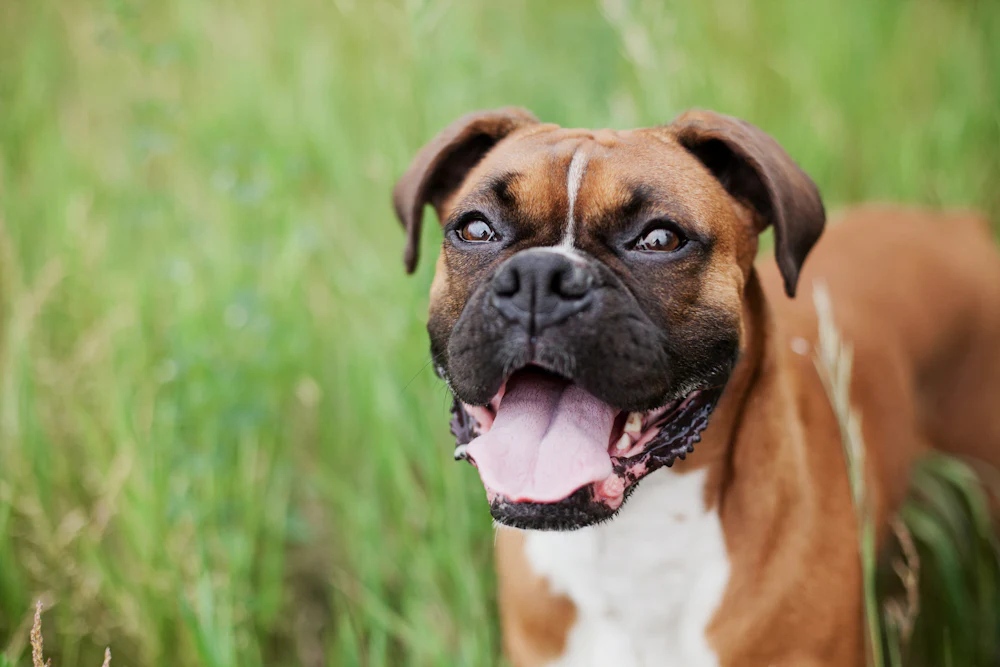
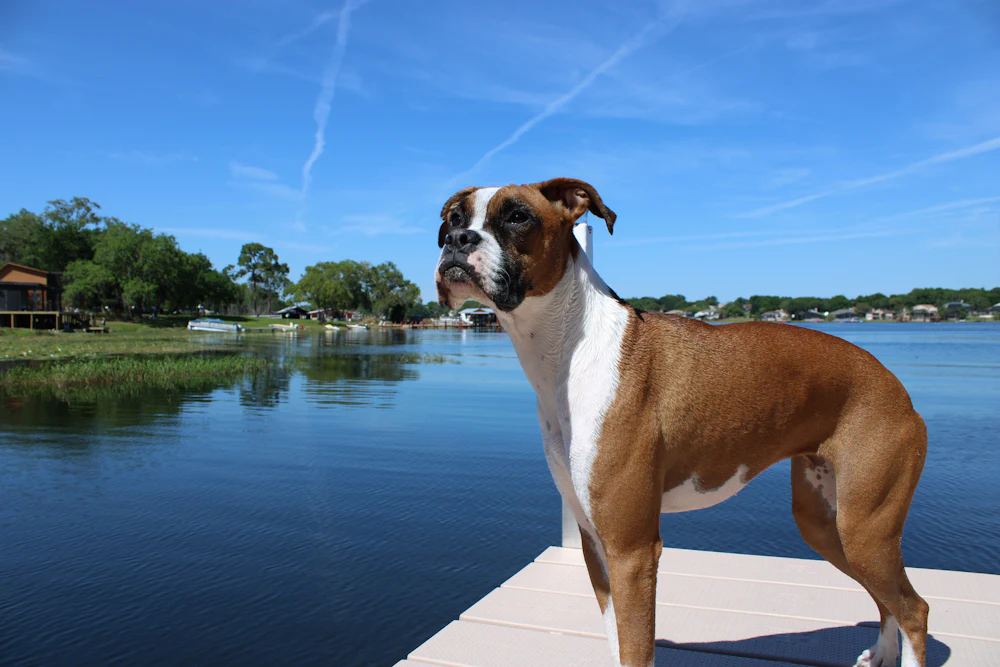
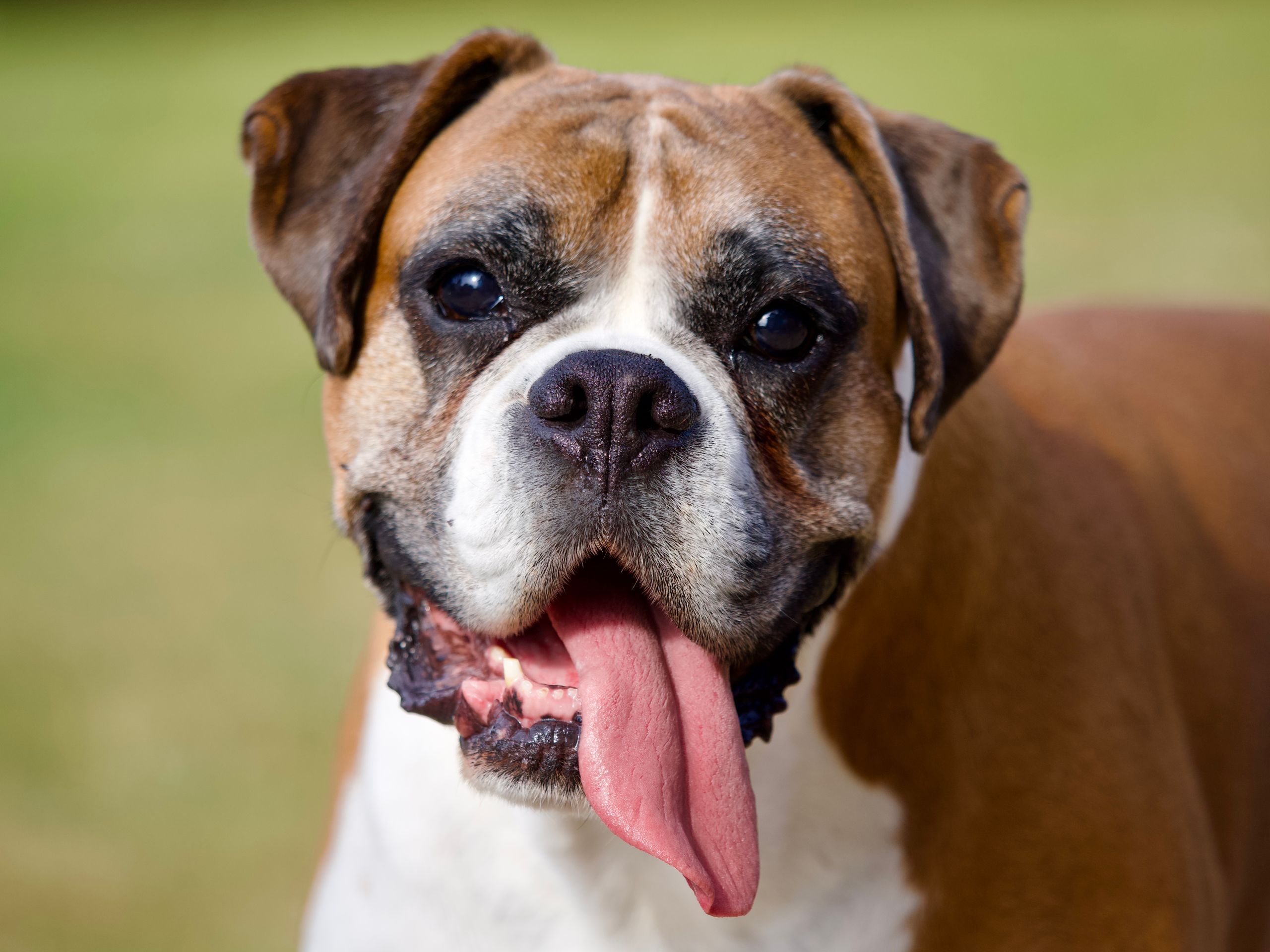
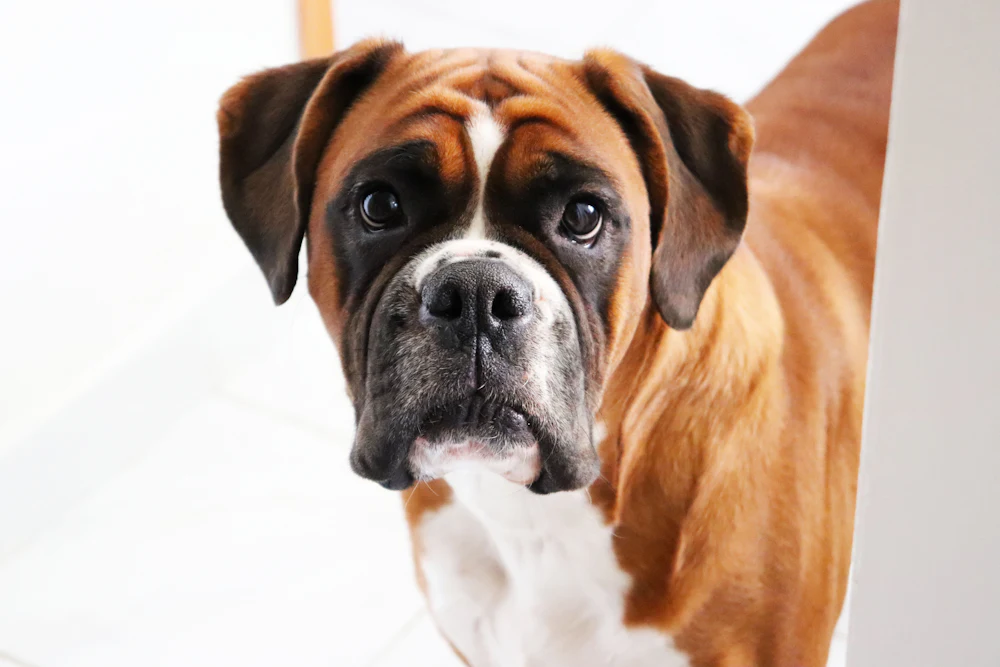
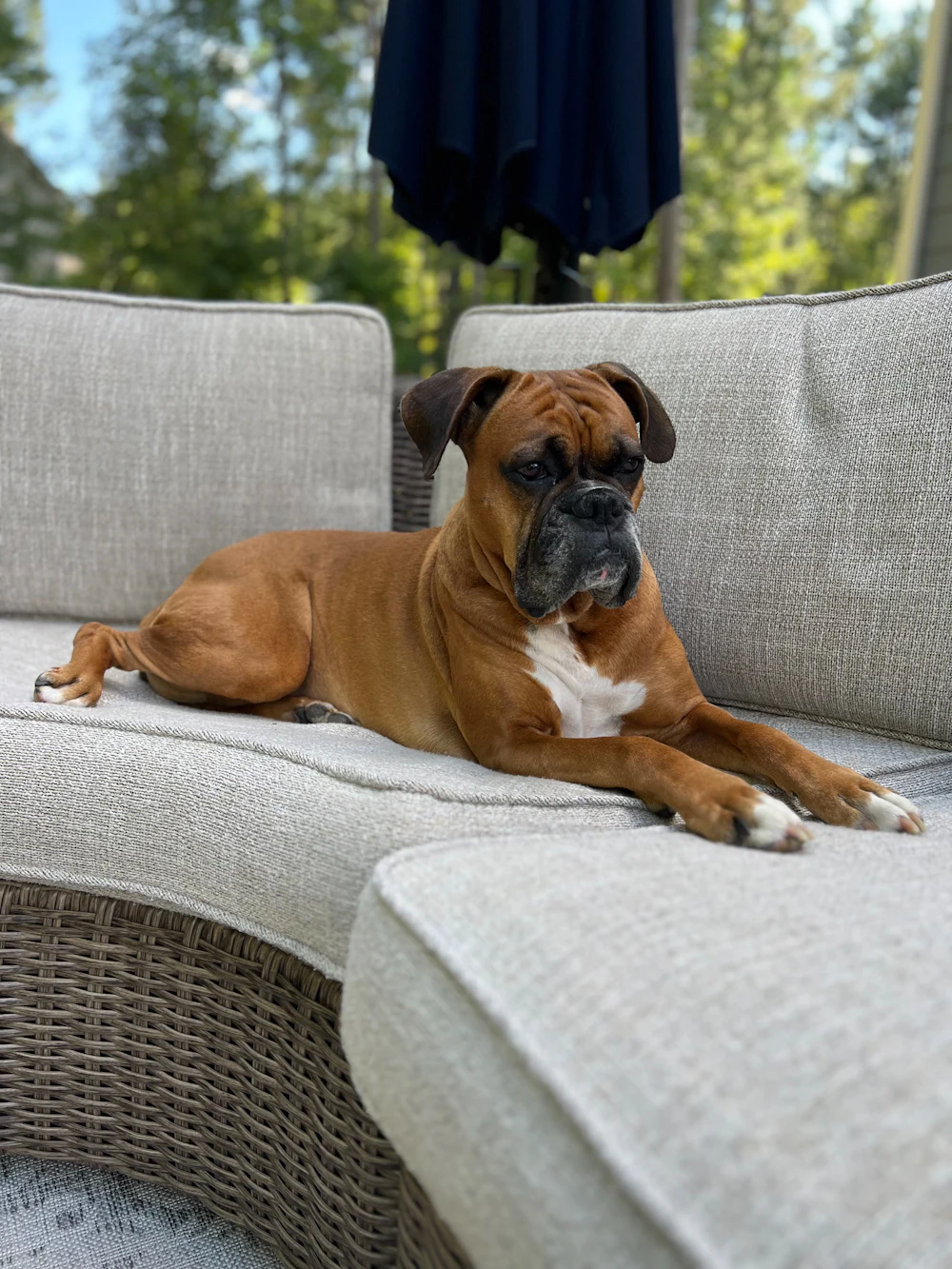
The standard describes a short, hard, glossy and close fitting coat. Colours are fawn, from light to dark deer red, or brindle with dark or black stripes on a fawn background, always with a black mask. White markings are allowed. Grooming is easy: a weekly brush or wipe with a rubber mitt keeps the coat shiny and removes loose hair. The coat gives little protection against cold, so a jacket helps in winter, and pale areas can burn in strong summer sun.
Feeding and weight
Boxers are enthusiastic eaters and gain weight easily, so measure meals, count treats and keep the dog lean. Feed a good quality complete diet suited to a large, active dog, split into two meals a day to reduce bloat risk, and avoid vigorous exercise for an hour either side. Many Boxers eat quickly, so a slow feeder or scattered food helps. Give large breed puppy food and steady, not rapid, growth.
Work out a starting calorie figure and food weight with the calorie calculator. Not sure this is the right breed? Take the quiz.
Health
Every breed carries predispositions. These are the conditions most often discussed for the Boxer, not a prediction for any individual dog.
- Boxer cardiomyopathy (arrhythmogenic right ventricular cardiomyopathy)
- Cancers, notably mast cell tumours
- Brachycephalic airway problems (milder than in flatter breeds)
- Hip dysplasia
- Degenerative myelopathy
What to ask the breeder. Ask for heart screening with a Holter monitor for the parents, hip scores, and DNA testing for ARVC where available.
Choosing a puppy
Choose a breeder who screens the parents' hearts and hips and raises puppies in the home. Boxer puppies are bouncy and mouthy, so offer chews and teach polite play from the first week. Protect growing joints by avoiding stairs, jumping and forced exercise, and start socialisation immediately, with lifts, trams, traffic and visitors. Short, frequent training sessions, crate or bed settling and calm greetings pay off for years, as a mature Boxer is a strong dog.
In Luxembourg the national kennel club is the Fédération Cynologique Luxembourgeoise (FCL), a member of the FCI. Many owners also buy from breeders in Germany, France or Belgium; a puppy coming from another EU country must be microchipped and vaccinated against rabies, which in practice means it cannot travel before about fifteen weeks of age. Where to get a dog in Luxembourg.
The older Boxer
Boxers often show their age by eight or nine, with slower movement, stiffness and weight gain. Keep them walking gently, provide an orthopaedic bed and non slip flooring, and keep weight in check. Regular vet checks should include the heart, and any lumps should be examined promptly, since the breed is prone to tumours. Many older Boxers keep their playfulness and their need to be near the family.
A realistic day
A realistic weekday for a working household in Luxembourg City, with a midday visit. Adjust it to your dog, not the other way round.
A forty minute brisk walk with a few recall and sit exercises, then breakfast.
A chew and a settle on a bed while you leave for work.
A walker takes the dog for a lively forty five minute outing in a park or forest.
A longer walk or play session, up to an hour, in the Bambësch or a quiet park.
A short final walk, then bedtime near the family.
A Boxer in Luxembourg
A Boxer can live in a Luxembourg flat if its exercise and company needs are met. The dog is clean, short coated and does not need much grooming, but its exuberance in lifts and corridors needs managing, so teach it to sit and wait before doors open. Many residents live in flats with lifts, and a Boxer used to them early will accept them calmly. Neighbours may be wary of a large dog, so manners matter.
Summer heat is the main issue. Temperatures can reach the 30s, and a short muzzled dog struggles to cool itself, so keep outings early or late, carry water and avoid hot pavements. In winter the thin coat needs a jacket. The Grünewald and Bambësch give excellent walking, and the free buses and trams make them accessible, though check that the dog can ride calmly first.
Every dog in Luxembourg must be identified, declared to the commune and covered by liability insurance. How registration works.
When you travel
A Boxer left with a sitter needs company, structure and exercise, because boredom leads to destructive behaviour. Provide detailed notes on feeding times, walks and commands, and avoid hot or strenuous exercise. Warn the sitter about bloat symptoms, such as a swollen belly, retching and restlessness, and about the dog's strength at the door. Leave heart medication details if any, and the vet's number.
PAWLY's holiday and overnight care takes place in your home, so your dog keeps its own bed and routine.
Myths and facts
MythBoxers are aggressive.
FactThe standard asks for a calm, equable dog that is harmless with its family. Most problems come from poor socialisation or too little exercise.
MythBoxers do not feel the heat because they are short haired.
FactA short coat does not help a short muzzle. They overheat easily and need cool, shaded exercise in summer.
MythA Boxer is fully grown at one year.
FactBoxers mature slowly and stay puppyish for years, so training must continue well beyond puppyhood.
Is it the right dog for you?
Suits
- Active families who enjoy a playful dog
- People home for much of the day
- Owners who like a strong, affectionate companion
- Those willing to train consistently
Think twice if
- You are away at work all day
- You want a quiet, calm dog from the start
- You dislike drool and snoring
- Summer heat is a problem for you
Questions owners ask
Are Boxers good family dogs?
Yes, they are often wonderful with children and love being part of family life. They are large, bouncy and slow to mature, so supervise play and teach calm manners. Slow, steady training pays off.
How big does a Boxer get?
According to the FCI standard, males measure 57 to 63 cm and females 53 to 59 cm at the withers, with males over 30 kg and females around 25 kg.
Do Boxers drool and snore?
Some do, because of the short muzzle and loose lips. The amount varies, but noisy breathing, laboured panting or collapse after exercise needs veterinary attention. Wipe the face after drinking.
Can a Boxer be left alone?
Not for long. Boxers are people dogs, and a bored, lonely Boxer may chew, bark or become anxious. A midday visit and a good morning walk make a working day manageable.
Sources
Photo: Unsplash (Unsplash License) · Photo: Unsplash (Unsplash License) · Photo: Pexels (Pexels License) · Photo: Unsplash (Unsplash License) · Photo: Unsplash (Unsplash License)
General information for dog owners in Luxembourg, not veterinary or legal advice. Official facts (origin, size, group, history and temperament as described by the breed standard) follow the FCI standard; health and care sections reflect breed-club and veterinary guidance and are typical ranges rather than rules. For your own dog, ask your vet, the breed club or your commune. How this guide is written and checked. Last reviewed 8 October 2026.
Need someone for your Boxer?
PAWLY offers an individual 45-minute walk or a home visit at your dog's pace, the same walker every time, and a written report with photos after every visit, across Luxembourg City.
Read next: the journal, for the Boxer
All articles
Dogs in hot weather: the Luxembourg summer guide
Flat-faced and short-nosed breeds like the Boxer overheat quickly, which matters in a Luxembourg summer.

The dog that barks and lunges on the lead
Some Boxer dogs are selective with other dogs; this is the plan for lunging and barking on the lead.

The front door: barking, deliveries and escapes
A watchful breed reacts at the door; this is how to manage it.
Similar breeds
All 198 breeds
Dobermann
An elegant, square-built German guard dog that is far more devoted, sensitive and people-minded than its fierce reputation suggests.
EnergyGroomingFlat life
Rottweiler
A calm, powerful working dog from the town of Rottweil, loyal and protective, and a real responsibility.
EnergyGroomingFlat life
Dogue de Bordeaux
An ancient French guardian with a huge head and a soft heart, calm at home, vigilant at the door and demanding of careful ownership.
EnergyGroomingFlat life

