


History
The FCI traces the Rottweiler to Roman times, when dogs of this type accompanied the legions across the Alps and drove the herds that fed the troops. In the area around Rottweil, in what is now Baden-Württemberg, these dogs crossed with local dogs and became known as butchers' dogs, valued for driving cattle to market and for guarding property. The town gave the breed its name, and the work shaped it into a strong, steady and biddable dog.
When cattle began to travel by rail in the later nineteenth century, the drovers' dogs lost their purpose and the breed almost vanished. It survived because enthusiasts took it up for other work, and by 1910 the Rottweiler had official recognition as a police dog, thanks to its suitability for such duties. The FCI standard today describes a medium to large, stalwart dog, neither heavy nor light, and neither leggy nor weedy, of great strength, agility and endurance.
Temperament
The FCI standard describes the Rottweiler as good natured, placid in basic disposition, very devoted, obedient, biddable and eager to work. It adds that the dog should be self-assured, steady and fearless, with great alertness and an even-tempered response to its surroundings. That portrait is rarely the one in the press. A well-bred, well-raised Rottweiler is calm at home, thoughtful, and rather aloof with strangers.
Protectiveness is in the breed's history, so the dog watches the house and its people carefully, and it expects to be taken seriously. That is the root of most problems: a powerful dog bred to guard needs clear rules and a steady owner. Boredom and isolation do harm. Many Rottweilers are clownish and affectionate in private, leaning their weight against your legs, and delighted by company. Early, wide socialisation is the best insurance against nerves or over-reaction.
Children and other pets
With its own family, a properly raised Rottweiler is often patient, devoted and tolerant, and many love children. The weight and power of an adult mean that any play with young children must be supervised, and visiting children should be managed carefully, since a protective dog can misread rough games. Some are dominant with other dogs, especially of the same sex, so early socialisation is vital. Introduce cats and small pets slowly, and always supervise.
Exercise and the daily walk
An adult Rottweiler needs between an hour and a half and two hours of exercise a day, split between walking and activity. Walks should be steady and purposeful rather than frantic: hiking, long lead walks, swimming, and carrying or retrieving games all suit a dog bred for stamina. Avoid repetitive hard impact, such as ball chasing on hard ground, while the dog is still growing, because heavy puppies can strain developing joints.
Rottweilers are working dogs, and they are happier with a task. Obedience classes, tracking, scent games and organised sport give the mind something to chew on, and tired minds make for calm dogs at home. Control matters outside: choose secure places for any off lead time, and keep the dog under reliable control in busy areas. In hot weather, walk early or late and keep sessions shorter, because a heavy dog with a dark coat heats up easily.
Training
Rottweilers are intelligent and willing, but training is not optional. Their strength means a poorly trained dog can be dangerous, even without ill will. Start the day the puppy arrives, keep sessions short, and reward good behaviour consistently with food, play and calm praise. Harsh methods tend to harden a dog, and they produce the very reactions owners fear. Fairness and clear boundaries build the steady dog the standard describes.
Socialisation is as important as obedience. Introduce the puppy to people, dogs, traffic, lifts, trams and noises in a positive way, and keep going through adolescence, when confidence wobbles. Teach loose lead walking, a reliable recall and a settled wait at doors. Group classes are useful, and professional help should be sought early at the first sign of guarding or reactivity. This is a breed for owners ready to invest time.
Coat and grooming
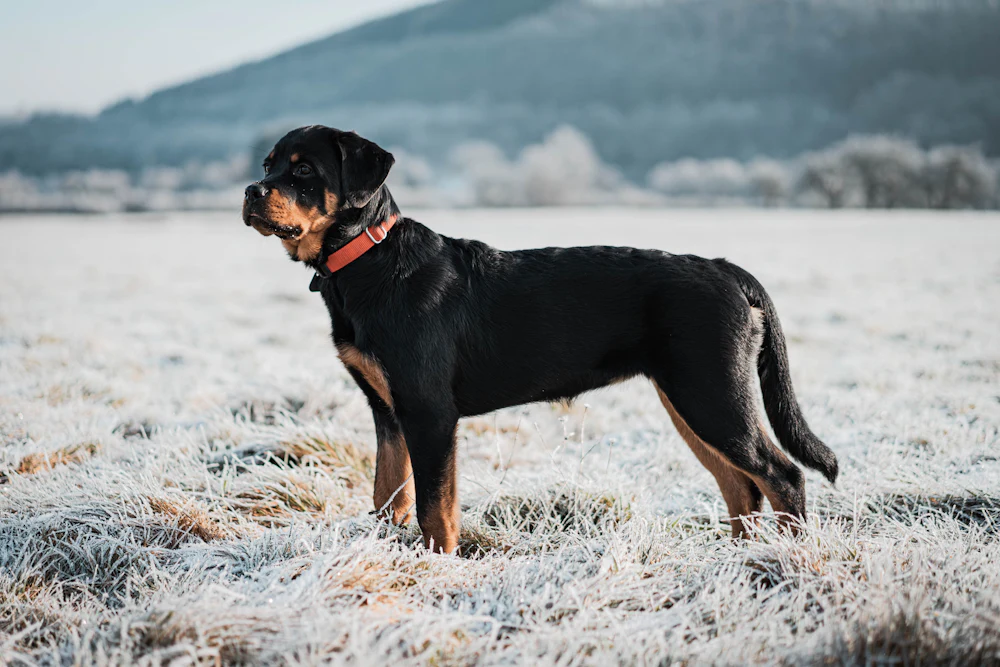
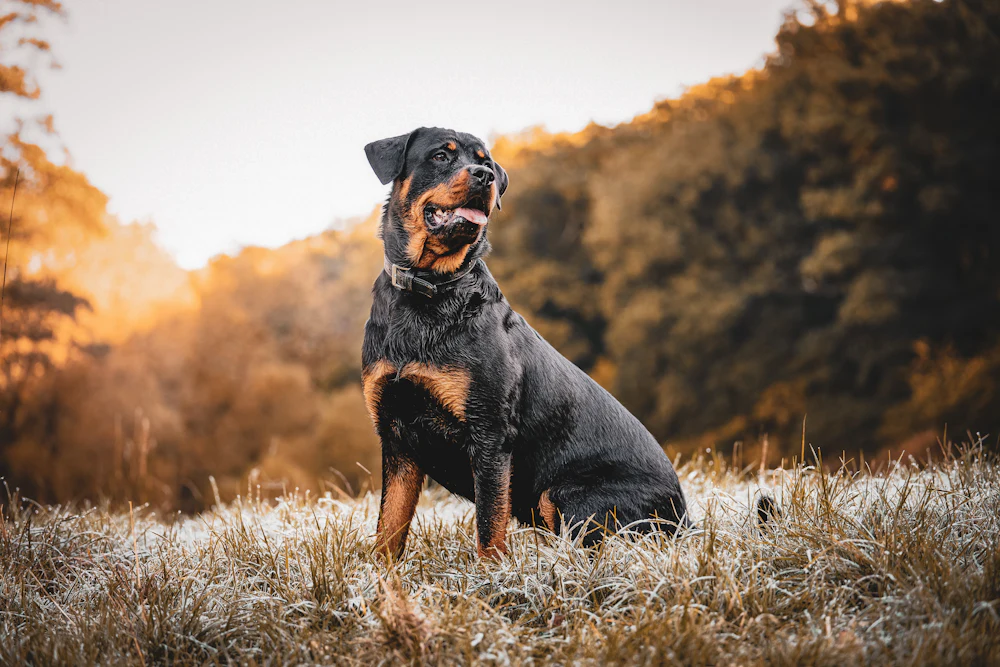
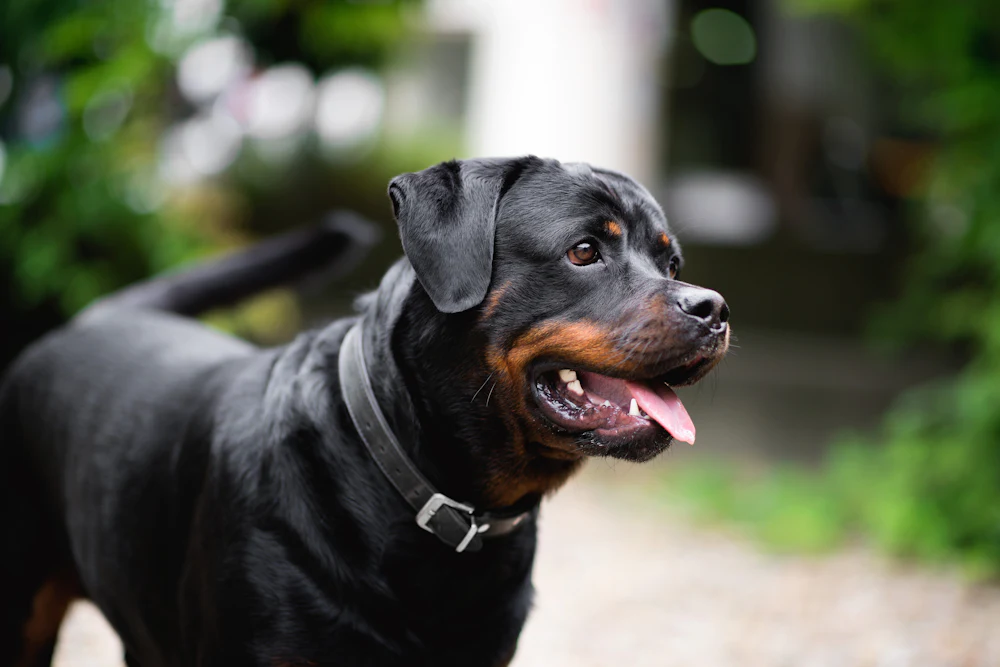
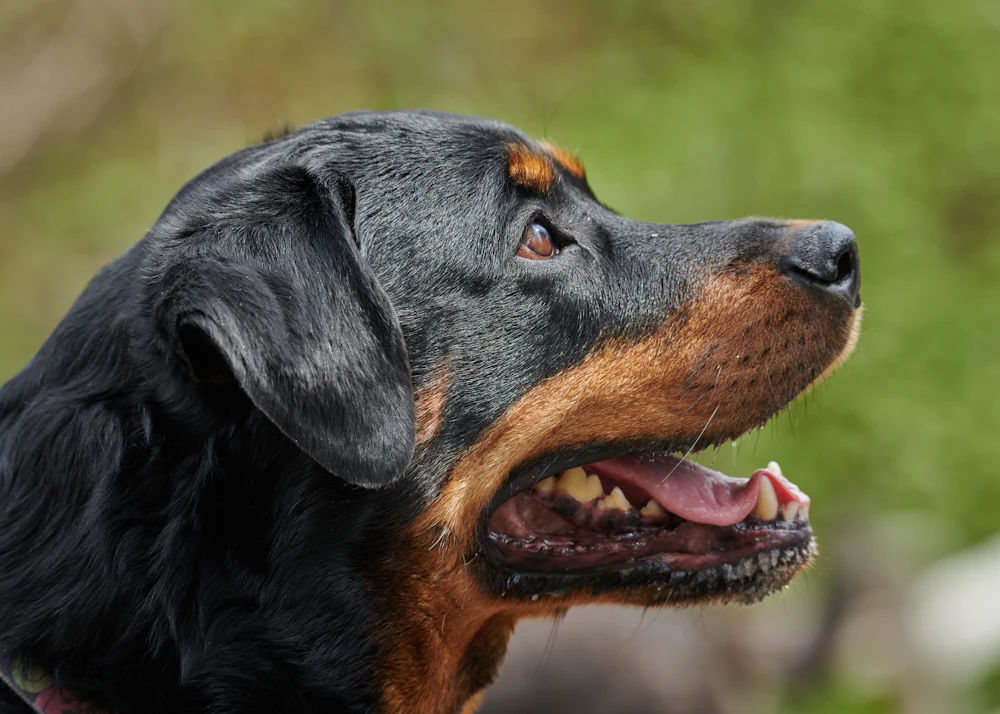
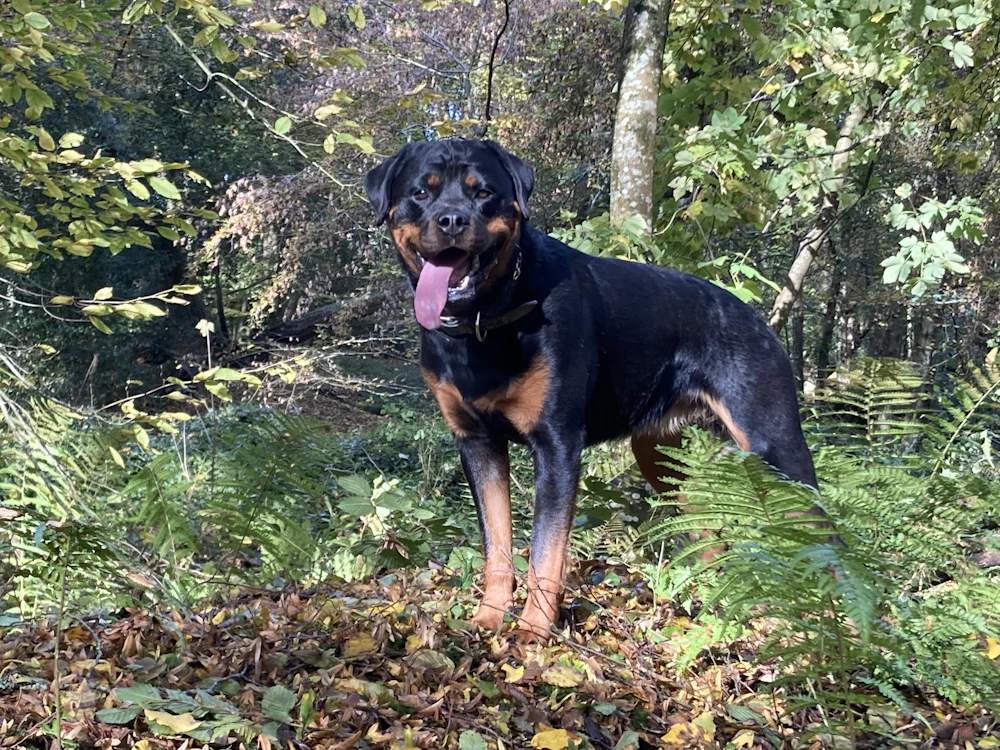
The coat is medium length, coarse, dense and flat, with an undercoat, and the FCI permits only black with clearly defined markings of rich tan on the cheeks, muzzle, throat, chest and legs, over both eyes and under the base of the tail. Care is easy: brush weekly, and more often during the heavy seasonal moults, when the undercoat comes out in clumps. Bathe only when needed. Check ears, trim nails and keep teeth clean.
Feeding and weight
Feed a good complete diet suited to a large, muscular dog, and keep the dog lean, since extra weight strains hips, elbows and knees. A deep chest means a risk of bloat, so give two smaller meals, avoid exercise before and after eating, and discourage gulping with a slow feeder. Rottweilers are often keen eaters, so measure portions and use part of the ration for training. Take your vet's advice on puppy diets, since steady growth is better than rapid growth.
Work out a starting calorie figure and food weight with the calorie calculator. Not sure this is the right breed? Take the quiz.
Health
Every breed carries predispositions. These are the conditions most often discussed for the Rottweiler, not a prediction for any individual dog.
- Hip and elbow dysplasia
- Osteosarcoma (bone cancer)
- Cruciate ligament rupture
- Subaortic stenosis
- Gastric dilatation-volvulus
What to ask the breeder. Hip and elbow scores, a heart examination and an eye examination for the parents.
Choosing a puppy
Choose a breeder who tests the parents and can show hip and elbow scores, a heart examination and an eye examination. Meet the mother, who should be calm, confident and friendly, and ask to see the living conditions. A good breeder will interview you too. Expect a clumsy, mouthy puppy that grows quickly. Begin socialisation and training straight away, protect the joints by avoiding stairs and long runs, and enrol in a good puppy class.
In Luxembourg the national kennel club is the Fédération Cynologique Luxembourgeoise (FCL), a member of the FCI. Many owners also buy from breeders in Germany, France or Belgium; a puppy coming from another EU country must be microchipped and vaccinated against rabies, which in practice means it cannot travel before about fifteen weeks of age. Where to get a dog in Luxembourg.
The older Rottweiler
Rottweilers are not long lived, and the later years need attention. Stiffness, slower walks and weight loss may signal joint disease or other problems, so see your vet regularly. Keep the dog lean, provide a supportive bed, and avoid slippery floors. Cruciate injuries and bone tumours are among the breed's known risks, so any limp that lasts more than a day or two should be checked. Gentle daily outings keep an older dog happy.
A realistic day
A realistic weekday for a working household in Luxembourg City, with a midday visit. Adjust it to your dog, not the other way round.
Steady 45 minute walk with some obedience practice.
Breakfast, then a settled rest.
Midday visit from a walker: toilet break and a calm walk.
Longer walk in the forest or park, with scent or retrieve games.
Light supper, a last toilet trip and bed.
A Rottweiler in Luxembourg
A calm Rottweiler can live in a Luxembourg flat if exercise and training are consistent, though a large dog in a lift and on stairs needs good manners, and neighbours deserve consideration. The Rottweiler is not one of the four types named in the law of 9 May 2008, but a large, protective dog is noticed in the city, so reliable obedience and a short lead in busy places are good practice. The Bambësch and Grünewald forests are ideal for long walks.
Every dog must be microchipped, declared to the commune and insured for third-party liability, and the commune charges an annual dog tax. Summers can reach the 30s, which is hard on a heavy dark coated dog: walk before breakfast and after dusk, and keep indoors cool. Parks such as Parc Merl and the Pétrusse valley suit shorter outings. Buses and trams are free nationwide, so use quiet times to practise travelling calmly with your dog.
Every dog in Luxembourg must be identified, declared to the commune and covered by liability insurance. How registration works.
When you travel
A sitter needs to be confident with a large, strong dog. Share the daily routine, the feeding plan and the training cues, and arrange a meeting before you leave. Rottweilers can be reserved with strangers, so introductions matter. The sitter should use a secure lead, avoid busy settings, and never leave the dog unsupervised with unknown visitors. Leave the vet's details and a note that the dog must be kept cool in summer.
PAWLY's holiday and overnight care takes place in your home, so your dog keeps its own bed and routine.
Myths and facts
MythRottweilers are naturally aggressive.
FactThe FCI describes a good natured, placid, biddable dog. Problems usually come from poor breeding, poor socialisation or poor handling.
MythThey need a guard dog trainer.
FactThey need ordinary good training and socialisation. Protective instincts are inherited, and encouraging aggression creates a danger.
MythThey cope well with being left alone.
FactThey are devoted and need company. Long isolation leads to boredom, barking and destruction.
Is it the right dog for you?
Suits
- Experienced owners who enjoy training
- Active people who love long walks
- Households that can give time and company
- Owners who can handle a strong dog
Think twice if
- You want a dog that greets strangers
- You cannot commit to training and socialisation
- You are short of time or physical strength
- You rent a flat where large dogs are unwelcome
Questions owners ask
Are Rottweilers good family dogs?
In the right home, yes. A well-bred, well-raised Rottweiler is devoted and gentle with its family. Its size and protective nature mean children must be supervised, and the dog needs steady training and socialisation.
Are Rottweilers banned in Luxembourg?
The law of 9 May 2008 names four types of dog needing a training certificate and ministerial authorisation, and the Rottweiler is not among them. All dogs must still be microchipped, declared and insured.
How big do Rottweilers get?
Males stand 61 to 68 cm and females 56 to 63 cm, with ideal weights of about 50 kg and 42 kg. They are heavy for their height and need a lean, fit condition.
How much exercise does a Rottweiler need?
Between an hour and a half and two hours a day for a healthy adult, mixing walks with training and play. Take care in hot weather and avoid hard exercise while young.
Sources
Photo: Unsplash (Unsplash License) · Photo: Unsplash (Unsplash License) · Photo: Unsplash (Unsplash License) · Photo: Unsplash (Unsplash License) · Photo: Unsplash (Unsplash License)
General information for dog owners in Luxembourg, not veterinary or legal advice. Official facts (origin, size, group, history and temperament as described by the breed standard) follow the FCI standard; health and care sections reflect breed-club and veterinary guidance and are typical ranges rather than rules. For your own dog, ask your vet, the breed club or your commune. How this guide is written and checked. Last reviewed 8 October 2026.
Need someone for your Rottweiler?
PAWLY offers an individual 45-minute walk or a home visit at your dog's pace, the same walker every time, and a written report with photos after every visit, across Luxembourg City.
Read next: the journal, for the Rottweiler
All articles
Feeding, portions and how to tell if your dog is the right weight
Large dogs suffer more from extra weight; this is how to judge the right one.

Lumps and bumps: what to check and when
Early checks on lumps matter in a breed prone to tumours.

Running with your dog, safely
The Rottweiler has the stamina for running; this explains how to build up safely.
Similar breeds
All 198 breeds
Dobermann
An elegant, square-built German guard dog that is far more devoted, sensitive and people-minded than its fierce reputation suggests.
EnergyGroomingFlat life
German Shepherd
Intelligent, loyal and built to work. In the right hands one of the finest dogs there is; without a job, a handful.
EnergyGroomingFlat life
Cane Corso
An athletic Italian guardian with a working dog's mind, devoted to its family and quietly certain about who belongs at the gate.
EnergyGroomingFlat life

