


History
The Bulldog was first classified in the 1630s and was originally used for bull-baiting. After 1835, the year the blood sport was banned in Britain, the breed began to change into the shorter-faced, squatter dog we recognise today. Breeders who had once valued gameness began to value a different kind of character, and the dog that came out of the process was a household animal rather than a fighter, and the shape has been exaggerated ever since.
The Bulldog entered the show ring in 1860, and the FCI standard notes that it went through a considerable development of personality, eventually being regarded as Britain's national dog. The same standard is firm that no single feature should be exaggerated so as to spoil the symmetry or the movement of the dog. It is worth holding that sentence up against many of the dogs seen in parks today, because the modern pet market has often pushed in the opposite direction.
Temperament
The FCI standard describes a dog that gives an impression of determination, strength and activity, alert, bold, loyal, dependable and courageous. Behind the ferocious look it places an affectionate nature, and that is what most people who live with Bulldogs report: a stocky, solemn animal that wants to be wherever you are, preferably touching your feet.
In practice the breed is calmer than the standard's list of adjectives suggests. Stubbornness is the usual complaint, and a Bulldog that has decided against a walk will sit down on the pavement and consider the matter at length. Aggression or marked shyness counts as a fault in the standard, and a well-bred dog is neither.
Children and other pets
Bulldogs are generally gentle and patient with children and tolerant of other pets, and the affectionate nature described in the standard shows most clearly with people they know. Their weight and short breath mean they prefer calm games to chasing. A toddler can safely lean on a Bulldog, but the dog should not be hauled about or sat on. Supervise, as with any breed, and give the dog somewhere to retreat when the house is noisy.
Exercise and the daily walk
Short, gentle walks in cool weather are enough. Twenty or thirty minutes at a Bulldog's own pace, twice a day, suits most adults far better than one long outing. Early mornings and late evenings are best, and in warm weather the walk should be brief and in shade.
Most Bulldogs cannot swim safely, so keep them away from open water and pools unless closely supervised. Never leave one in a parked car, and avoid hard games in the heat. A dog that begins to snort, drool heavily or lie down should be taken somewhere cool at once.
Training
Bulldogs are affectionate and good-natured, and also stubborn. They respond to patience, food and praise, and switch off completely when pushed. Keep sessions short, choose cool hours when the dog is fresh, and finish while the dog is still interested. A Bulldog that has been shouted at will simply stop taking part.
Daily care is part of training. Teach the puppy to accept cleaning of the facial folds, the tail pocket and the paws, and to stand for checks of the eyes and skin. A dog that has learned to enjoy this at ten weeks is a much easier patient at ten years.
Coat and grooming
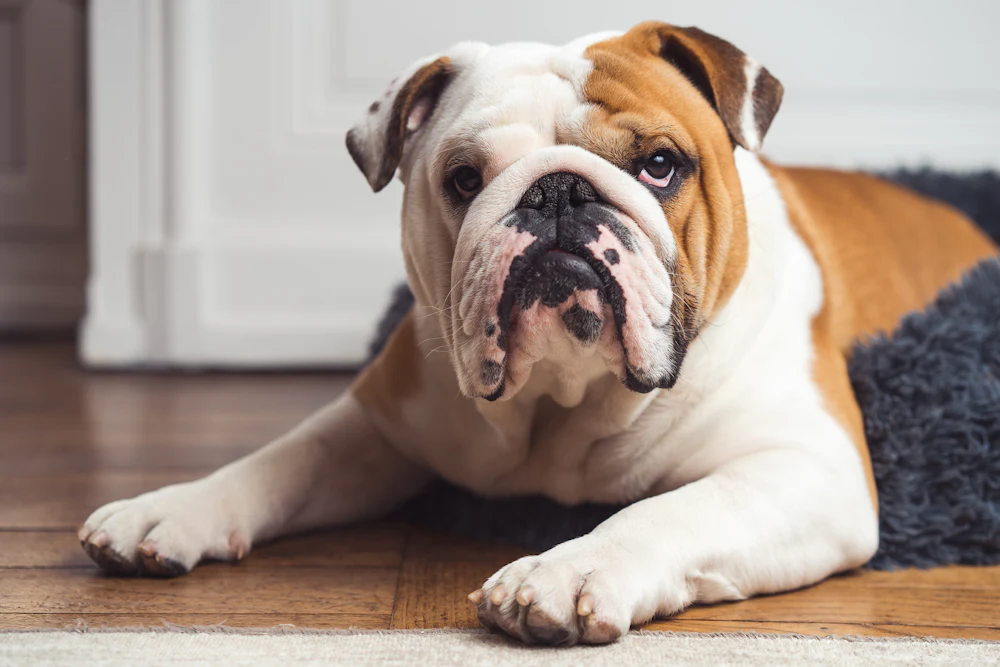
The FCI describes a fine, short, close and smooth coat. Colours include brindles, reds, fawns and whites, and pied combinations. The coat is easy, with a weekly brush to remove loose hair, but the folds are not. Clean and dry the facial folds and the tail pocket regularly to prevent infection, and check between the toes after wet walks. A little shedding is normal all year.
Feeding and weight
Keep a Bulldog lean to protect breathing and joints, because extra weight makes everything harder for this shape. Many have sensitive skin and digestion, so change foods gradually and discuss persistent itching or loose stools with your vet rather than switching brands repeatedly. Measure meals, keep treats small, and use a flat dish or slow feeder if the dog gulps.
Work out a starting calorie figure and food weight with the calorie calculator. Not sure this is the right breed? Take the quiz.
Health
Every breed carries predispositions. These are the conditions most often discussed for the English Bulldog, not a prediction for any individual dog.
- Brachycephalic obstructive airway syndrome (noisy breathing, heat and exercise intolerance)
- Skin fold dermatitis
- Hip dysplasia
- Eye problems including cherry eye and entropion
- Difficult births, with most puppies delivered by caesarean section
- A short average lifespan
What to ask the breeder. Look for moderate conformation and respiratory grading of the parents where available, and ask about caesarean births and longevity in the line.
Choosing a puppy
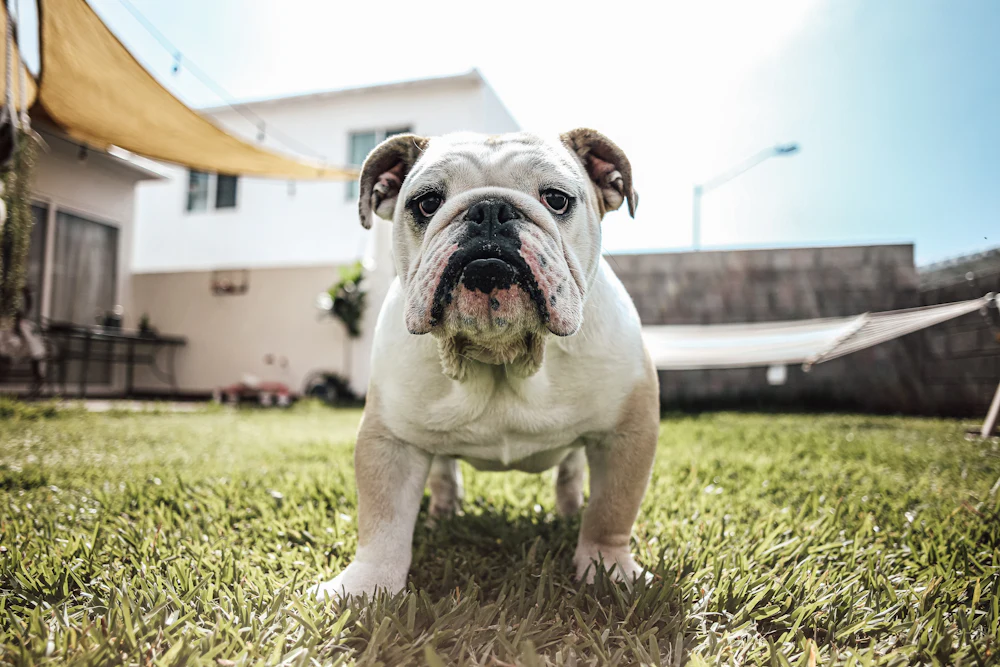
Look for moderate conformation: open nostrils, a visible muzzle, a less exaggerated body, and parents that breathe quietly and can walk comfortably. Ask about caesarean births and the age of older dogs in the line, and expect a breeder to talk about health before colour. A puppy that already snores loudly or struggles after a short play is a warning, not a quirk.
In Luxembourg the national kennel club is the Fédération Cynologique Luxembourgeoise (FCL), a member of the FCI. Many owners also buy from breeders in Germany, France or Belgium; a puppy coming from another EU country must be microchipped and vaccinated against rabies, which in practice means it cannot travel before about fifteen weeks of age. Where to get a dog in Luxembourg.
The older English Bulldog
Breathing, skin and joints need close attention as Bulldogs age. Cool rooms in summer, soft bedding and a lean body weight help most. Watch for increased snoring, reluctance on stairs, red or smelly folds and cloudy eyes, and book regular checks. Shorter, more frequent walks replace the longer ones the dog used to manage.
A realistic day
A realistic weekday for a working household in Luxembourg City, with a midday visit. Adjust it to your dog, not the other way round.
A short walk while the air is cool.
Breakfast and fold cleaning.
Midday visit: a gentle stroll and company.
Evening walk once the heat has gone.
Bed, usually with snoring.
An English Bulldog in Luxembourg
Their low exercise needs suit a flat, and a lift is a real advantage because stairs are hard on a heavy, short-legged dog. The Pétrusse valley and Parc Merl offer shaded paths for gentle strolls, and a slow circuit is plenty. Neighbours rarely complain, though the snoring may carry through thin walls.
Heat is the main danger. Summers here can reach the 30s °C, so plan walks for early morning and late evening, keep rooms cool and never leave the dog in a car. Remember that dog tax, third-party liability insurance and microchipping apply as for any dog, and that a Bulldog is also one of the more expensive breeds to insure.
Every dog in Luxembourg must be identified, declared to the commune and covered by liability insurance. How registration works.
When you travel
Bulldogs should not fly in the hold and are at risk in heat, so a sitter at home is usually the best option. The sitter should know how to clean the folds, how to keep the dog cool and what laboured breathing looks like, and have your vet's number to hand. Leave notes on feeding, walking times and any medication.
PAWLY's holiday and overnight care takes place in your home, so your dog keeps its own bed and routine.
Myths and facts
MythBulldogs are aggressive because of their history.
FactBull-baiting ended in the nineteenth century, and the FCI standard describes an affectionate nature behind the fierce look. Modern Bulldogs are generally calm.
MythA Bulldog is a low-maintenance dog.
FactExercise needs are low, but daily fold care and veterinary costs are among the highest of any breed.
MythSnoring and snorting are just part of the charm.
FactThey often signal airway obstruction and deserve a vet's attention.
Is it the right dog for you?
Suits
- Owners wanting a calm, low-energy companion
- Apartment dwellers with a lift
- People prepared for veterinary costs
Think twice if
- Active lifestyles
- Hot climates
- Budgets without room for health costs
Questions owners ask
Why do Bulldogs need caesareans?
The puppies' heads are large relative to the mother's pelvis, so most litters are delivered surgically. It is a consequence of the breed's shape and a reason to buy only from breeders who plan carefully and put the mother's welfare first.
Are Bulldogs good with children?
Generally very good: calm and tolerant, and happy to lie nearby. Their bulk can knock a toddler over by accident, and they dislike rough handling, so supervise young children and teach them to leave the dog alone when it rests.
How much exercise does a Bulldog need?
Around thirty to sixty minutes a day, in short, gentle outings. In warm weather less is better, and the walk should be shaded. Mental games indoors help burn energy without heat.
Can a Bulldog be left alone at work?
For a few hours, usually yes, if the home is cool and the dog has been exercised. A midday visit from a walker or sitter breaks the day, allows a toilet stroll and lets someone check the dog's breathing.
Sources
Photo: Unsplash (Unsplash License) · Photo: Unsplash (Unsplash License) · Photo: Unsplash (Unsplash License) · Photo: Unsplash (Unsplash License)
General information for dog owners in Luxembourg, not veterinary or legal advice. Official facts (origin, size, group, history and temperament as described by the breed standard) follow the FCI standard; health and care sections reflect breed-club and veterinary guidance and are typical ranges rather than rules. For your own dog, ask your vet, the breed club or your commune. How this guide is written and checked. Last reviewed 8 October 2026.
Need someone for your English Bulldog?
PAWLY offers an individual 45-minute walk or a home visit at your dog's pace, the same walker every time, and a written report with photos after every visit, across Luxembourg City.
Read next: the journal, for the English Bulldog
All articles
Dogs in hot weather: the Luxembourg summer guide
Flat-faced and short-nosed breeds like the English Bulldog overheat quickly, which matters in a Luxembourg summer.

The itchy dog: working through it in the right order
Skin trouble is among the conditions discussed for the English Bulldog; this is the order to work through it.

Separation anxiety: the signs owners miss and what actually helps
The English Bulldog bonds closely with its people; this covers the signs owners miss.
Similar breeds
All 198 breeds
French Bulldog
Charming, funny and made for apartment life, with health limitations every owner must know before buying.
EnergyGroomingFlat life
Boxer
A clown with a guardian's heart: playful, loyal and slow to grow up.
EnergyGroomingFlat life
Shar-Pei
A self-possessed guardian in a loose, sandpaper coat, devoted to its own household and politely uninterested in almost everyone else.
EnergyGroomingFlat life

