History
The Giant Schnauzer, or Riesenschnauzer, comes from Southern Germany, where it was first used to drive cattle. The FCI standard notes that its exceptional working ability was recognised around the turn of the twentieth century. It has been entered in a stud book since 1913, and in 1925 it was officially recognised as a working dog, a status the breed still takes seriously through its working trials.
Away from the farm, the breed found work as a guard at breweries, butchers and markets, and later as a police and service dog in Germany. That history explains the dog you meet today: strong, watchful and built for a long day of work. It is the largest of the three Schnauzer breeds, and the standard describes it as an enlarged, powerful version of the Schnauzer, classed as a utility and companion dog.
Temperament
The FCI standard describes a good natured, even temperament and an incorruptible loyalty towards the master. It also credits the breed with highly developed senses, intelligence, trainability, strength and endurance, which is why it works as a family, sport, utility and working dog. In practice that loyalty is intense. A Giant Schnauzer chooses its people, watches them closely and takes its role as protector seriously.
Away from home, expect a dog that is reserved with strangers and assesses newcomers before accepting them. Many are bossy or pushy with other dogs, particularly of the same sex, and some are loud when excited. They are clever enough to test boundaries, and a bored young Giant can invent its own entertainment. Fair, consistent leadership brings out the steady side the standard describes.
Children and other pets
A Giant Schnauzer is devoted to its own household and is often patient with the children in it, but at 35 kilos or more it can knock a child flat without meaning to. Supervise all contact, and teach visiting children to let the dog approach them. Visitors need careful introductions, and the dog should be settled before the door opens. With other dogs it can be a challenge, so socialise widely when young.
Exercise and the daily walk
Plan on an hour and a half to two hours a day, spread over at least two outings. This is a working breed, and physical exercise alone is not enough. A brisk walk in the Bambësch followed by ten minutes of obedience, a tracking game or a search for hidden toys will tire a Giant Schnauzer far more than a longer plain stroll.
Dog sports suit the breed well, including obedience, tracking and working trials. Without a purpose the dog becomes pushy, noisy and destructive. Avoid hard running around mealtimes, because the deep chest carries a bloat risk, and keep growing puppies to short, gentle outings until their joints have matured.
Training
Giant Schnauzers are intelligent and quick, but strong willed. They respond to calm, consistent, reward based training from someone they respect, and they resent nagging. Heavy handed methods produce resistance in a dog of this size. Keep sessions short and purposeful, vary the exercises, and be clear about house rules from the first day.
Socialise early and thoroughly, with people, dogs, trams, lifts and city noise, and practise calm lead walking before the dog is at full strength. An adolescent that pulls is a physical problem. Enrol in a good training class, ideally with an instructor who knows working breeds, and carry on into the second year.
Coat and grooming
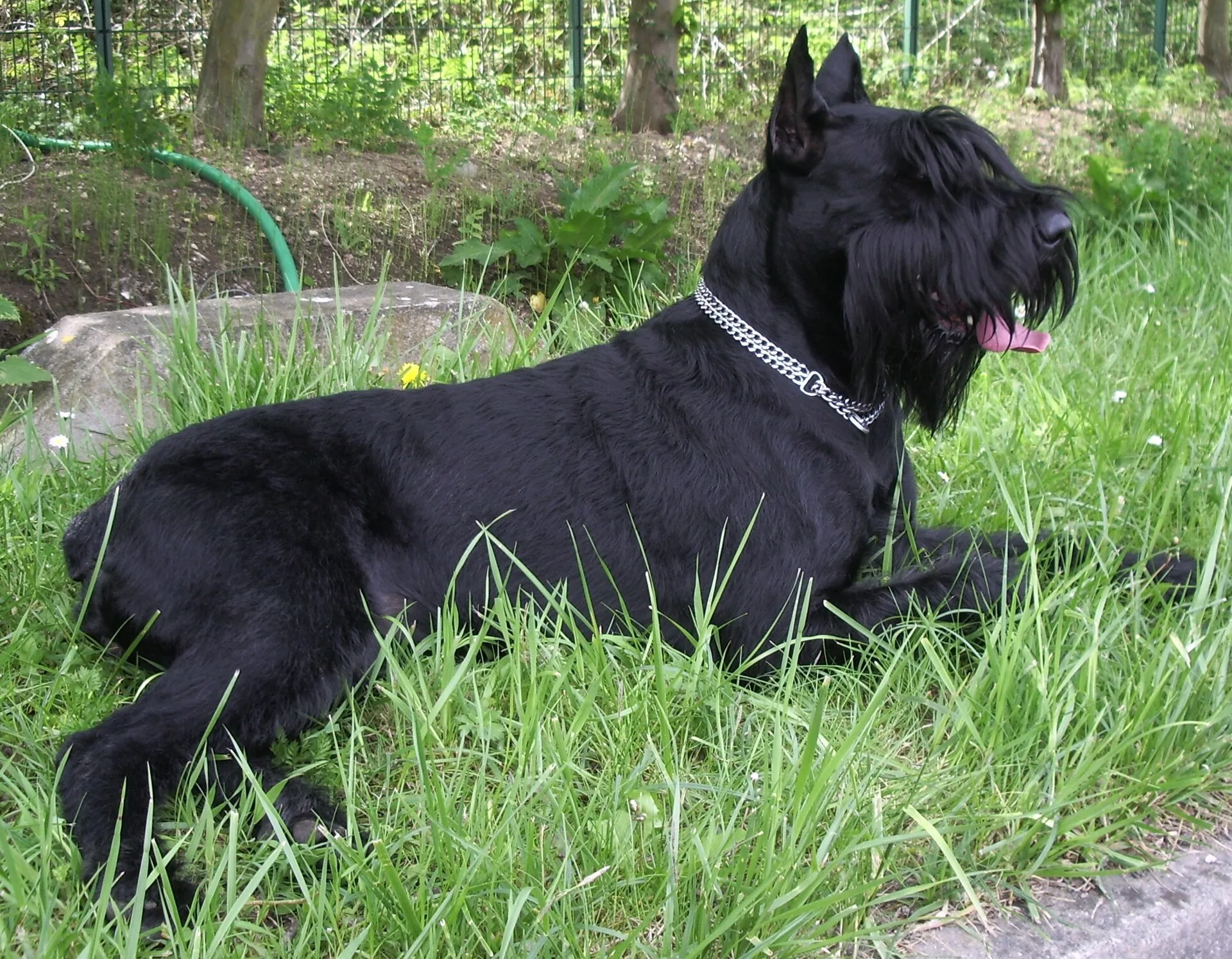
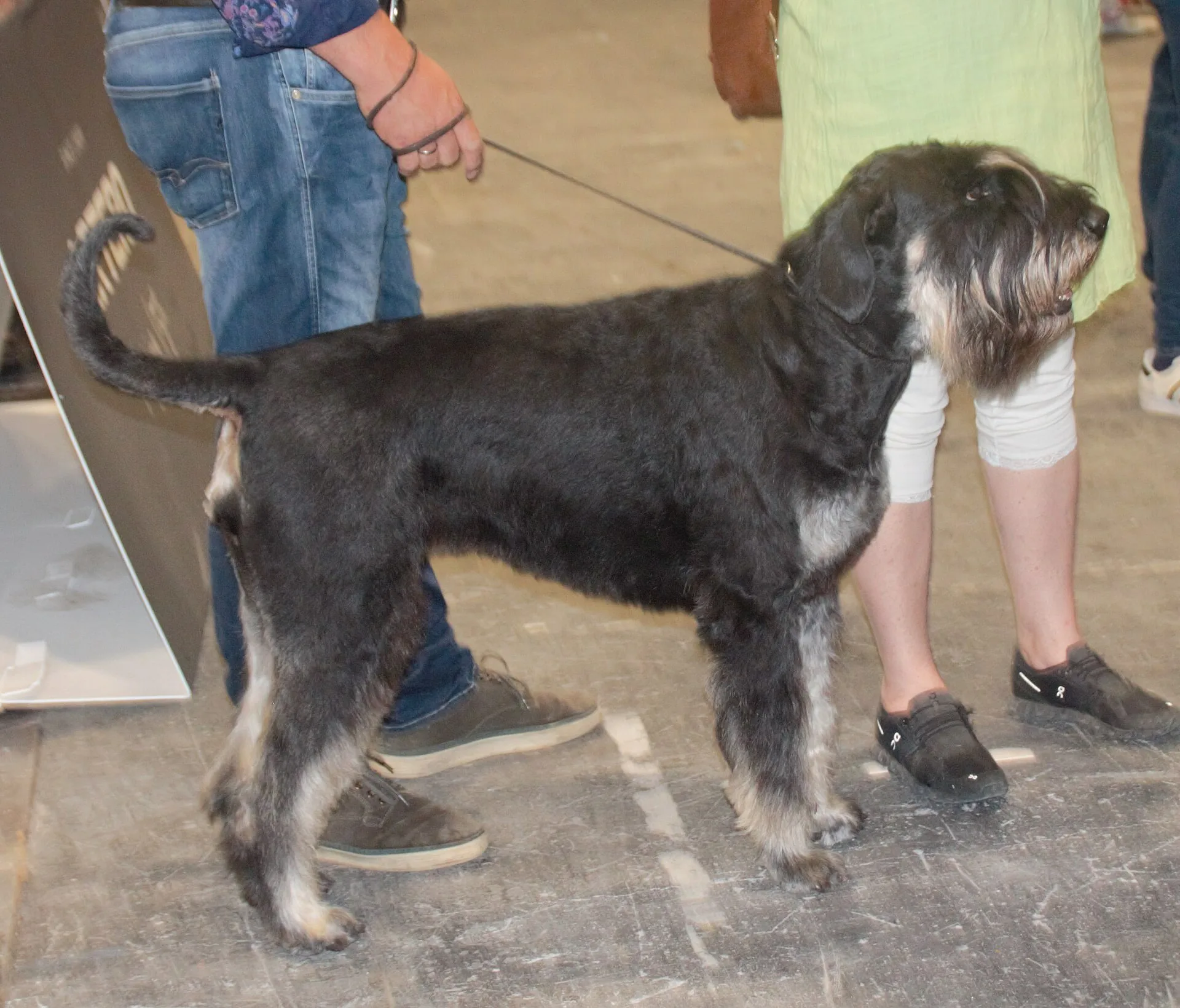
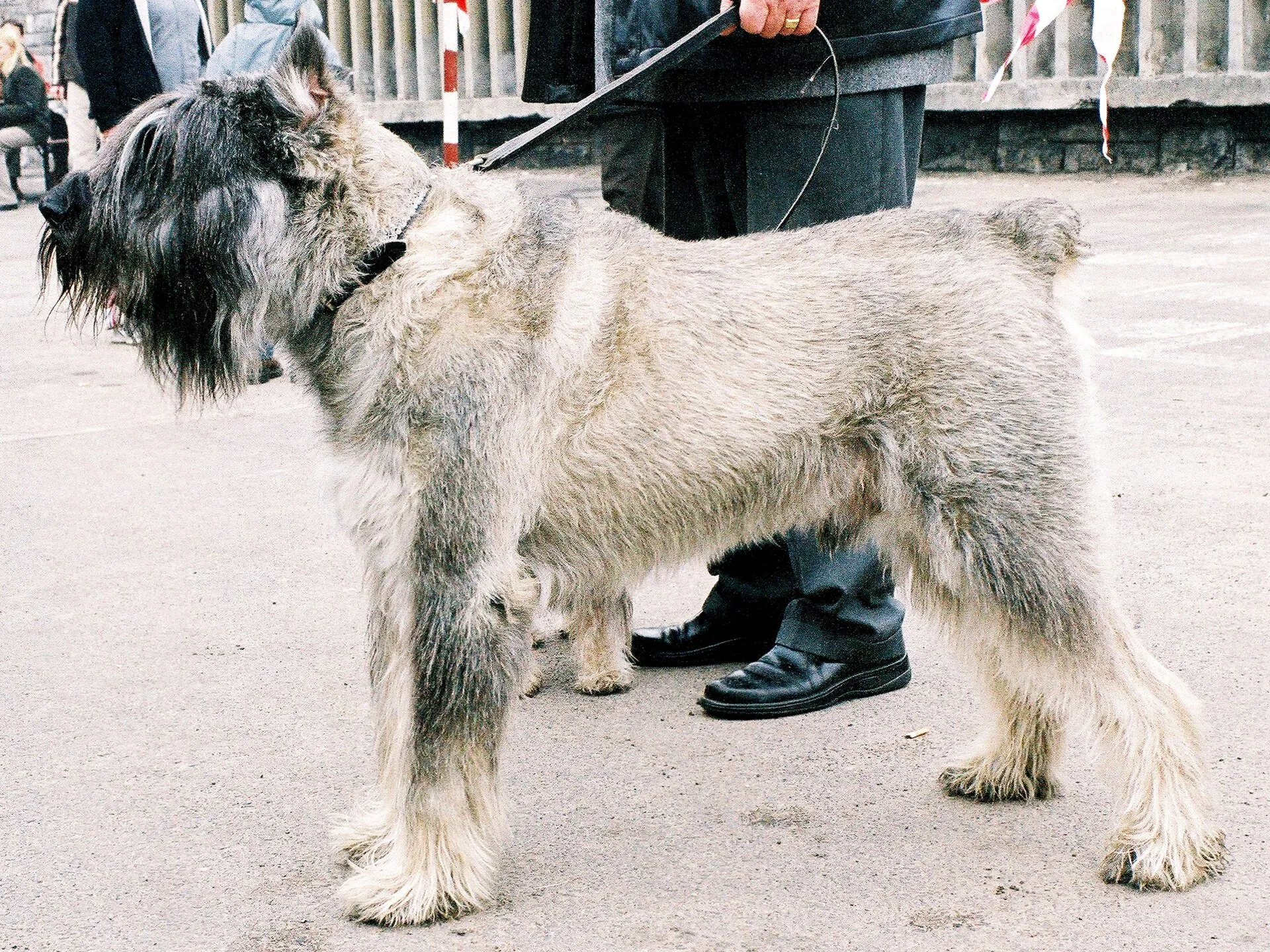
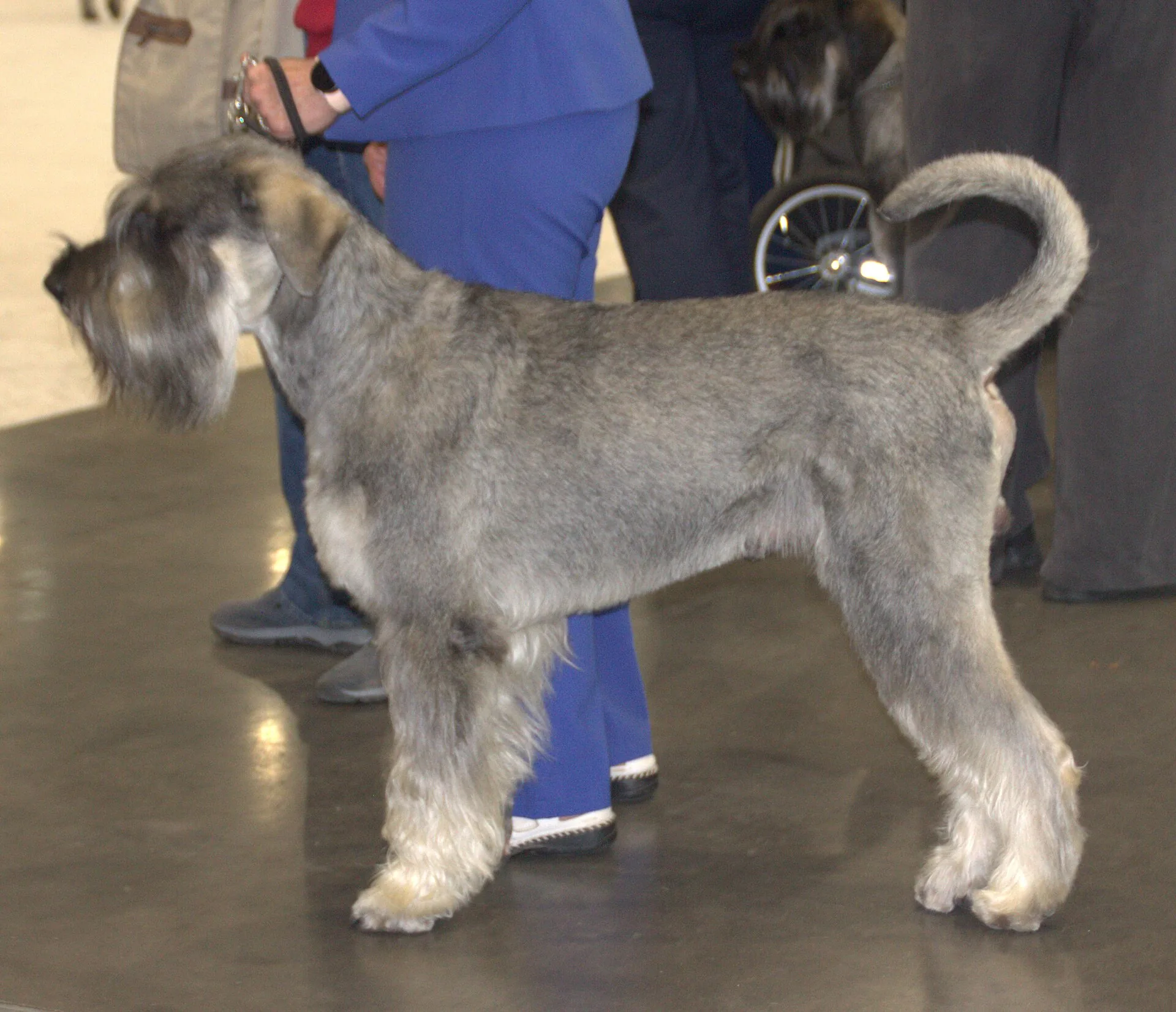
The coat is wiry, harsh and dense, with a dense undercoat and a beard and bushy eyebrows. The FCI standard permits pure black, pepper and salt with a dark mask, and black and silver. It sheds little, but it needs care: brush weekly and trim or hand strip every few months. The beard collects water and food, so wipe it after meals and drinks.
Feeding and weight
Feed a good quality diet in two or three measured meals to reduce the bloat risk, and avoid heavy exercise just before or after eating. Keep the dog lean, because extra weight loads the joints. A large breed puppy food supports steady, controlled growth.
Work out a starting calorie figure and food weight with the calorie calculator. Not sure this is the right breed? Take the quiz.
Health
Every breed carries predispositions. These are the conditions most often discussed for the Giant Schnauzer, not a prediction for any individual dog.
- Hip and elbow dysplasia (malformed joints, causing lameness and arthritis)
- Gastric dilatation-volvulus (bloat), an emergency in deep chested dogs
- Hypothyroidism (an underactive thyroid)
- Some cancers, which become more likely in older dogs
- Cataracts and other inherited eye conditions
What to ask the breeder. Ask for hip and elbow scores, thyroid and eye results for both parents, and what the breeder knows about health and longevity in the lines.
Choosing a puppy
Meet the mother and, if possible, the father, and judge their temperament as well as their papers. Choose a breeder who socialises puppies in a busy house from the start. Expect a clever, mouthy, fast growing puppy that needs early classes, firm rules and a lot of calm supervision. Do not over exercise it while the joints are growing.
In Luxembourg the national kennel club is the Fédération Cynologique Luxembourgeoise (FCL), a member of the FCI. Many owners also buy from breeders in Germany, France or Belgium; a puppy coming from another EU country must be microchipped and vaccinated against rabies, which in practice means it cannot travel before about fifteen weeks of age. Where to get a dog in Luxembourg.
The older Giant Schnauzer
Giants often slow down from around eight years. Watch for stiffness on rising, weight gain and any new lump, which should be checked promptly. Keep the dog lean, replace long walks with shorter ones, and keep the mind busy with scent games. Ask your vet about joint support and regular senior check-ups.
A realistic day
A realistic weekday for a working household in Luxembourg City, with a midday visit. Adjust it to your dog, not the other way round.
A steady, disciplined walk of 30 to 40 minutes, practising a calm heel along the pavement before the streets fill up.
Breakfast, with a rest afterwards, then a short training game before you leave.
Midday visit from a walker for a toilet break, a lead walk and a ten minute training game.
A longer walk in a park or forest, with scent work or obedience, followed by a rest before dinner.
A final quiet toilet walk, then settle on a bed for the night.
A Giant Schnauzer in Luxembourg
A Giant Schnauzer can be calm indoors once exercised, but it is a large, protective dog and a lift or a narrow stairwell is a test of manners. Teach it to sit and wait before doors, to ignore neighbours and to give other lift users space. Most flats are manageable if the dog gets real work outside, but a ground floor home with a garden is easier.
Good exercise is within reach. The Bambësch and the Grünewald offer long, quiet walks away from crowds, and the Pétrusse valley works early in the morning. Choose quiet routes while the dog learns to pass others calmly. Summers in the 30s are hard on a black, heavily built dog, so walk early and late and keep a water supply. Trams and buses are free, but a large, reserved dog needs a lot of preparation first.
Every dog in Luxembourg must be identified, declared to the commune and covered by liability insurance. How registration works.
When you travel
Introduce the sitter beforehand, because Giants are wary of strangers, and let the dog accept them with you present. Agree the rules for doors, visitors and lifts. Keep the dog on a secure lead outside, stick to its routine and provide mental work on every visit. Make sure the sitter has experience with large, strong dogs.
PAWLY's holiday and overnight care takes place in your home, so your dog keeps its own bed and routine.
Myths and facts
MythGiant Schnauzers are dangerous.
FactThey are strong, protective dogs, but the standard describes a good natured, even temperament. In experienced, consistent hands they are steady and loyal.
MythA Giant is just a big Standard Schnauzer.
FactThey are separate breeds, with a heavier build, more power and a more intense temperament. Anyone who knows one would not confuse them.
MythWiry coats never need grooming.
FactThe coat sheds little, but it needs weekly brushing and regular trimming or hand stripping, and the beard needs cleaning after meals.
Is it the right dog for you?
Suits
- Experienced, active owners
- People who enjoy training or dog sports
- Homes with space and a calm routine
- Owners who can supervise a strong dog confidently
Think twice if
- First-time owners
- Homes with many visitors
- People with little time for training and exercise
- Anyone hoping for a dog that loves every stranger
Questions owners ask
Is a Giant Schnauzer good for a first-time owner?
Usually not. It is powerful, intense and clever, and it needs experienced, consistent handling and plenty of work. First-time owners who are determined can succeed with a good trainer, but it is a demanding first dog.
Does a Giant Schnauzer shed?
Very little, but that does not mean easy care. The wiry coat needs weekly brushing and trimming or hand stripping every few months, and the beard needs wiping after meals.
Are Giant Schnauzers good with children?
Often patient with their own family's children, but a large, powerful dog needs supervision around any child. Visitors' children should be introduced carefully, and the dog should be calm before contact.
How much exercise does a Giant Schnauzer need?
About an hour and a half to two hours a day, with real mental work such as obedience, scent games or tracking. A walk alone is not enough for this working breed.
Sources
Photo: Original uploader was Der Schnauzer at fr.wikipedia, CC BY 1.0, via Wikimedia Commons · Photo: Canarian, CC BY-SA 4.0, via Wikimedia Commons · Photo: Canarian, CC BY 4.0, via Wikimedia Commons · Photo: No machine-readable author provided. Pleple2000 assumed (based on copyright claims)., CC BY-SA 3.0, via Wikimedia Commons
General information for dog owners in Luxembourg, not veterinary or legal advice. Official facts (origin, size, group, history and temperament as described by the breed standard) follow the FCI standard; health and care sections reflect breed-club and veterinary guidance and are typical ranges rather than rules. For your own dog, ask your vet, the breed club or your commune. How this guide is written and checked. Last reviewed 8 October 2026.
Need someone for your Giant Schnauzer?
PAWLY offers an individual 45-minute walk or a home visit at your dog's pace, the same walker every time, and a written report with photos after every visit, across Luxembourg City.
Read next: the journal, for the Giant Schnauzer
All articles
Grooming and coat care through the Luxembourg year
The Giant Schnauzer has a coat that needs a routine that holds through the Luxembourg seasons.

Choosing a groomer, and what to ask before you book
A coat like this usually means a groomer; this covers what to ask before you book.

The dog that barks and lunges on the lead
Some Giant Schnauzer dogs are selective with other dogs; this is the plan for lunging and barking on the lead.
Similar breeds
All 198 breeds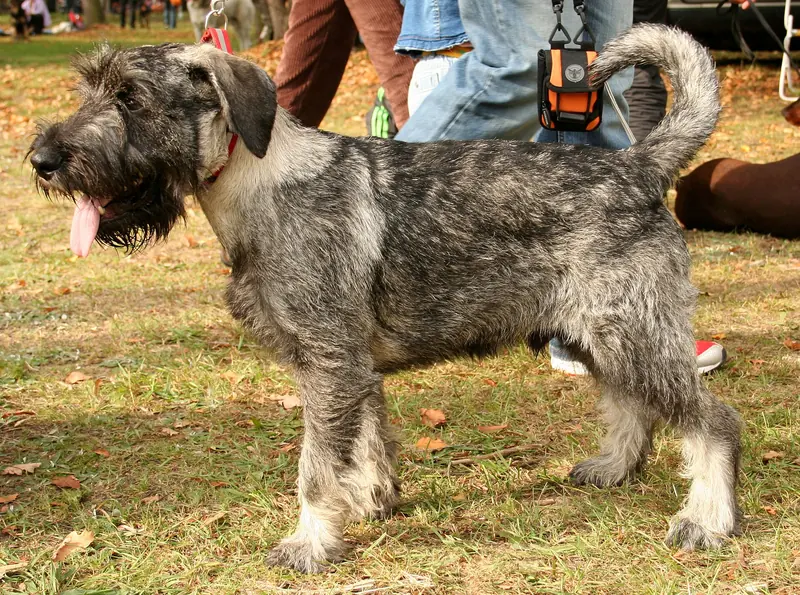
Standard Schnauzer
The original whiskered Schnauzer: a square, quick-witted German stable dog with a ratter's alertness and a strong sense of ownership over its people.
EnergyGroomingFlat life
Dobermann
An elegant, square-built German guard dog that is far more devoted, sensitive and people-minded than its fierce reputation suggests.
EnergyGroomingFlat life
Rottweiler
A calm, powerful working dog from the town of Rottweil, loyal and protective, and a real responsibility.
EnergyGroomingFlat life

