
History
The Swiss call this dog the Grosser Schweizer Sennenhund, and the FCI lists Switzerland as its country of origin. In 1908, at the show held in Langenthal to mark 25 years of the Swiss Kennel Club, two short-haired dogs entered as Bernese Mountain Dogs were shown to Professor Albert Heim, the great champion of the Swiss mountain breeds. He recognised them as survivors of the old large mountain dog, sometimes called the butcher's dog, which had once been common across Europe as a guard, draught and cattle-droving dog.
The Swiss Kennel Club recognised the dogs as a separate breed in 1909 and entered them in volume 12 of the Swiss Stud Book. A breed club followed in 1912, with the aim of keeping the type pure, and the FCI published its first standard on 5 February 1939. The current standard, which the FCI classes as a breed without a working trial, describes the dog as originally a watch and draught dog, now also a companion, guard and family dog.
Temperament
The FCI standard asks for a self-confident, alert and watchful dog that is fearless in everyday situations, good-natured and devoted towards the people it knows. In practice the Greater Swiss is a leaner, more reserved relative of the Bernese in attitude: affectionate and slow to anger, but not a dog that gives itself to every stranger.
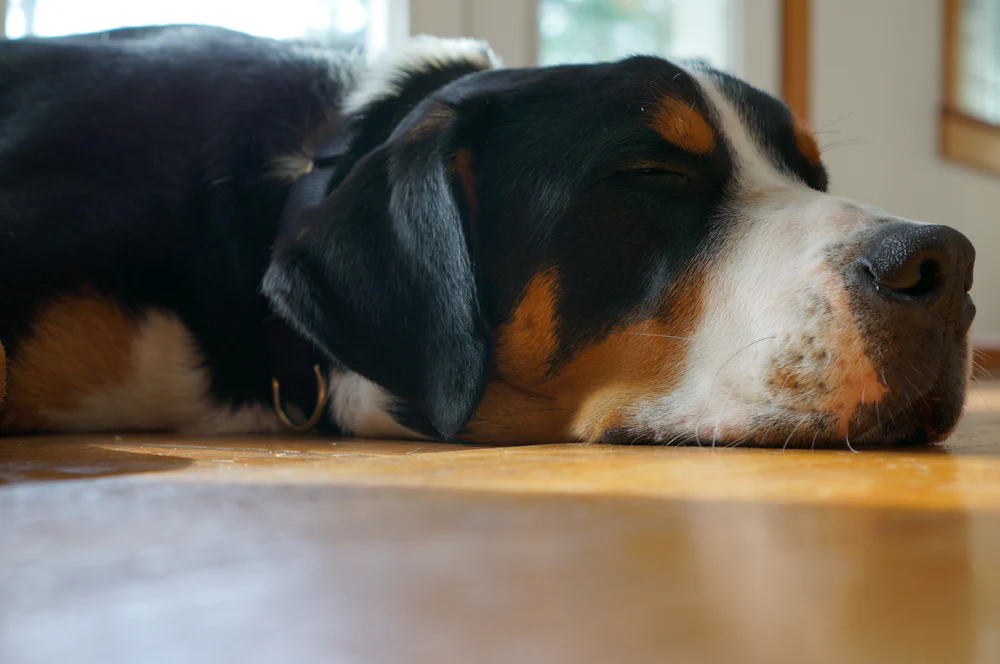
Indoors it is usually a calm presence that follows the family from room to room and settles in the doorway of whichever one they are in. Outdoors it can be surprisingly boisterous until it is two or three years old, and a young adult leaning into a lead can pull a small person off their feet. Loneliness is the real difficulty: this is a dog bred to work beside its people, and it does not cope well with long empty days.
Children and other pets
Greater Swiss are generally patient and affectionate with children they grow up with, and they enjoy being part of family life. The danger is size and enthusiasm: a young dog can knock over a toddler without any ill intent, and many like to lean or herd people by bumping them. Cats in the household are often fine, though some dogs chase a running cat and the breed's size makes that more than a nuisance.
Exercise and the daily walk
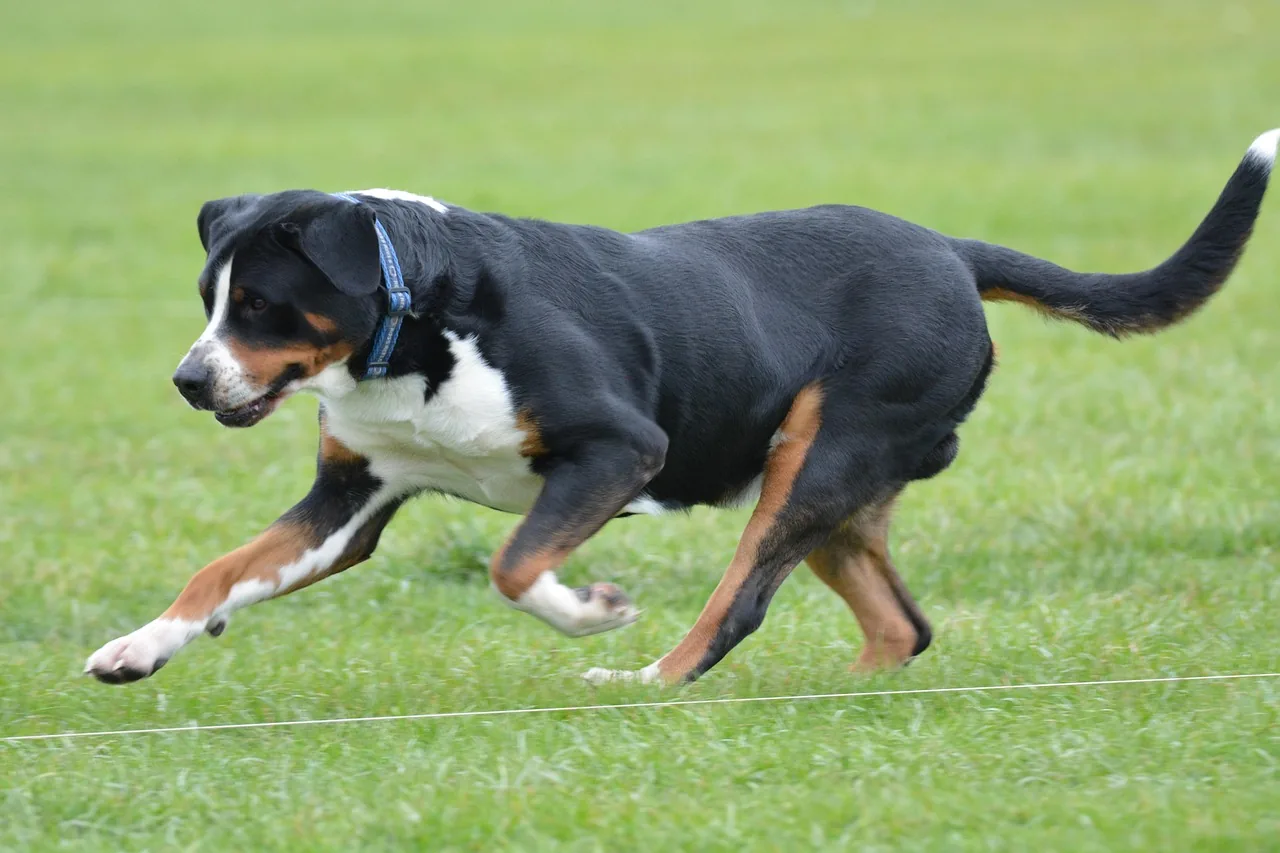
This is a strong, heavy dog, not an athlete in the sporting sense, and a healthy adult is content with an hour to an hour and a half a day, preferably split into two outings.
Puppies and adolescents grow fast and are prone to joint trouble, so avoid long runs, repeated stair climbing and jumping out of cars until the dog is fully grown, usually at about two years. A thick double coat and a big frame make summer exercise a risk, so walk early or late and carry water.
Training
Lead manners come first: a dog that walks politely at four months is a pleasure at forty kilograms, and one that pulls is a daily struggle. Greater Swiss are intelligent and willing but not quick to hurry, and they respond to calm, consistent, reward-based teaching.
Introduce the puppy to lifts, trams, buses, children, other dogs and unfamiliar people in the first months so that its natural watchfulness does not turn into suspicion. A recall is useful but cannot be guaranteed once a scent or a distant dog catches its attention, and a long line is a sensible compromise in unfenced places.
Coat and grooming
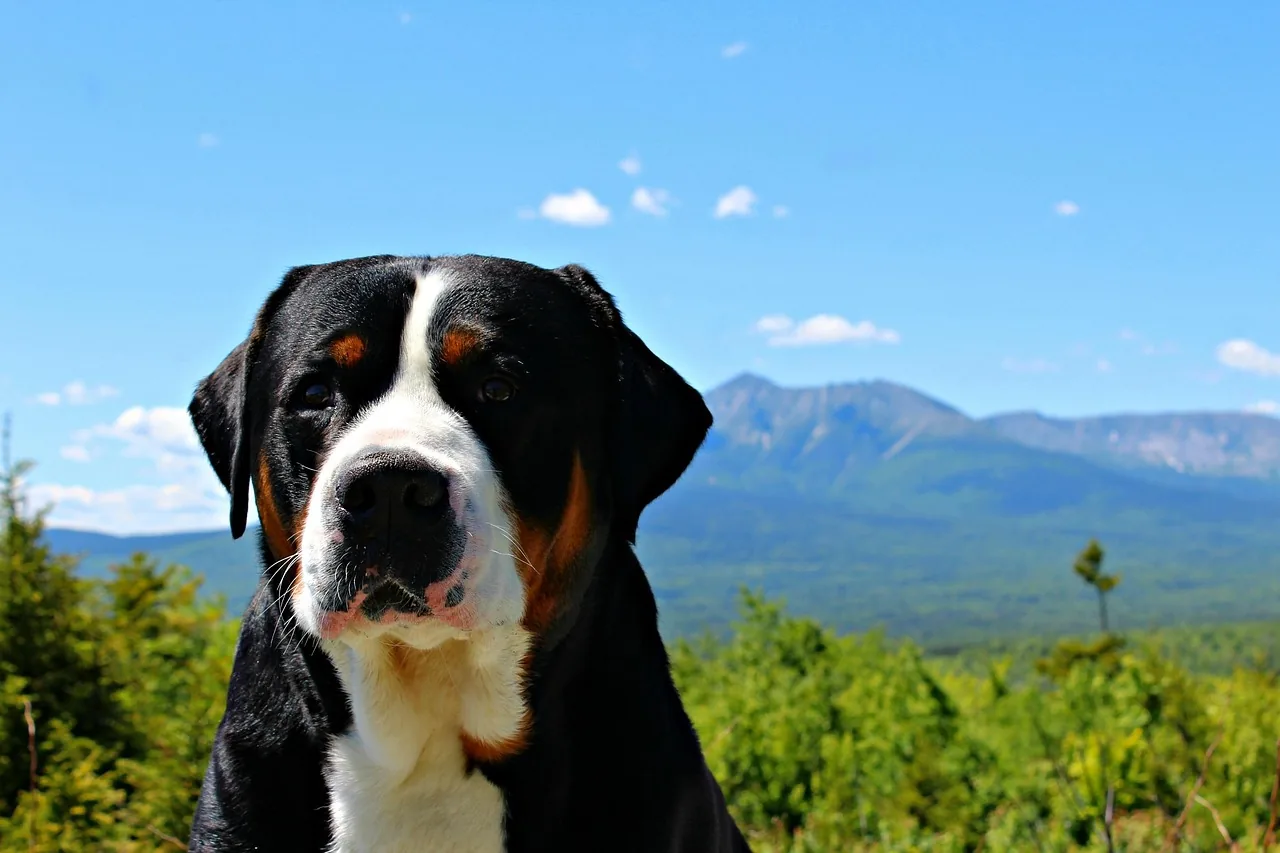
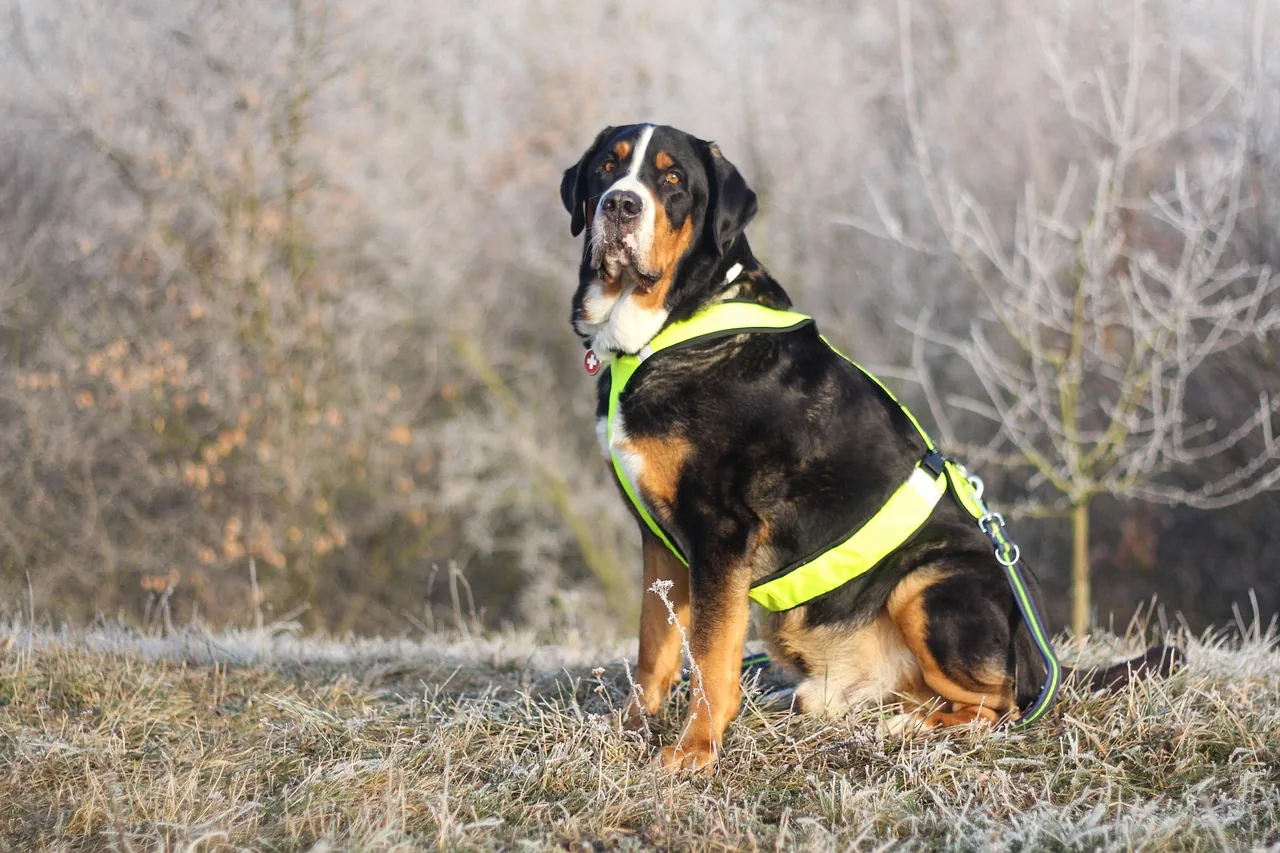
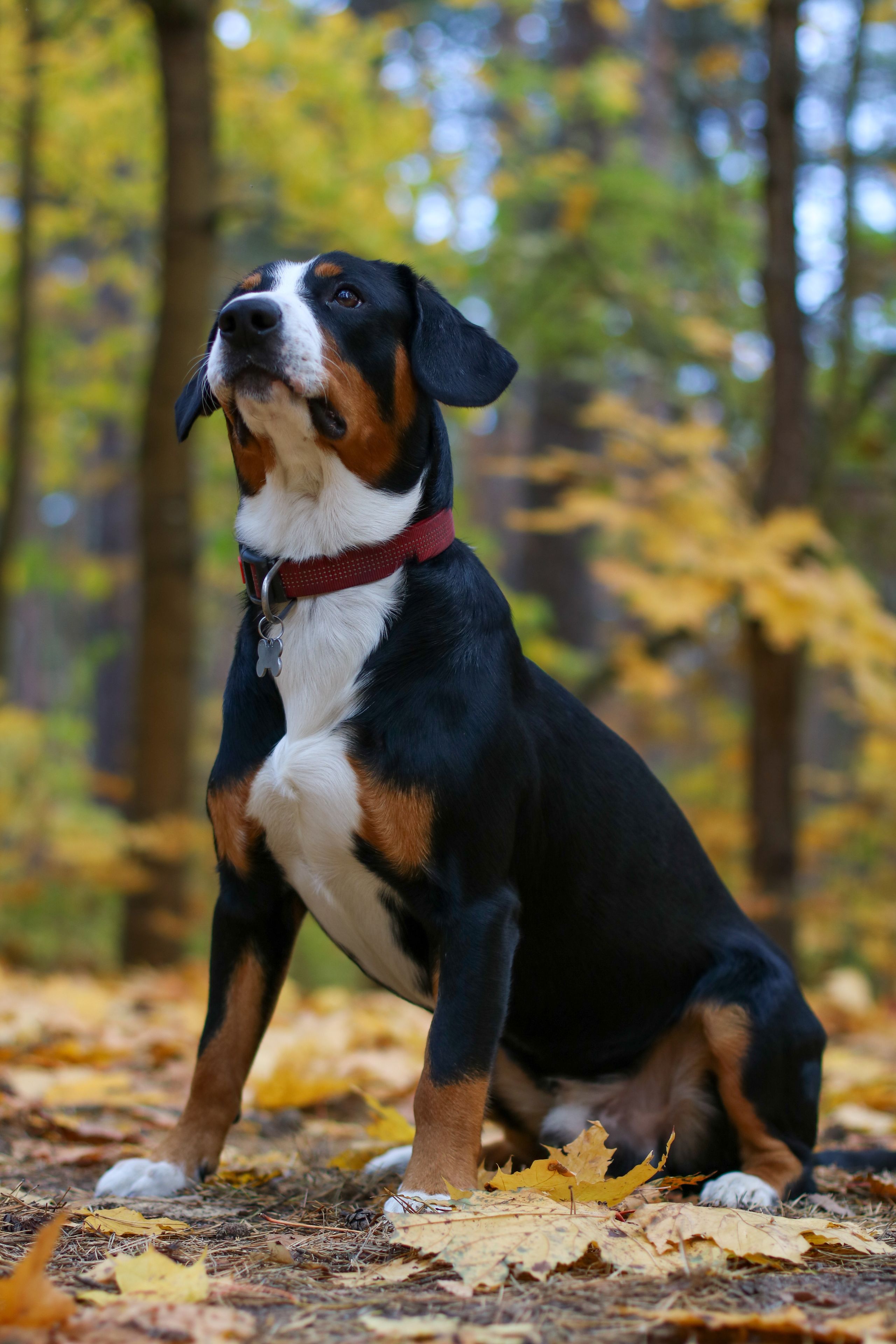
The FCI standard describes a double coat: a thick outer coat of medium length lying close over a dense undercoat, which should be as dark grey or black as possible. The classic colour is tricolour, with a black base, symmetrical reddish-brown (rust) markings and clean white markings. Brushing once or twice a week keeps the coat in order, but twice a year the undercoat comes out in handfuls and daily brushing is needed.
Feeding and weight
A large, fast-growing breed does best on a diet formulated for large breed puppies, which controls growth rate and protects developing joints. Adults should be kept lean, because extra weight adds strain to hips and elbows. Feed two or three smaller meals rather than one large one, avoid vigorous exercise for an hour either side, and use a slow-feeder bowl if the dog bolts its food.
Work out a starting calorie figure and food weight with the calorie calculator. Not sure this is the right breed? Take the quiz.
Health
Every breed carries predispositions. These are the conditions most often discussed for the Greater Swiss Mountain Dog, not a prediction for any individual dog.
- Hip and elbow dysplasia, and osteochondritis (OCD) of the shoulder and other joints
- Gastric dilatation and volvulus (bloat and stomach torsion)
- Eye conditions, including distichiasis (extra eyelashes rubbing the eye)
- Splenic torsion, a twisting of the spleen
- Urinary incontinence in spayed females
- Epilepsy and cancer, which breed clubs list among the breed's concerns
What to ask the breeder. Ask for hip, elbow, shoulder and eye examination results for both parents, ideally from recognised national schemes, and ask about the ages at which relatives have died and why.
Choosing a puppy
A Greater Swiss puppy is a heavy, clumsy, adorable bundle that will be knee high within months and enormous by the first birthday. Keep exercise gentle and short, avoid stairs where you can, and use non-slip flooring. Start lead training, handling of paws and ears, and short periods of being left alone from the first week at home.
In Luxembourg the national kennel club is the Fédération Cynologique Luxembourgeoise (FCL), a member of the FCI. Many owners also buy from breeders in Germany, France or Belgium; a puppy coming from another EU country must be microchipped and vaccinated against rabies, which in practice means it cannot travel before about fifteen weeks of age. Where to get a dog in Luxembourg.
The older Greater Swiss Mountain Dog
Many Greater Swiss are visibly older by seven or eight, and a life of about eight to eleven years is typical, so the senior phase arrives early. Stiffness in the hips and elbows is the usual first sign, and a warm, padded bed and non-slip floors help. Keep the weight down, shorten walks without cutting them out, and ask your vet about joint support and pain relief.
A realistic day
A realistic weekday for a working household in Luxembourg City, with a midday visit. Adjust it to your dog, not the other way round.
Out for a toilet break and a short, calm lead walk, then breakfast. Wait before any hard exercise.
Owner leaves for work. The dog settles in its bed with a chew; a puppy stays in a safe room.
Midday visit from a walker: toilet break, a steady 40 minute walk in the shade, fresh water and some company.
Main walk of the day, 45 to 60 minutes through a park or forest, with time to sniff and a little training on the way.
Quiet evening meal, a last short toilet break, and a brush of any muddy paws before bed in the family's room.
A Greater Swiss Mountain Dog in Luxembourg
A Greater Swiss can live in a flat if the lift is large enough and the dog is calm on the way in and out. Stairs should be avoided for puppies and for older dogs with sore joints, so a ground floor or lift building is much easier.
Luxembourg's climate suits the breed well from October to April, and the Grünewald and Bambësch forests give long, shaded walks that are ideal in summer. Dogs in the city should be walked early on days in the 30s, and parks such as Parc Merl and the Pétrusse valley are good for steady walks, though a dog this size needs a firm hand on the lead around bikes and children. Buses and trams are free nationwide, and a calm, well socialised dog is a good travelling companion.
Every dog in Luxembourg must be identified, declared to the commune and covered by liability insurance. How registration works.
When you travel
Visits work best when they are long enough for a proper walk and company, and overnight care in the home is better than short drop-ins. Keep to the usual feeding routine, with two smaller meals and rest around them, and watch for any sign of bloat such as a swollen belly, retching or restlessness, which is an emergency.
PAWLY's holiday and overnight care takes place in your home, so your dog keeps its own bed and routine.
Myths and facts
MythGreater Swiss are just bigger Bernese Mountain Dogs.
FactThey are a separate breed with a short, dense coat, a different history and generally a leaner, longer-lived and somewhat more reserved outlook, although they share the Swiss tricolour.
MythA calm giant needs very little exercise.
FactA steady hour or more a day is needed to keep muscle, weight and mind in order.
MythA big dog makes a good guard, so training is optional.
FactThe breed is watchful, not aggressive, and the standard asks for a good-natured dog. Poorly socialised dogs can be suspicious, which is a risk with an animal this size, so training is essential.
Is it the right dog for you?
Suits
- A family with space, time and a car or good access to green spaces
- Owners who like a calm, loyal and fairly independent big dog
- People who work from home part of the week or have a daily dog visit
- Walkers who enjoy steady forest rambles in all weathers
Think twice if
- Your flat is small, up several flights of stairs, or has no lift
- You are away from home for long hours every day
- You dislike shedding, drool and mud on the floor
- You want a dog that is easy to lift into a car or carry when injured
Questions owners ask
How big does a Greater Swiss Mountain Dog get?
The FCI standard gives a height at the withers of 65 to 72 centimetres for males and 60 to 68 centimetres for females. It does not state a weight, but adults are heavy, strongly built dogs, so plan for a large car and a firm hand on the lead.
Are they good with children?
Usually yes, they are patient and affectionate with children they know. Their size is the issue: a young dog can knock a toddler flat without meaning to, so supervise and teach children to treat the dog gently.
Can a Greater Swiss live in a flat?
It can, provided the dog is calm, gets daily walks and is not left alone for long hours. Lifts, stairs and slippery floors need thought, because joint trouble is common in the breed.
How much do they shed?
A fair amount all year, and a great deal for a couple of weeks twice a year when the undercoat is released.
Sources
- FCI breed standard No. 58 (Greater Swiss Mountain Dog)
- Greater Swiss Mountain Dog Club of America health statement (via AKC)
Photo: Unsplash (Unsplash License) · Photo: Pixabay (Pixabay Content License) · Photo: Pixabay (Pixabay Content License) · Photo: Pixabay (Pixabay Content License) · Photo: Pexels (Pexels License)
General information for dog owners in Luxembourg, not veterinary or legal advice. Official facts (origin, size, group, history and temperament as described by the breed standard) follow the FCI standard; health and care sections reflect breed-club and veterinary guidance and are typical ranges rather than rules. For your own dog, ask your vet, the breed club or your commune. How this guide is written and checked. Last reviewed 8 October 2026.
Need someone for your Greater Swiss Mountain Dog?
PAWLY offers an individual 45-minute walk or a home visit at your dog's pace, the same walker every time, and a written report with photos after every visit, across Luxembourg City.
Read next: the journal, for the Greater Swiss Mountain Dog
All articles
Dogs in hot weather: the Luxembourg summer guide
The Greater Swiss Mountain Dog carries a heavy coat or a heavy frame, which makes a Luxembourg summer the hard season.

How long can a dog really be left alone?
A sociable breed has a real limit on time alone; this is how to work it out.

Feeding, portions and how to tell if your dog is the right weight
Large dogs suffer more from extra weight; this is how to judge the right one.
Similar breeds
All 198 breeds
Bernese Mountain Dog
A gentle Swiss giant, beautiful and good-natured, with a sadly short life expectancy.
EnergyGroomingFlat life
Appenzeller Sennenhund
A cheeky, tricoloured Swiss farm dog with a restless mind and an opinion about everything that moves past the window.
EnergyGroomingFlat life
Entlebucher Mountain Dog
The smallest and liveliest of the Swiss mountain dogs, a compact tricolour cattle dog that herds, plays and keeps a sharp eye on its patch.
EnergyGroomingFlat life

