History
The FCI lists Ireland as the country of origin and describes the Irish Red and White Setter as a field dog and, in the words of the standard, a most acceptable companion and friend in the homes and the fields. According to the standard, the breed had probably developed by the late 1600s. Two varieties of Irish setter existed for a long time, but selective breeding produced the solid red type that dominated by the mid 1800s, and the red and white strain almost vanished by the end of that century.
The red and white setter was revived in the 1920s, and by 1944 it had recovered enough to form its own breed club. The modern Irish Red and White Setter Field and Show Society was founded in 1981, and the breed now has an international following, with both field trial champions and show champions. The FCI standard is dated 15 June 2005, classes the breed in Group 7, Section 2, British and Irish pointers and setters, with a working trial, and stresses that judges should assess it chiefly from a working point of view.
Temperament
The FCI standard describes an aristocratic, keen and intelligent dog that is friendly and trainable, with determination, courage and spirit. It is a high spirited dog, affectionate, eager to be with its family and willing to greet strangers with a wagging tail, so it makes a poor guard.
A setter on a good scent will quarter the ground with its nose down and ignore everything around it, and it may be miles away before it realises. Indoors it is mostly gentle and tolerant, but it needs plenty of exercise to be calm, and a bored dog can be loud, destructive and endlessly inventive. It is sensitive and does not respond well to harsh handling, and it matures slowly, often remaining playful until three or four.
Children and other pets
A well exercised Irish Red and White Setter is usually a cheerful, tolerant friend for children. Its exuberance is the main hazard, and a young dog moving at speed can easily knock over a small child. It generally gets on well with other dogs and is sociable at the park. With cats and small pets it varies, since it is a bird dog by nature and a running animal may be chased. Early introductions and supervision will help.
Exercise and the daily walk
An adult needs around two hours of exercise a day, and much of that should be vigorous. The dog needs to run, preferably off lead in a safe area, and to use its nose. Gundog training, retrieving games, hill walking and canicross all suit it.
Off-lead running requires a reliable recall, and that takes time to build, because setters are easily distracted by scent and movement. Use a long line until you are confident, and keep the dog away from roads, livestock and wildlife. Keep puppies to gentle, short exercise until about a year, then increase gradually. In warm weather exercise early or late, and keep an eye on the ears and feathering for burrs and grass seeds.
Training
Irish Red and White Setters are intelligent and keen, but they are also independent and can be slow to settle. They learn quickly when training is varied and rewarding, and lose interest when it is repetitive or harsh. Short, cheerful sessions with plenty of praise and food work best.
Practise recall from the first week on a long line, with high value rewards, and make coming back the best part of the walk. Teach the dog to wait at doors and in the lift, as its enthusiasm can be overwhelming.
Coat and grooming
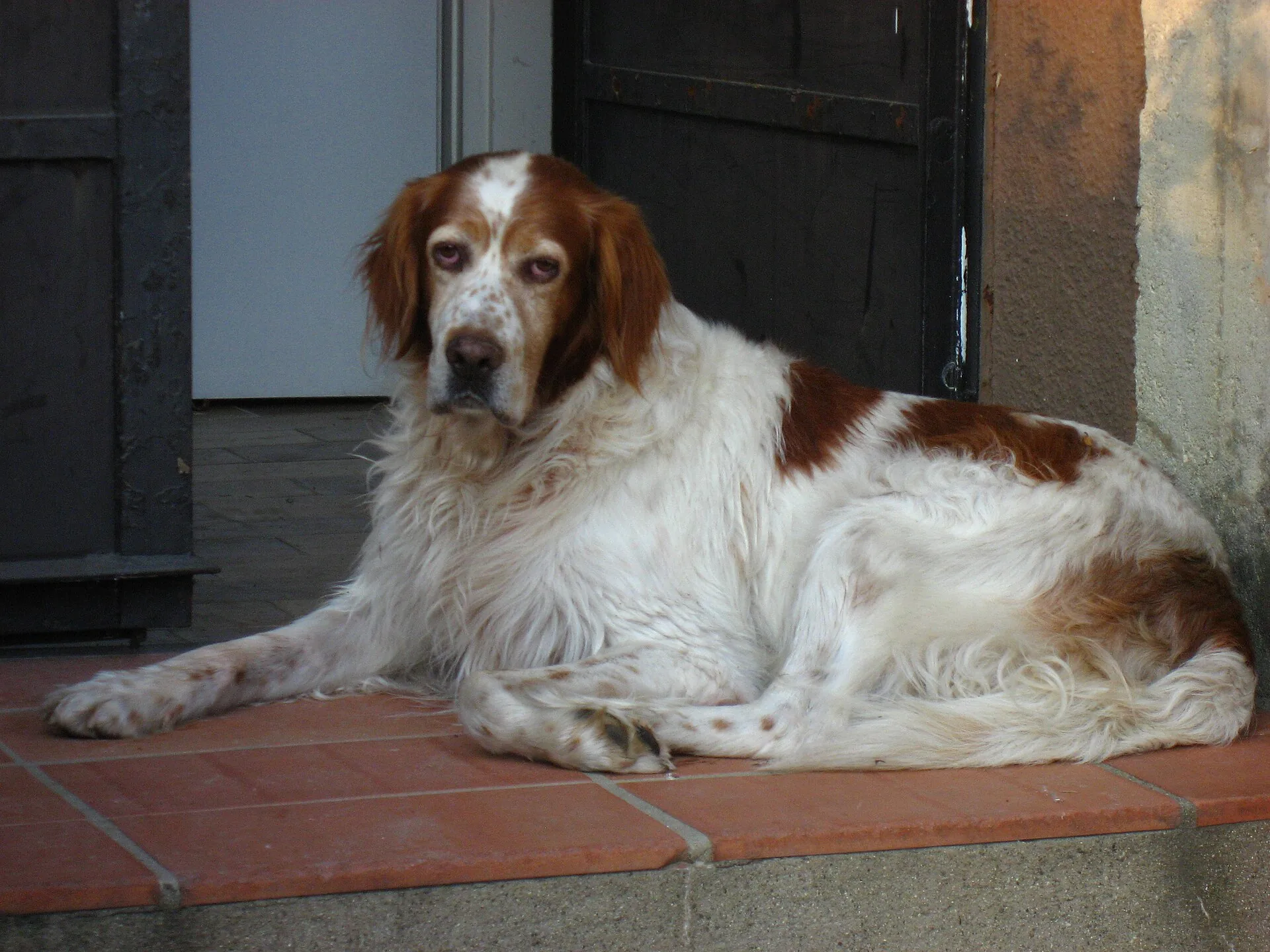
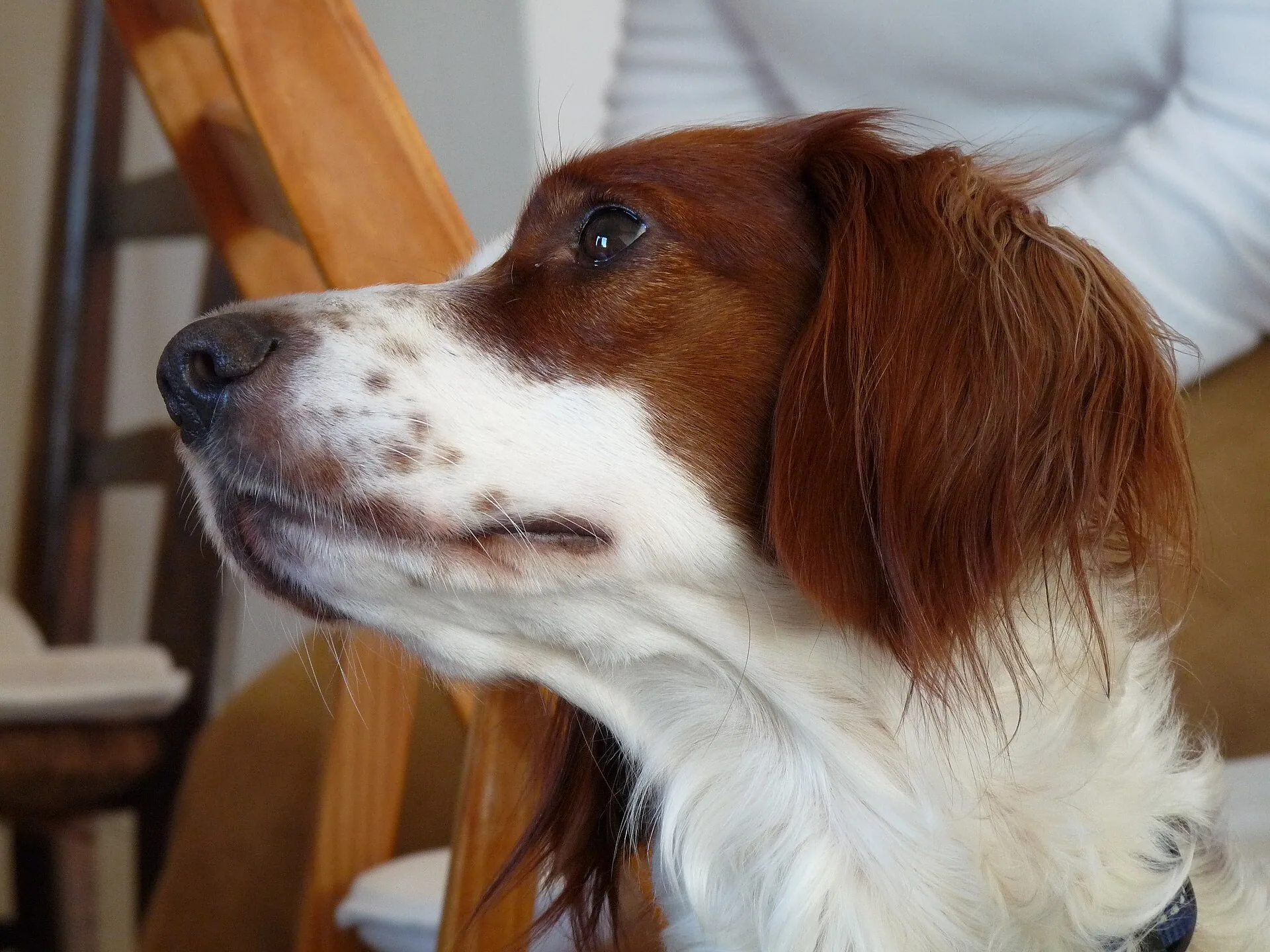
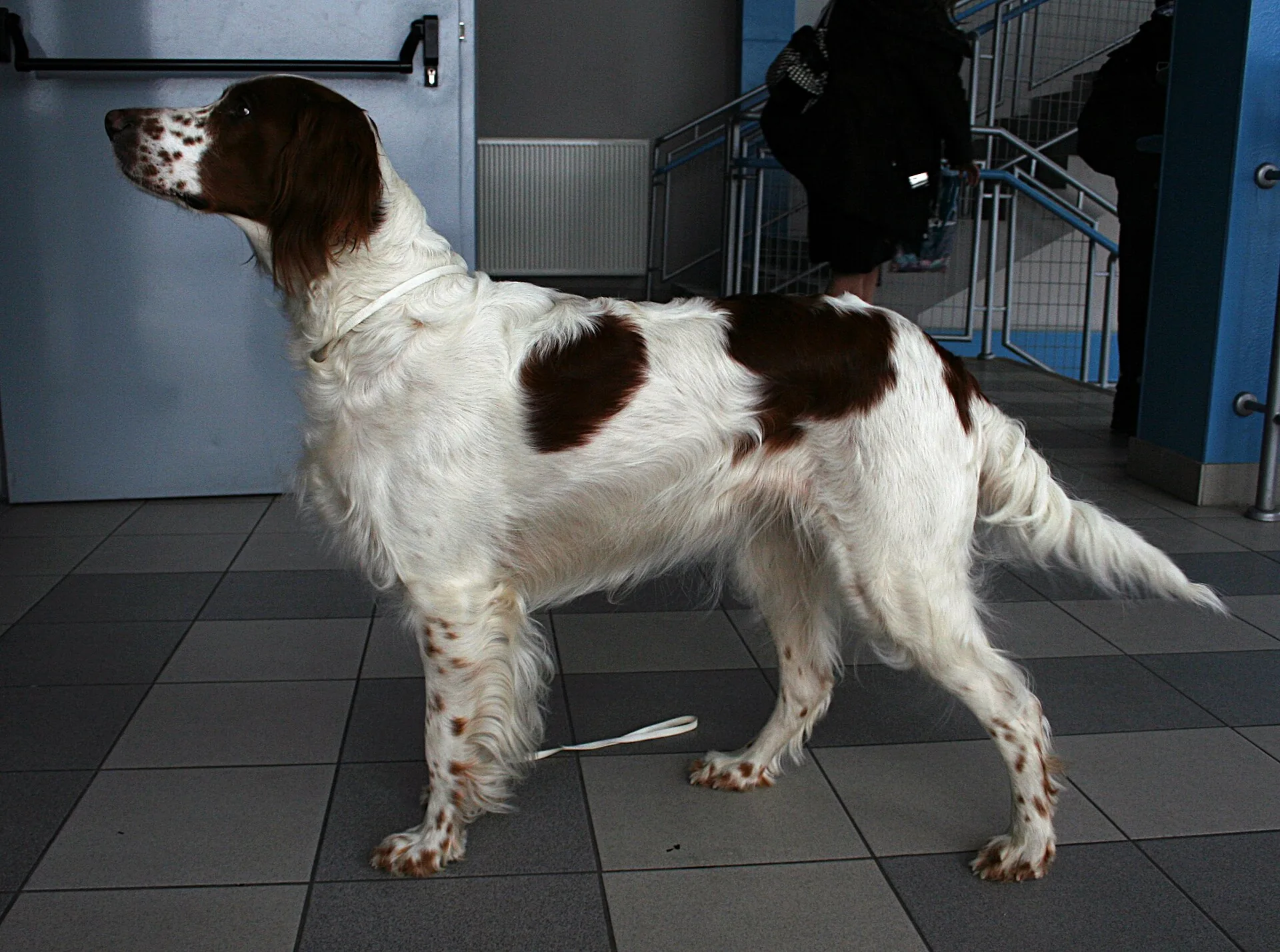
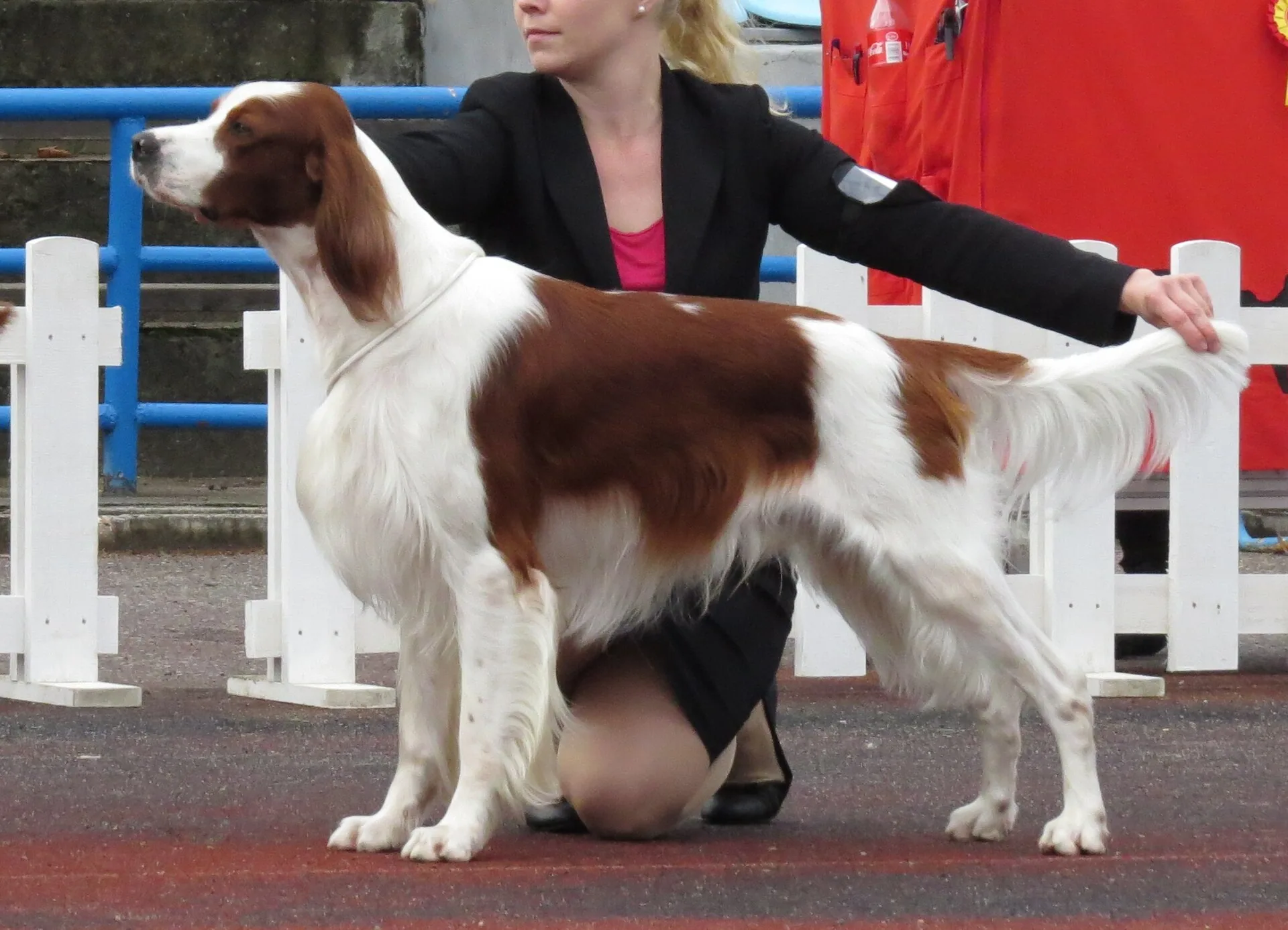
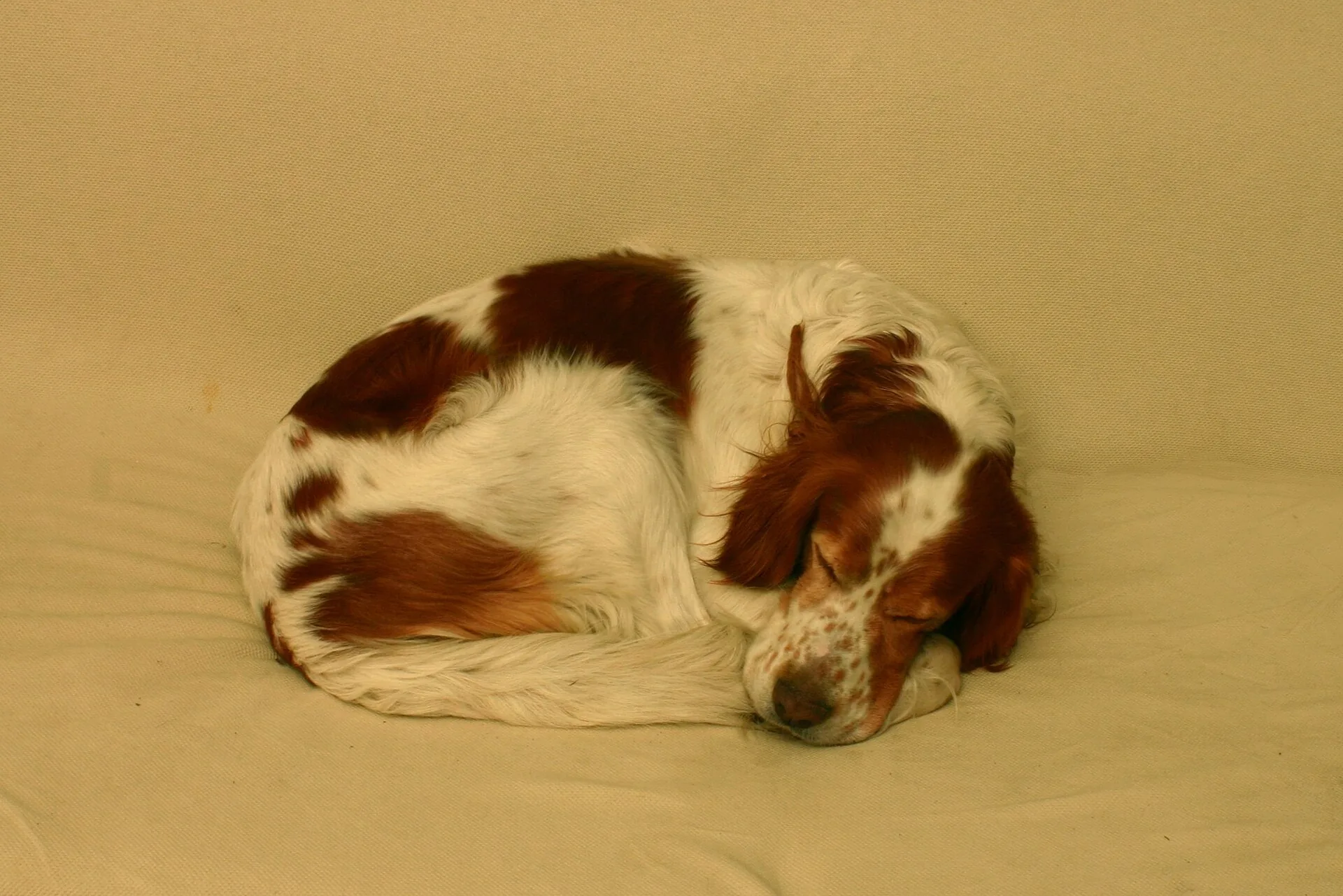
The FCI standard describes long, silky feathering on the legs, ears and chest, with short, flat hair elsewhere. All feathering should be straight and free from curl, although a slight wave is permitted. The base colour is white with solid red patches. Flecking, but not roaning, is permitted on the face and feet and up the limbs to the elbow and hock, and roaning elsewhere is a fault. Brush two or three times a week, check the ears and feathering for burrs, and expect moderate shedding.
Feeding and weight
An active setter needs a good quality complete diet, in measured portions adjusted to its exercise. Feed two meals a day rather than one large meal, as the deep chested build increases the risk of bloat, and rest the dog for an hour before and after meals. Keep the dog lean, and use part of its daily food for training.
Work out a starting calorie figure and food weight with the calorie calculator. Not sure this is the right breed? Take the quiz.
Health
Every breed carries predispositions. These are the conditions most often discussed for the Irish Red and White Setter, not a prediction for any individual dog.
- Canine leucocyte adhesion deficiency (CLAD), an inherited immune disorder for which a DNA test exists
- Progressive retinal atrophy (PRA), an inherited eye disease
- Hip dysplasia, a malformation of the hip joint
- Gastric dilatation and volvulus (bloat and stomach torsion)
- Ear infections, because of the drop ears and feathering
- Allergies and skin problems in some dogs
What to ask the breeder. Ask for DNA test results for CLAD and PRA for both parents, hip scores and eye examination certificates, and ask the breeder whether the dogs are working in the field as well as in the show ring.
Choosing a puppy
An Irish Red and White Setter puppy is playful, adventurous and attached to people from the start. Provide short, controlled exercise, plenty of chew toys, and early social experience with lifts, traffic, children and other dogs. Start recall work immediately, using a long line and a whistle or cue word. Keep walks short and avoid hard exercise on hard surfaces until the joints have matured.
In Luxembourg the national kennel club is the Fédération Cynologique Luxembourgeoise (FCL), a member of the FCI. Many owners also buy from breeders in Germany, France or Belgium; a puppy coming from another EU country must be microchipped and vaccinated against rabies, which in practice means it cannot travel before about fifteen weeks of age. Where to get a dog in Luxembourg.
The older Irish Red and White Setter
Irish Red and White Setters are often active well into their senior years, and eleven to thirteen years is typical. Older dogs slow down, may develop stiffness, and sleep more, but they still enjoy a good sniff and a swim. Regular vet checks should include teeth, ears, eyes and any lumps.
A realistic day
A realistic weekday for a working household in Luxembourg City, with a midday visit. Adjust it to your dog, not the other way round.
Toilet break and a brisk 30 minute walk, or a short run, then breakfast and a rest before further exercise.
Owner leaves for work. The dog settles with a chew and a stuffed toy, tired from the morning outing.
Midday visit from a walker: toilet break, a one hour walk with sniffing and some off-lead time if safe, fresh water.
Main outing of an hour or more, ideally in the forest with a long line or a fenced field, plus recall practice and a retrieving game.
Last toilet break, a quick check of ears and feathering for burrs, and a quiet evening on the sofa.
An Irish Red and White Setter in Luxembourg
A setter can live in a Luxembourg flat, but only if the owner supplies a great deal of exercise and company. A lift is usually fine, as the dog is tidy and sociable, but its exuberance on the lead needs control. Households with a garden, or a flat near open space, make life much easier.
The Grünewald and Bambësch forests are natural territory for a setter, and the Pétrusse valley and Parc Merl serve for everyday walks. Unfenced woodland holds deer and game that a bird dog will pursue, so use a long line until the recall is proven. In summer, with temperatures in the 30s, exercise early and late and carry water. In winter the dog loves cold, wet weather but needs a rub down afterwards. Free public transport helps with reaching further walking areas.
Every dog in Luxembourg must be identified, declared to the commune and covered by liability insurance. How registration works.
When you travel
A sitter should expect an energetic, affectionate dog that needs real exercise every day, not just a toilet break. Walks on a long line or in a secure field are best, with a harness and a double lead on the road. Make sure the dog cannot slip out of the door when it opens, and leave the vet's number and written notes.
PAWLY's holiday and overnight care takes place in your home, so your dog keeps its own bed and routine.
Myths and facts
MythAn Irish Red and White Setter is just a Red Setter with white markings.
FactIt is a distinct breed with its own history and standard. The red and white strain is older, was revived in the 1920s.
MythSetters are born obedient gundogs.
FactInstinct is there, but a good recall and manners must be taught. Many setters are distracted by scent and need patient training.
MythA gundog is happy with a daily walk round the block.
FactIt needs a couple of hours of real exercise and mental work, ideally with some off-lead running, or it will become restless and destructive.
Is it the right dog for you?
Suits
- Active owners who walk, run or hike for at least two hours a day
- People interested in gundog training or field work
- Families with older children who enjoy a lively, friendly dog
- Homes with a garden or easy access to forests
Think twice if
- You cannot give a couple of hours of exercise most days
- You want a dog with a rock solid recall in open country
- You have cats, rabbits or small pets that need protection
- You are away from home for long hours every day
Questions owners ask
How big is an Irish Red and White Setter?
The FCI standard gives 62 to 66 centimetres for males and 57 to 61 centimetres for females, with no weight given. It is an athletic, well proportioned dog without excess weight.
Is it the same as an Irish Setter?
No. The Irish Red and White Setter is a separate breed with white and red colouring, its own standard.
Does it need a garden?
A garden is a bonus but not essential. What it needs is a lot of exercise, ideally off lead in safe spaces, as well as company and mental stimulation.
Does it shed a lot?
A moderate amount. The silky feathering tangles and collects burrs, so regular brushing and ear checks are necessary, especially after woodland walks.
Sources
Photo: Ordinary Guy, CC BY 2.0, via Wikimedia Commons · Photo: Louis Bafrance, CC BY 3.0, via Wikimedia Commons · Photo: Pleple2000, CC BY-SA 3.0, via Wikimedia Commons · Photo: Томасина, CC BY-SA 3.0, via Wikimedia Commons · Photo: Ordinary Guy, CC BY 2.0, via Wikimedia Commons
General information for dog owners in Luxembourg, not veterinary or legal advice. Official facts (origin, size, group, history and temperament as described by the breed standard) follow the FCI standard; health and care sections reflect breed-club and veterinary guidance and are typical ranges rather than rules. For your own dog, ask your vet, the breed club or your commune. How this guide is written and checked. Last reviewed 8 October 2026.
Need someone for your Irish Red and White Setter?
PAWLY offers an individual 45-minute walk or a home visit at your dog's pace, the same walker every time, and a written report with photos after every visit, across Luxembourg City.
Read next: the journal, for the Irish Red and White Setter
All articles
Building a recall you can actually rely on
Scent and movement can cancel a recall; this is the method for the Irish Red and White Setter.

Ears: the three signs that mean an appointment
Ear trouble is common in the Irish Red and White Setter; these are the three signs that mean an appointment.

How much exercise does your dog actually need?
The Irish Red and White Setter is an active breed, so it is worth checking the exercise numbers against your actual week.
Similar breeds
All 198 breeds
Irish Setter
A rich chestnut bird dog from Ireland, racy and affectionate, with boundless good humour and a nose that can override any recall.
EnergyGroomingFlat life
English Setter
A gentle, speckled bird dog that ranges wide in the field and then folds itself, surprisingly neatly, onto the nearest sofa.
EnergyGroomingFlat life
Gordon Setter
The heaviest and most deliberate of the setters, a black and tan Scottish bird dog with a dignified manner and a love of routine.
EnergyGroomingFlat life

