





History
The FCI calls the breed the Irish Red Setter. According to its standard it was developed in Ireland as a hunting dog, derived from the Irish Red and White Setter and an unknown solid red dog, and was a clearly identifiable type by the eighteenth century. Setters were bred to range over open country, locate game birds by scent and hold a point so the guns could approach. The solid red coat that makes the breed so recognisable today was fixed by Irish breeders over many generations.
The first Irish Red Setter Club was founded in Dublin in 1882 and published a breed standard in 1886. Over time the breed developed into what the standard calls a hardy, healthy, intelligent dog with excellent working ability and great stamina. The current FCI standard dates from 2001, lists the breed's use as gun dog and family dog, and places it in Group 7, Section 2.2, setters, with a working trial.
Temperament
The standard describes the Irish Setter as keen, intelligent, energetic, affectionate and loyal, and adds that it is racy, athletic and kindly in expression. Those who live with the breed would add sociable and cheerful. Irish Setters tend to like everyone, including strangers, and they are rarely suspicious or sharp.
They are also slow to mature, sometimes clownish, and easily distracted outdoors by scents and birds. An adult that is properly exercised is gentle and affectionate indoors, often seeking physical contact. A bored or under-exercised one can become restless, noisy and destructive. Sensitivity runs deep under the exuberance, and the breed responds poorly to harsh handling.
Children and other pets
Irish Setters are usually excellent with children, playful and tolerant, though their size and enthusiasm mean small children can be bowled over. They generally get on very well with other dogs and enjoy company. Cats raised with the dog are usually accepted. Birds, rabbits and other small animals stimulate the hunting instinct, and outdoor cats may be chased. A securely closed door and gate matter more than with many breeds.
Exercise and the daily walk
An adult Irish Setter needs at least two hours of exercise a day, with time to run freely in safe, open areas. Lead walking alone is not enough. The breed thrives on long walks, running, searching games and, for adults, jogging or cycling alongside the owner once growth is complete.
Recall is the major challenge. A setter that catches scent can range far and fast, and forest wildlife or nearby roads make that dangerous. Use a long line until recall is reliable and choose open spaces with good visibility. Avoid long runs, repeated jumping and stairs while a puppy is growing, usually until around eighteen months.
Training
Irish Setters are intelligent and keen, but easily distracted and slow to mature, and many owners describe a long adolescence. Short, positive sessions with food and play, repeated often, work far better than long drills. Harsh corrections tend to make the dog anxious and less cooperative.
Focus on recall, a stop signal, lead manners and calm greetings from puppyhood. Teaching the dog to settle at home is as important as exercise. Gundog training, scent work or field trials give the breed a purpose that matches its instincts, and many dogs become far easier at home when they have a regular activity.
Coat and grooming
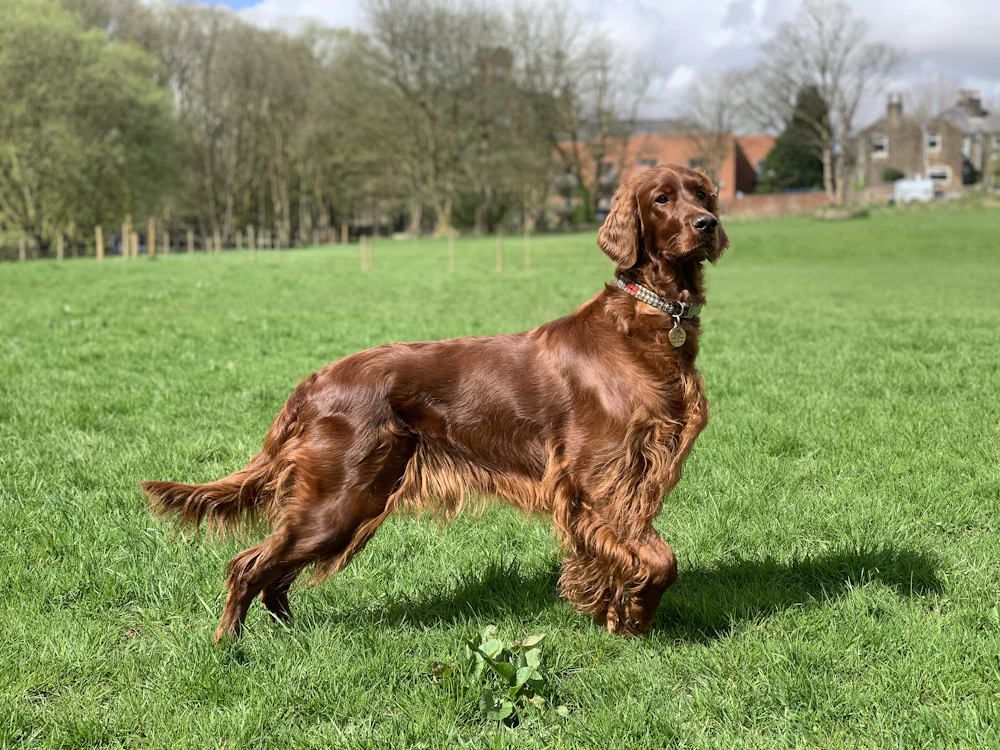
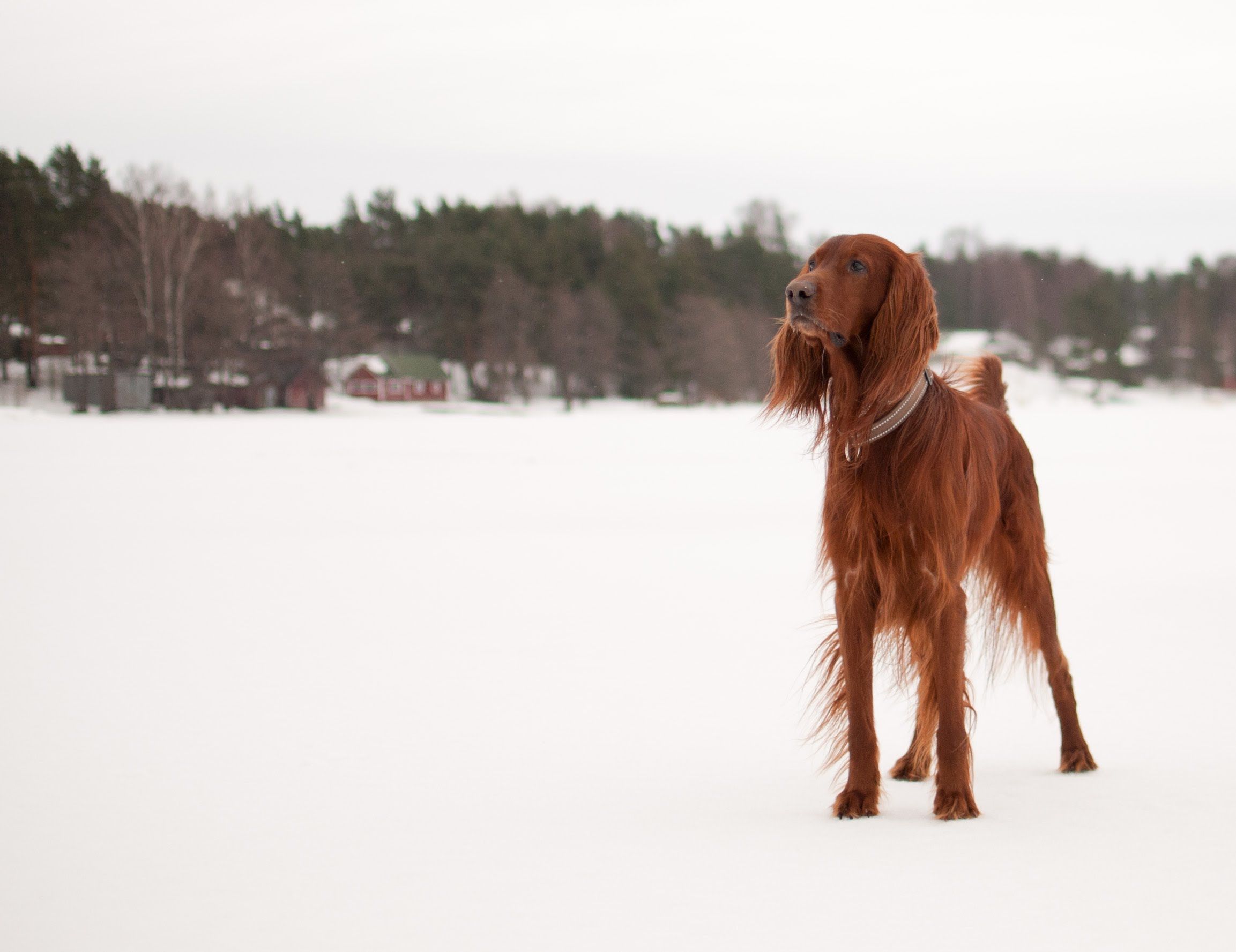
The coat is short and fine on the head, front of the legs and ear tips, and of moderate length, flat and as free from curl or wave as possible on the body, with feathering on the ears, legs, belly and tail. Brush two or three times a week to keep the feathering free of tangles, burrs and seeds. Shedding is moderate. The FCI standard requires rich chestnut with no trace of black; white on the chest, throat or toes and a small star or narrow streak on the face are permitted.
Feeding and weight
Feed a good-quality complete diet matched to an active large dog's needs, in two meals a day. Setters are often lean and can be picky as youngsters, so weigh food and track body condition rather than following a fixed portion. Allow rest for an hour or so before and after meals, given the deep chest and the breed's known risk of bloat.
Work out a starting calorie figure and food weight with the calorie calculator. Not sure this is the right breed? Take the quiz.
Health
Every breed carries predispositions. These are the conditions most often discussed for the Irish Setter, not a prediction for any individual dog.
- Gastric dilatation-volvulus (bloat)
- Hip dysplasia
- Canine leucocyte adhesion deficiency (CLAD, DNA test available)
- Progressive retinal atrophy (rcd1-PRA, DNA test available)
- Hypothyroidism
What to ask the breeder. Ask for hip scores for both parents and DNA results for CLAD and rcd1 progressive retinal atrophy, and ask whether any relatives have suffered from bloat.
Choosing a puppy
Irish Setter puppies are lively, curious and mouthy, with energy that can surprise new owners. Puppy-proof the flat and keep plenty of chew toys available. Socialise widely with people, children, other dogs, lifts and urban noise. Start recall and name games from the first days and use a long line outdoors. Keep exercise short and varied, with plenty of sniffing, while the joints develop.
In Luxembourg the national kennel club is the Fédération Cynologique Luxembourgeoise (FCL), a member of the FCI. Many owners also buy from breeders in Germany, France or Belgium; a puppy coming from another EU country must be microchipped and vaccinated against rabies, which in practice means it cannot travel before about fifteen weeks of age. Where to get a dog in Luxembourg.
The older Irish Setter
Older Irish Setters often stay young at heart but tire sooner and may develop stiffness. Gentler, more frequent walks, a soft bed and non-slip flooring help. Keep an eye on weight, thyroid function and any sign of discomfort after meals. Gentle brushing and scent games keep an older dog engaged and close to its people.
A realistic day
A realistic weekday for a working household in Luxembourg City, with a midday visit. Adjust it to your dog, not the other way round.
An hour of running and sniffing on a long line in an open area
Breakfast, a chew toy and a rest in a quiet room
Midday visit: a brisk walk with recall games and fresh water
Long evening outing, then dinner and a short brush
Short final walk and settle for the night
An Irish Setter in Luxembourg
An Irish Setter can live in a flat in Luxembourg City if its daily exercise is generous and reliable, ideally with a midday break. The breed is friendly with neighbours and other dogs in lifts and corridors, but its enthusiasm needs managing in tight spaces. Woods such as the Grünewald and Bambësch are lovely for walks, but full of deer, so keep the dog on a long line unless recall is proven.
The chestnut coat copes reasonably with heat, but hard exercise on summer days in the 30s °C should be moved to early morning and late evening. Check the feathering for seeds and burrs after walks in autumn. Free public transport makes it easy to reach forests and open areas. Standard rules apply: microchip, registration with the commune, liability insurance and the annual dog tax.
Every dog in Luxembourg must be identified, declared to the commune and covered by liability insurance. How registration works.
When you travel
A sitter should know that an Irish Setter needs long walks every day and company in between. Keep it on a long line in wooded areas, check for seeds after walks and brush out the feathering. Feed two meals with rest around them, and seek a vet immediately for signs of bloat such as restlessness, retching or a swollen belly.
PAWLY's holiday and overnight care takes place in your home, so your dog keeps its own bed and routine.
Myths and facts
MythIrish Setters are not intelligent.
FactThe breed is intelligent but slow to mature and easily distracted, which is often mistaken for a lack of brains.
MythA setter will calm down by one year old.
FactMany remain adolescent until two or three and need consistent exercise and training until then.
MythRed setters are only show dogs.
FactThe breed remains a capable gun dog, and the FCI standard still describes it as a working hunting dog with great stamina.
Is it the right dog for you?
Suits
- Active owners who walk or run for long periods every day
- Families with children who want a friendly, playful dog
- People interested in gundog work or scent sports
- Households with someone home for part of the day
Think twice if
- You want a dog with reliable off-lead recall from early on
- Your daily walks would be short
- You keep birds or small pets
- You prefer a breed that is calm and mature in its first year
Questions owners ask
Is an Irish Setter good with children?
Usually very good. The breed is affectionate and playful and enjoys family life. Supervision is needed with small children because a young setter is large, fast and enthusiastic, and teaching children to stay calm around the dog helps everyone.
Can an Irish Setter be left alone during the day?
Not for a full working day without a break. The breed is sociable and can become noisy or destructive when bored. A midday walk, plenty of exercise before work and puzzle toys make it far more realistic for working owners.
What is the difference between an Irish Setter and an Irish Red and White Setter?
They are separate breeds. The FCI standard says the Irish Setter descends partly from the Red and White Setter. The Irish Setter is solid chestnut, while the Red and White has a white base with red patches.
How often should an Irish Setter be groomed?
Brush two or three times a week, focusing on the feathering, and check ears and feet after walks. Trim the hair on the feet and around the ears occasionally. Bathing is needed only when the dog is dirty.
Sources
Photo: Unsplash (Unsplash License) · Photo: Unsplash (Unsplash License) · Photo: Unsplash (Unsplash License) · Photo: Pexels (Pexels License) · Photo: Pexels (Pexels License)
General information for dog owners in Luxembourg, not veterinary or legal advice. Official facts (origin, size, group, history and temperament as described by the breed standard) follow the FCI standard; health and care sections reflect breed-club and veterinary guidance and are typical ranges rather than rules. For your own dog, ask your vet, the breed club or your commune. How this guide is written and checked. Last reviewed 8 October 2026.
Need someone for your Irish Setter?
PAWLY offers an individual 45-minute walk or a home visit at your dog's pace, the same walker every time, and a written report with photos after every visit, across Luxembourg City.
Read next: the journal, for the Irish Setter
All articles
Grooming and coat care through the Luxembourg year
The Irish Setter has a coat that needs a routine that holds through the Luxembourg seasons.

Building a recall you can actually rely on
Scent and movement can cancel a recall; this is the method for the Irish Setter.

Choosing a groomer, and what to ask before you book
A coat like this usually means a groomer; this covers what to ask before you book.
Similar breeds
All 198 breeds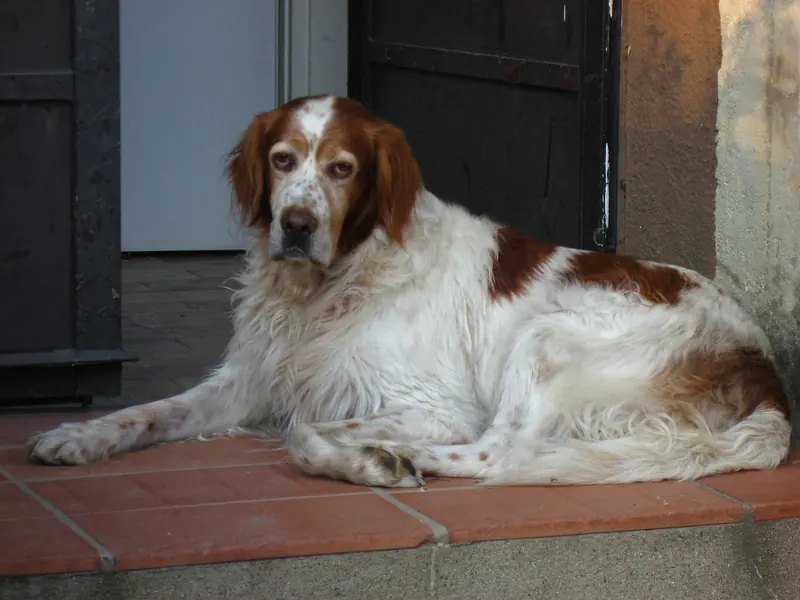
Irish Red and White Setter
The older, less fashionable Irish setter, white with red patches, and a gundog that still wants a field and a job.
EnergyGroomingFlat life
English Setter
A gentle, speckled bird dog that ranges wide in the field and then folds itself, surprisingly neatly, onto the nearest sofa.
EnergyGroomingFlat life
Gordon Setter
The heaviest and most deliberate of the setters, a black and tan Scottish bird dog with a dignified manner and a love of routine.
EnergyGroomingFlat life

