History
The Mastino Napoletano descends, according to the FCI standard, from the great Roman mastiff described by writers of the first century A.D. Roman legions took these dogs across Europe, and the standard credits them as ancestors of many European mastiff breeds. In southern Italy the type survived for centuries in the countryside around Naples and Mount Vesuvius, kept by farmers and estate owners as a guard for property and livestock.
By the mid-twentieth century the dog was known only locally. From 1947 a group of enthusiasts, among them the writer Piero Scanziani, began to select and describe the breed, and it was then recognised and standardised. Italy is the country of origin, and the current FCI standard, published on 13 November 2015, places it in Group 2, Section 2.1, among the mastiff-type molossoid breeds, without a working trial. Its listed use is protection and guard dog, which remains an accurate description of its instincts today.
Temperament
The standard asks for a dog that is steady and loyal, not aggressive, an attentive guardian of its property and its people, and it speaks of intelligence, nobility and majesty. At home a Neapolitan is usually quiet, affectionate and slow-moving, content to lie near its family and watch. It rarely barks without reason, and its sheer presence does most of the guarding.
With strangers the breed is reserved and watchful, and it takes its protective role seriously. It is not a dog to greet the courier with a wagging tail, and it needs owners who can manage visitors calmly and confidently. Neapolitans are sensitive to the mood of their household and respond poorly to rough handling. They can be stubborn, and once a 65 kg dog decides not to move, persuasion works far better than force.
Children and other pets
A well-raised Neapolitan is often gentle and patient with the children of its own family, but its size alone makes it unsuitable for unsupervised play with small children, who can be knocked over by a turning dog. Visiting children may be seen as strangers, so supervision matters. It can live with another dog, ideally of the opposite sex and raised together, while same-sex tensions with large dogs are possible. Cats introduced early are usually accepted.
Exercise and the daily walk
The Neapolitan is not an athlete, and its needs are modest: two or three steady walks totalling 45 minutes to an hour a day keep it fit and mentally content. The standard describes a slow, lion-like walk with a feline, rolling quality, and that is the pace the dog naturally chooses. Forced running, cycling alongside or long hikes in warm weather are not appropriate for this breed.
Puppies and adolescents need particular care. Growth is rapid, and joints are vulnerable until about 18 months, so avoid stairs where possible, jumping out of cars and long, repetitive exercise. Short, varied outings on soft ground are ideal. In summer, keep exercise to the coolest hours, carry water and watch for heavy panting, as the breed overheats quickly.
Training
Training a Neapolitan is about early habits rather than complex obedience. Lead manners, calm greetings, waiting at doors and lifts, and accepting handling by the vet must be in place before the dog becomes too heavy to steer. Use food, praise and patience; the breed learns but does not hurry, and a harsh approach damages trust with a dog that remembers.
Socialisation is essential and should continue into adulthood. Introduce the puppy to many people, places and noises in controlled ways, so that it can distinguish between normal visitors and genuine threats. An under-socialised guarding breed of this size is a real responsibility. Puppy classes with an instructor who understands molossoid breeds are worth the time, and experienced handling is strongly recommended.
Coat and grooming
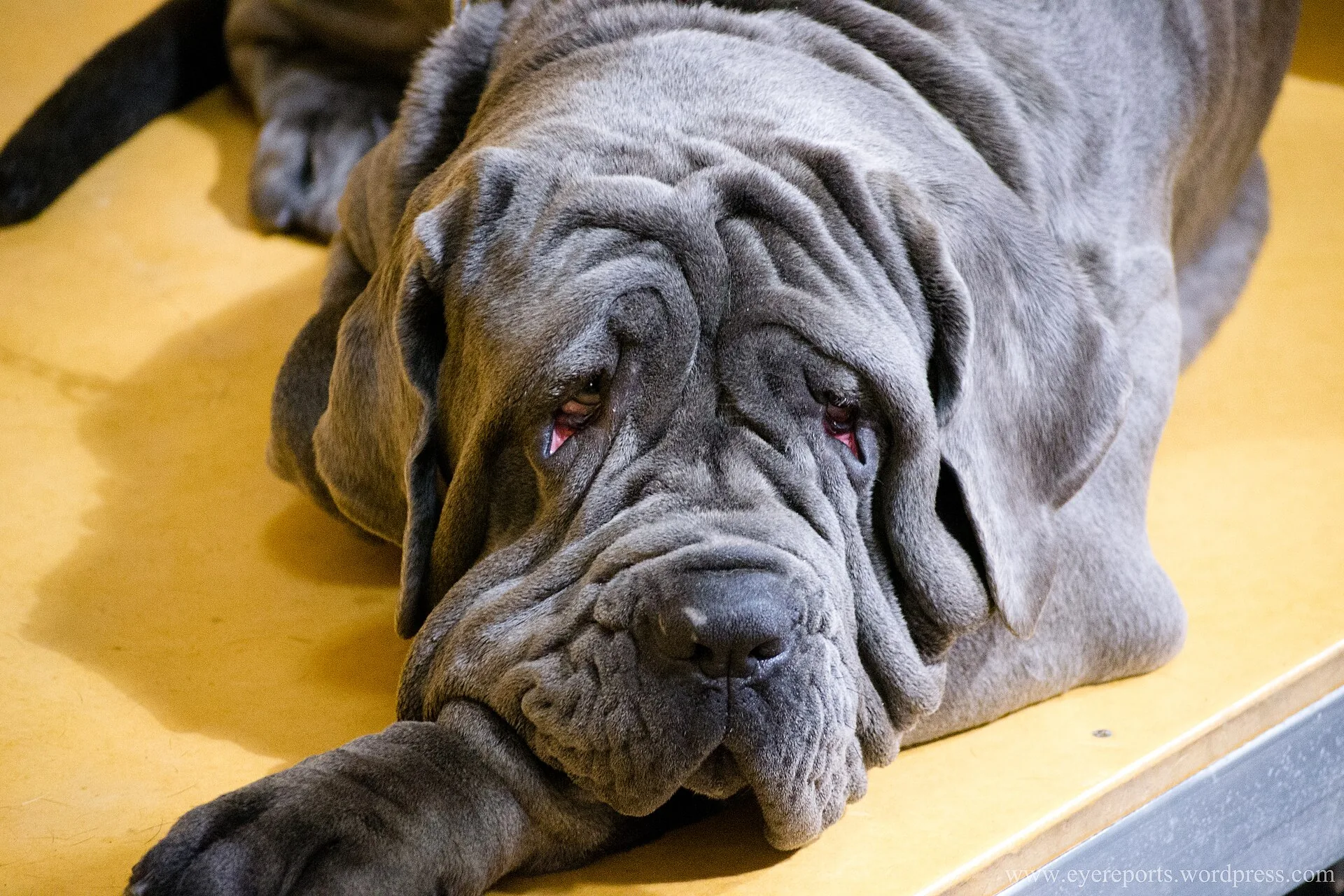
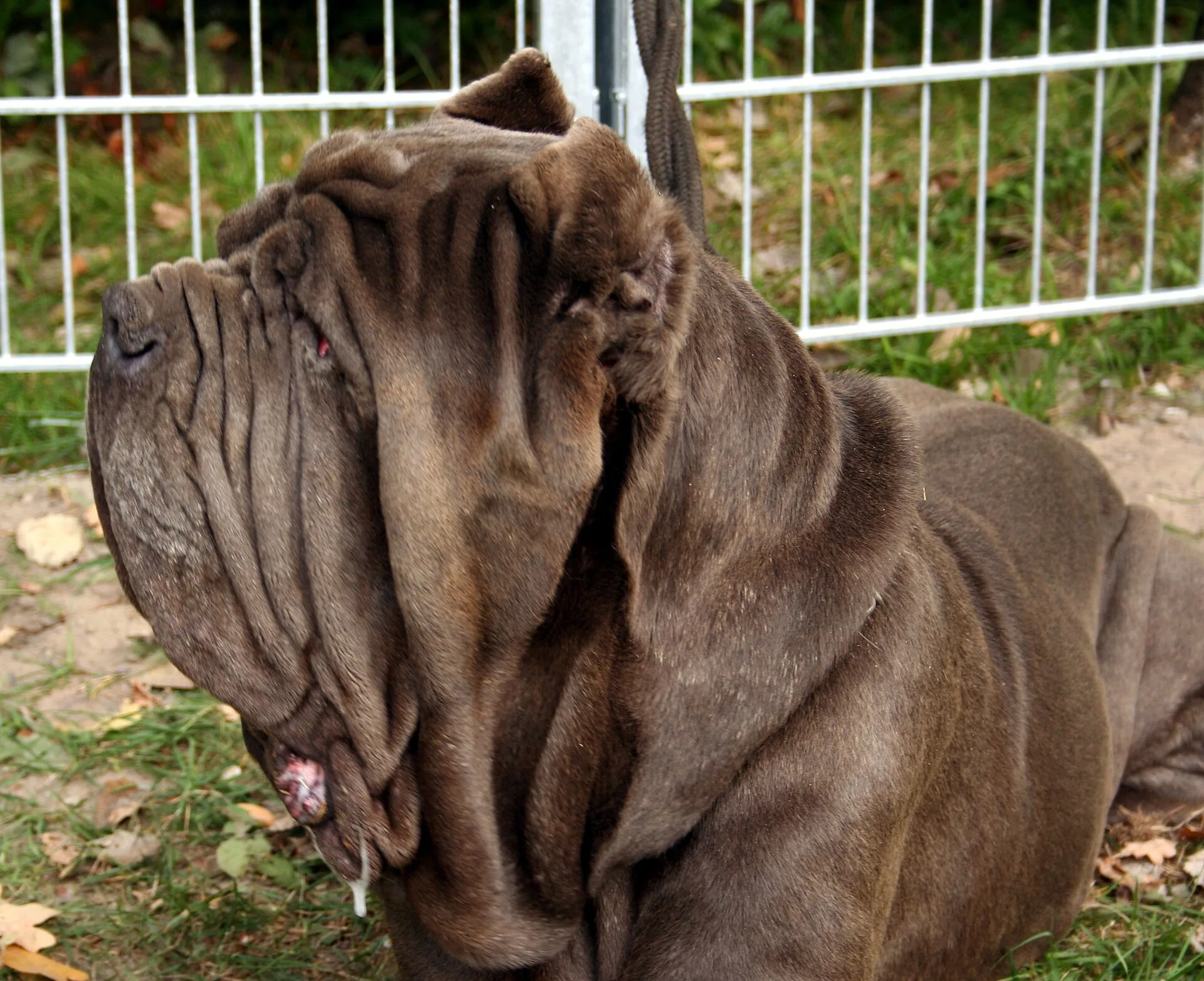
The FCI standard calls for a short, hard, dense coat of the same length all over, not exceeding 1.5 cm. Grey, lead grey and black are preferred, while brown, fawn and deer red are also accepted, and all these colours may be brindled. Weekly brushing with a rubber mitt is enough for the coat itself, with moderate shedding. The real grooming work is the skin: facial folds, lips and the area around the eyes need daily cleaning and drying to prevent irritation and infection.
Feeding and weight
Feed a complete diet designed for giant breeds, especially during growth, when controlled, steady development matters more than rapid gain. Split the daily ration into two or three meals and avoid vigorous exercise for an hour before and after eating, as the breed has a deep chest and is at risk of bloat. Keep the dog lean to protect joints. Expect drool around mealtimes and water bowls, and place a mat under them.
Work out a starting calorie figure and food weight with the calorie calculator. Not sure this is the right breed? Take the quiz.
Health
Every breed carries predispositions. These are the conditions most often discussed for the Neapolitan Mastiff, not a prediction for any individual dog.
- Hip and elbow dysplasia
- Gastric dilatation-volvulus (bloat)
- Eyelid problems (entropion, ectropion and cherry eye)
- Dilated cardiomyopathy (heart muscle disease)
- Skin fold infections
- Heat intolerance
What to ask the breeder. Ask to see official hip and elbow scores for both parents, plus recent eye and heart examinations, and meet the mother to judge her temperament.
Choosing a puppy
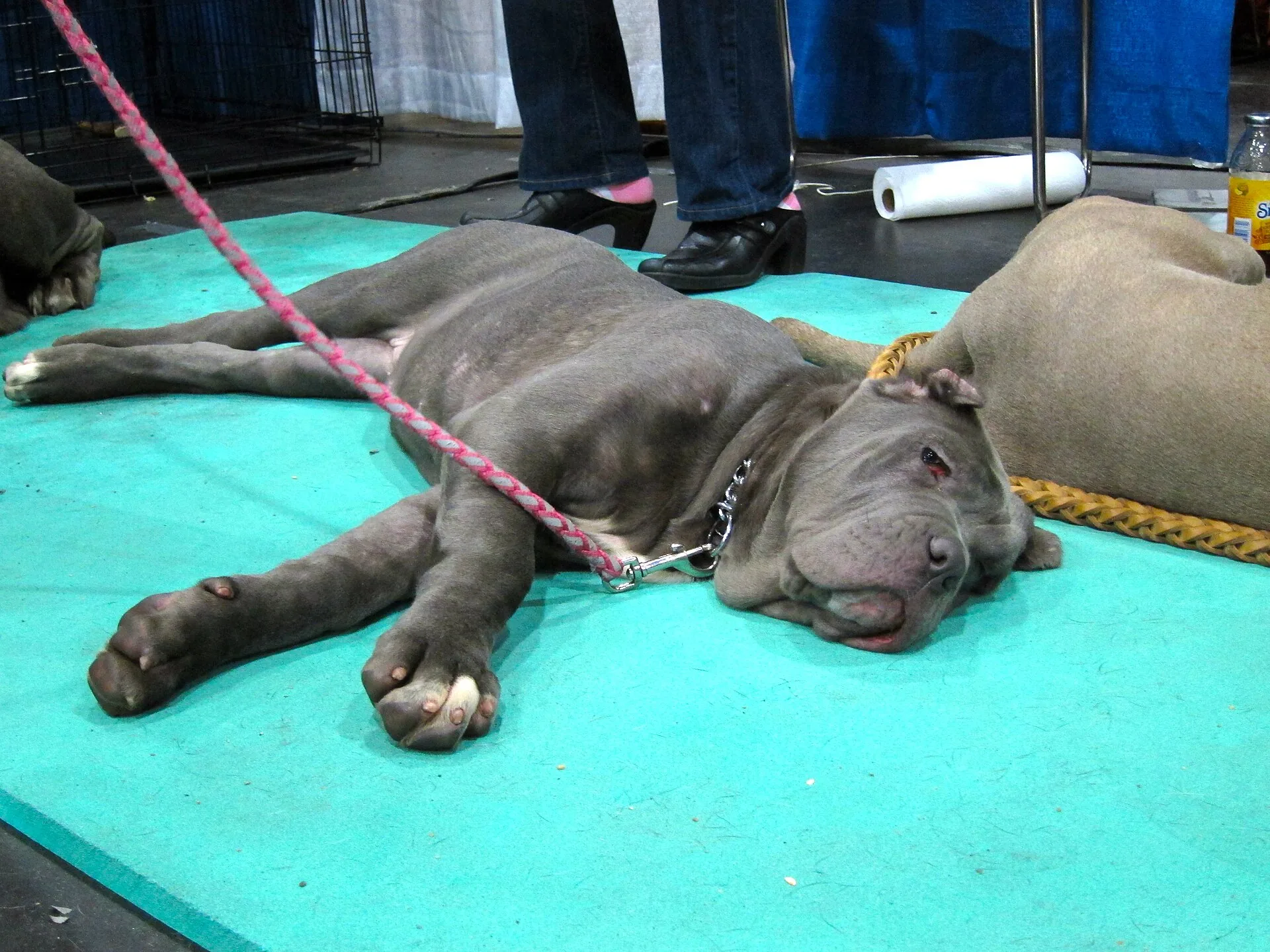
A Neapolitan puppy grows from a wrinkled bundle to a very large dog in a matter of months. Protect its joints by limiting stairs, jumping and long walks, and keep it lean. Begin handling the folds, ears and paws from the first day. Socialise widely but calmly, inviting different visitors to the home and practising polite greetings. Teach it to walk without pulling while it is still light enough to correct gently. Expect drool, chewing and occasional stubbornness.
In Luxembourg the national kennel club is the Fédération Cynologique Luxembourgeoise (FCL), a member of the FCI. Many owners also buy from breeders in Germany, France or Belgium; a puppy coming from another EU country must be microchipped and vaccinated against rabies, which in practice means it cannot travel before about fifteen weeks of age. Where to get a dog in Luxembourg.
The older Neapolitan Mastiff
Giant breeds age early, and a Neapolitan may show signs of slowing down from six or seven years old. Watch for stiffness, weight changes, breathing difficulties and heart problems, and keep veterinary checks regular. Soft, thick bedding protects pressure points, non-slip rugs help on smooth floors, and gentle, short walks maintain muscle. A ramp for the car is worth buying before it is needed.
A realistic day
A realistic weekday for a working household in Luxembourg City, with a midday visit. Adjust it to your dog, not the other way round.
A slow 20-minute walk before the heat or the rush hour, with plenty of time to sniff.
Breakfast, then a long rest after the meal with no play.
Midday visit: a short, gentle walk, fresh water, fold cleaning and a check of the water bowl.
Main walk of about 30 minutes in a quiet park, avoiding the hottest part of summer evenings.
Brief last outing, then settled on a thick bed for the night.
A Neapolitan Mastiff in Luxembourg
Living with a Neapolitan in Luxembourg City is possible but requires planning. A ground-floor flat or a building with a large lift is almost essential, because carrying an injured 60 kg dog up stairs is not an option, and repeated stair climbing harms young joints. Neighbours will notice a dog of this size in shared spaces, so calm lift manners and a short lead are important. Note that Luxembourg's law of 9 May 2008 on dogs names the Mastiff and dogs of similar morphology among the types that require a training certificate and ministerial authorisation; ask your commune or the competent ministry before buying how a Neapolitan will be treated.
Summer is the main challenge. With temperatures reaching the 30s °C, walks must move to early morning and late evening, and shade under the trees of the Bambësch or the Grünewald is better than open lawns. Cooling mats and a well-ventilated home help. All the general rules apply too: microchip, declaration to the commune, third-party liability insurance and the annual dog tax.
Every dog in Luxembourg must be identified, declared to the commune and covered by liability insurance. How registration works.
When you travel
A sitter should be physically capable, calm and introduced to the dog in advance, ideally more than once, as the Neapolitan is reserved with strangers and protective of its home. Meals must be followed by rest because of bloat risk, and facial folds need cleaning daily. In warm weather keep the home cool and walks short. Overnight care in the dog's own home is usually far less stressful for this breed than kennels.
PAWLY's holiday and overnight care takes place in your home, so your dog keeps its own bed and routine.
Myths and facts
MythNeapolitans are aggressive by nature.
FactThe FCI standard asks for a steady, loyal dog that is not aggressive. A well-bred, well-socialised Neapolitan is calm and watchful.
MythA big dog needs a lot of exercise.
FactThis breed needs moderate, steady walking. Too much exercise, especially when young or in heat, does harm.
MythThe wrinkles are purely cosmetic.
FactFolds need daily cleaning and drying, otherwise they can become sore and infected.
Is it the right dog for you?
Suits
- Experienced owners of large guarding breeds
- Calm households with ground-floor or lift access
- People who want a quiet, devoted companion rather than an athlete
- Owners prepared for drool and daily skin care
Think twice if
- This would be your first dog
- You live in a walk-up flat or a small space
- You often have many unfamiliar visitors
- You want long hikes or runs with your dog
Questions owners ask
How much do Neapolitan Mastiffs drool?
A lot, particularly after drinking, eating or in warm weather. Most owners keep towels in several rooms and wipe the dog's lips regularly. Drool varies between individuals, but if you dislike slobber on clothes and walls, this breed is probably not the right choice.
Can a Neapolitan live in a flat?
Only with the right flat: ideally on the ground floor or with a reliable, large lift, and with enough floor space for a giant dog to lie down comfortably. The breed is quiet indoors, but stairs and cramped corridors are hard on its joints.
How long do Neapolitans live?
Like many giant breeds, they have a relatively short life, generally about 8 to 10 years. Keeping the dog lean, protecting joints during growth and regular veterinary checks give the best chance of a healthy old age.
Are they good guard dogs?
Yes, by instinct. The breed is watchful and protective of its home and family, usually without much barking. This is precisely why careful socialisation and experienced handling matter: the owner, not the dog, must decide who is welcome.
Sources
Photo: gomagoti, CC BY-SA 2.0, via Wikimedia Commons · Photo: Przykuta, CC BY-SA 2.5, via Wikimedia Commons · Photo: Pets Adviser from Brooklyn, USA, CC BY 2.0, via Wikimedia Commons
General information for dog owners in Luxembourg, not veterinary or legal advice. Official facts (origin, size, group, history and temperament as described by the breed standard) follow the FCI standard; health and care sections reflect breed-club and veterinary guidance and are typical ranges rather than rules. For your own dog, ask your vet, the breed club or your commune. How this guide is written and checked. Last reviewed 8 October 2026.
Need someone for your Neapolitan Mastiff?
PAWLY offers an individual 45-minute walk or a home visit at your dog's pace, the same walker every time, and a written report with photos after every visit, across Luxembourg City.
Read next: the journal, for the Neapolitan Mastiff
All articles
Dogs in hot weather: the Luxembourg summer guide
The Neapolitan Mastiff carries a heavy coat or a heavy frame, which makes a Luxembourg summer the hard season.

Arthritis: the pain owners file under old age
Giant breeds tend to have joint trouble early; this is what to look for.

Growing a large-breed puppy without wrecking its joints
A giant puppy grows fast on soft bones; how it grows decides its joints for life.
Similar breeds
All 198 breeds
English Mastiff
A vast, gentle English guardian: calm, dignified and big enough to change the shape of your home.
EnergyGroomingFlat life
Cane Corso
An athletic Italian guardian with a working dog's mind, devoted to its family and quietly certain about who belongs at the gate.
EnergyGroomingFlat life
Dogue de Bordeaux
An ancient French guardian with a huge head and a soft heart, calm at home, vigilant at the door and demanding of careful ownership.
EnergyGroomingFlat life

