


History
According to the FCI standard, in ancient times the Portuguese Water Dog could be found along the whole Portuguese coast. As fishing methods changed it became concentrated in the Algarve in the south of the country, and it is regarded as an indigenous Portuguese breed. Fishermen used it as a crew member: it swam and dived to retrieve fish that escaped from nets and equipment that fell overboard, and it carried out other tasks in the water for the boats.
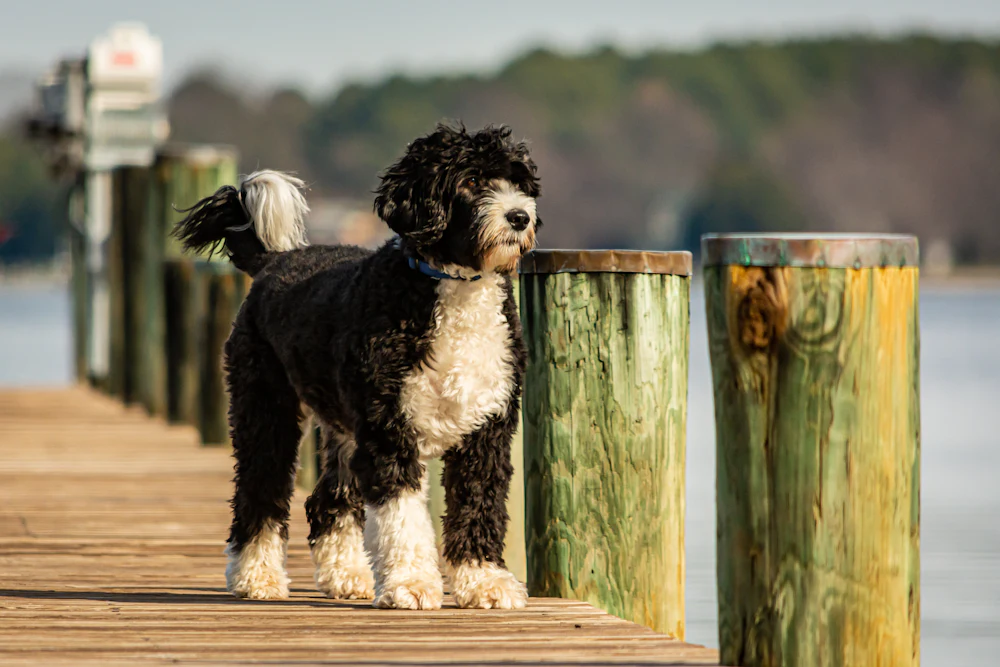
The standard describes its use today as assistance with fishing and retrieving, as well as a companion dog. Portugal is the country of origin, and the current FCI standard, dated 4 November 2008, places the breed in Group 8, Section 3, among the water dogs, without a working trial. Two coat varieties are recognised, curly and long wavy, and the traditional partial clip that leaves the hindquarters and muzzle short with a plume at the tail tip is mentioned in the standard as typical of the breed.
Temperament
The FCI standard calls the breed exceptionally intelligent, a dog that understands and obeys its owner easily and happily, and in the same breath describes it as impetuous, wilful and courageous. Both halves are true in daily life. A Portuguese Water Dog learns fast and enjoys working with its people, but it also has firm opinions and plenty of physical confidence.
Most are affectionate, sociable and outgoing with their families and friendly but sensible with visitors. They like to be involved, following their owners from room to room, and they can become noisy or destructive if left without stimulation for long periods. Mouthing, carrying objects around the house and enthusiastic jumping are typical in young dogs, part of a working retriever's nature rather than bad manners.
Children and other pets
With children this is usually a robust, playful and patient dog, at its best with families who include it in walks, swims and games. A young dog may knock over small children in its enthusiasm and likes to carry socks and toys in its mouth, so supervision and training matter. It generally gets on well with other dogs. Cats raised with it are often accepted, though some individuals chase moving animals outdoors.
Exercise and the daily walk
An adult needs about an hour and a half of activity a day, combining walks with retrieving games, training and, whenever possible, swimming. This is a strong, muscular dog with stamina, built to work for hours. Without enough exercise it will find outlets indoors, often by chewing or barking.
Water is the breed's natural element, and many dogs will try to swim at every opportunity. Lakes and rivers with safe entry points are ideal; always rinse the coat afterwards and check for currents and algae warnings. Dock diving, water work, obedience and agility all suit the breed. Retrieve games on land are a good daily substitute, and scent work offers mental exercise on rainy days.
Training
Training is usually rewarding. These dogs respond quickly to food, toys and praise and enjoy learning complex tasks. Because they are also wilful, consistency is important: if a rule is relaxed once, they will test it again. Short sessions, clear criteria and plenty of variety keep them engaged.
Teach calm greetings early, since jumping up is a common habit, and practise settling on a mat so the dog can relax at home and in cafés. Mouthy puppies should be given appropriate items to carry and chew. Socialisation with traffic, trams, lifts and city noise is important, as is regular handling for grooming. A well-trained Portuguese Water Dog is a capable all-round companion.
Coat and grooming
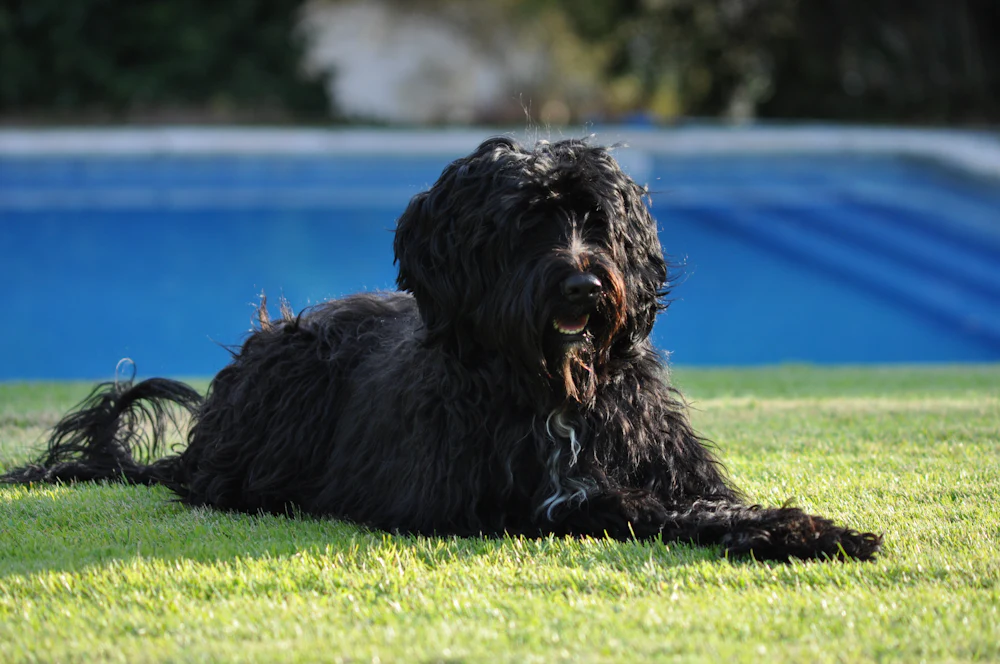
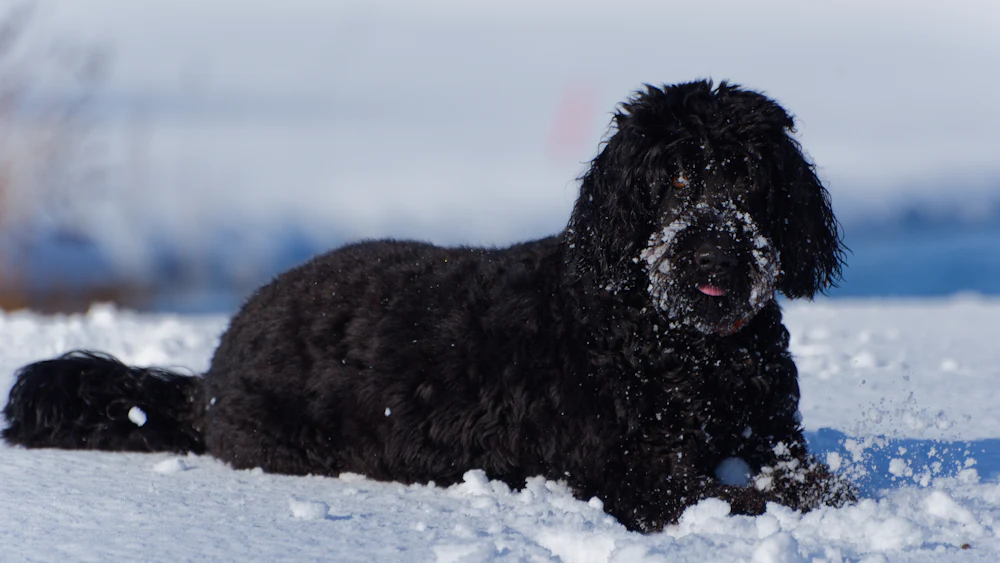
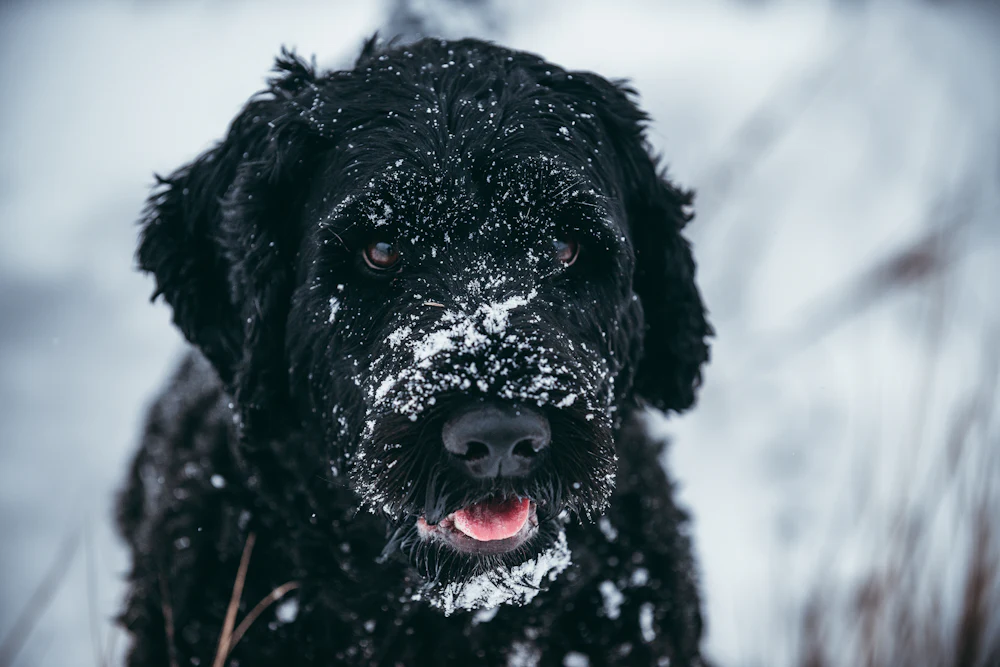
The whole body is covered with strong hair and no undercoat. In the curly variety the coat forms compact cylindrical curls; in the long variety it is loosely waved with a slight sheen. The standard accepts black or brown of various shades, or solid white, and in black or brown dogs white is accepted on the muzzle, topknot, neck, forechest, belly, tail tip and lower legs. The breed sheds little, but the coat grows continuously and mats, so it needs brushing several times a week and clipping every six to eight weeks.
Feeding and weight
A working water dog needs a good-quality complete diet, with portions adjusted to activity: a dog that swims and trains daily needs more than one walked mainly on lead. Two meals a day suit most adults. Keep treats small and use them for training. Monitor weight with your hands, since a full coat hides both ribs and fat. Fresh water should always be available, especially after swimming and in summer.
Work out a starting calorie figure and food weight with the calorie calculator. Not sure this is the right breed? Take the quiz.
Health
Every breed carries predispositions. These are the conditions most often discussed for the Portuguese Water Dog, not a prediction for any individual dog.
- Hip dysplasia
- Progressive retinal atrophy (PRA)
- GM1 storage disease (an inherited neurological disease)
- Juvenile dilated cardiomyopathy
- Addison's disease (hypoadrenocorticism)
What to ask the breeder. Ask for hip scores and recent eye examinations for both parents, DNA results for progressive retinal atrophy, GM1 storage disease and juvenile dilated cardiomyopathy, and how long the breeder's dogs typically live.
Choosing a puppy
A Portuguese Water Dog puppy is curious, mouthy and full of energy. Provide plenty of safe chews and carry toys, and begin training the day it arrives with name recognition, sit, recall and settle. Introduce it to grooming tools and a gentle hair dryer early, as it will be groomed for life. Short, positive introductions to water, never forced, help build confidence. Keep exercise moderate and varied while the joints are developing.
In Luxembourg the national kennel club is the Fédération Cynologique Luxembourgeoise (FCL), a member of the FCI. Many owners also buy from breeders in Germany, France or Belgium; a puppy coming from another EU country must be microchipped and vaccinated against rabies, which in practice means it cannot travel before about fifteen weeks of age. Where to get a dog in Luxembourg.
The older Portuguese Water Dog
Older Portuguese Water Dogs usually stay keen to work but may tire sooner. Keep them active with gentle walks, short swims in safe water and brain games. Maintain a lean weight to protect the hips and joints. Regular health checks become more important, including blood tests if the vet recommends them. Grooming may need to be adapted to the dog's comfort, with shorter sessions and a shorter clip.
A realistic day
A realistic weekday for a working household in Luxembourg City, with a midday visit. Adjust it to your dog, not the other way round.
Brisk 40-minute walk with retrieving games, then breakfast.
Owner leaves; the dog rests with a chew or puzzle toy.
Midday visit: a 45-minute outing with a training session and water if the weather allows.
Evening walk in the Grünewald or Bambësch, then a quick rinse and towel dry.
Calm time, a short brush of the legs and a final outing before bed.
A Portuguese Water Dog in Luxembourg
This breed can live happily in a flat in Luxembourg City if it gets enough exercise and company. Its low shedding coat is welcome in apartments with lifts and shared stairwells, but a wet, enthusiastic dog in a small lift is another matter, so keep towels handy. The dog will enjoy free buses and trams to reach greener areas once it is used to them.
Local parks such as Parc Merl, the Pétrusse valley and the Kinnekswiss are fine for daily walks, while the Grünewald and Bambësch forests offer longer outings. Swimming spots should be chosen carefully and only where dogs are permitted. Summer heat can be tiring, so plan exercise early in the morning or late in the evening. Find a groomer who knows water dog clips before the puppy arrives.
Every dog in Luxembourg must be identified, declared to the commune and covered by liability insurance. How registration works.
When you travel
A sitter should give the dog at least two good walks a day plus play, since boredom quickly leads to chewing or noise. Explain the brushing routine and how to dry the coat after rain or a swim. Warn the sitter about water: this dog will head for any pond or river. Leave clear instructions for food, any allergies and the vet's details, and book the regular grooming appointment if it falls during your trip.
PAWLY's holiday and overnight care takes place in your home, so your dog keeps its own bed and routine.
Myths and facts
MythThe Portuguese Water Dog is hypoallergenic.
FactNo dog is entirely hypoallergenic. The breed sheds little, which helps some allergy sufferers, but reactions vary.
MythIt only needs exercise in water.
FactIt needs daily walks, play and training; swimming is a bonus, not a substitute.
MythIts coat is low maintenance because it sheds little.
FactThe coat grows continuously and needs regular brushing and professional clipping.
Is it the right dog for you?
Suits
- Active owners who enjoy outdoor life and water
- Families with children who like to play
- People wanting a low-shedding dog and willing to groom
- Owners interested in training or dog sports
Think twice if
- Think twice if you want a low-maintenance coat
- Think twice if the dog would be alone for long hours
- Think twice if you cannot offer daily exercise and training
- Think twice if neat, quiet floors matter more than muddy paws
Questions owners ask
Does a Portuguese Water Dog shed?
Very little, because it has no undercoat. Loose hair tends to stay in the coat until it is brushed out, which is why regular brushing is essential to prevent mats. It is not guaranteed to suit allergy sufferers, so spend time with the breed first.
Curly or wavy coat, which is better?
Both varieties are equally correct under the FCI standard. Curly coats form tight curls, while wavy coats are looser and slightly shiny. Care is similar, and the clip chosen often affects appearance more than the coat type.
Do they need to swim?
Swimming is not essential but most love it, and it is an excellent form of exercise. If water is not available, retrieving games, long walks and training can keep the dog fit and content.
Are they easy to train?
Generally yes. They are intelligent and eager to work, but they can be wilful. Clear rules, short sessions and rewards help. Early socialisation and training are important to channel their energy.
Sources
Photo: Unsplash (Unsplash License) · Photo: Unsplash (Unsplash License) · Photo: Unsplash (Unsplash License) · Photo: Unsplash (Unsplash License)
General information for dog owners in Luxembourg, not veterinary or legal advice. Official facts (origin, size, group, history and temperament as described by the breed standard) follow the FCI standard; health and care sections reflect breed-club and veterinary guidance and are typical ranges rather than rules. For your own dog, ask your vet, the breed club or your commune. How this guide is written and checked. Last reviewed 8 October 2026.
Need someone for your Portuguese Water Dog?
PAWLY offers an individual 45-minute walk or a home visit at your dog's pace, the same walker every time, and a written report with photos after every visit, across Luxembourg City.
Read next: the journal, for the Portuguese Water Dog
All articles
Grooming and coat care through the Luxembourg year
The Portuguese Water Dog has a coat that needs a routine that holds through the Luxembourg seasons.

When a dog loses its hearing or its sight
Eye and hearing conditions are watched for in the Portuguese Water Dog; this covers living with them.

Forests, hunting season and wildlife
The Portuguese Water Dog was bred to follow game, which matters in the forests around Luxembourg.
Similar breeds
All 198 breeds
Spanish Water Dog
A rustic Andalusian all-rounder in a curly woolly coat, quick to learn, keen to work and wary of strangers until it knows them.
EnergyGroomingFlat life
Lagotto Romagnolo
A curly-coated Italian truffle hunter with a nose that never switches off, happiest when every walk becomes a search.
EnergyGroomingFlat life
Poodle
Far from a fashion accessory: one of the most intelligent and athletic breeds, in four sizes.
EnergyGroomingFlat life

