

History
The FCI standard, published in 2019 under the name Russkaya Psovaya Borzaya, traces the Borzoi to the fifteenth century and the Mongol invasion. Tatars brought sighthounds of Arab origin called Koutsi, while Russian hunters relied on the powerful Loshaya dogs, strong enough to catch and kill a deer or even an elk. Crosses between the two became the prototype of the Borzoi, later refined with Polish Greyhounds, Courland sighthounds and mountain sighthounds.
Large scale hunts grew fashionable among the Russian nobility in the eighteenth and nineteenth centuries. The first congress of Borzoi lovers took place in 1874, and the Moscow Hunting Society adopted the first standard in 1888. The FCI describes the breed as a hunting sighthound used mostly for hare and fox and less for wolf, which gently corrects the popular image. After the Revolution in 1917 the breed came close to disappearing in Russia, and breeders elsewhere did much to preserve it.
Temperament
The standard calls the temperament calm and the visual response well evident, and both halves matter. At home the Borzoi is quiet, gentle and rather cat like, content to lie on a sofa for hours. Outdoors, the moment something small and fast moves in the distance, the dog changes completely, and the response is instinct rather than disobedience. Towards people the standard asks for an attitude that is neutral to friendly.
Most Borzois are reserved rather than effusive. They are rarely clingy, and they often make their feelings known by leaning or resting a long head on your knee. They are sensitive to harsh handling and to raised voices, and do poorly in tense households. Aggression is a disqualifying fault in the standard. Barking is unusual, so the breed makes a poor alarm but a restful housemate.
Children and other pets
A well raised Borzoi is gentle with children and tolerant of ordinary household noise, but its size and speed matter. A running toddler may trigger a chase, and a dog this tall can knock over a small child by accident, so supervise play and teach children to be calm. With other dogs it is usually peaceful. Cats, rabbits and other small animals are different: a dog brought up with a cat may accept it indoors yet chase any other outdoors.
Exercise and the daily walk
A Borzoi does not need hours of walking, but it does need a chance to run. About an hour a day suits an adult, with steady lead walks supplemented by regular sprints in a securely fenced field. Free running in open ground near roads or wildlife is risky, because a sighthound at full gallop will not respond to a recall.
Puppies and adolescents should not be over exercised while their bones are growing, so keep the early months to short walks and gentle play. In between exercise, expect long periods of sleeping. Mental work is welcome, but a Borzoi is more interested in the lure or the course than in obedience drills, so keep sessions short and gentle.
Training
Borzois are intelligent and learn quickly, but they are independent and see little point in repeating what they have already mastered. Use reward based training, keep sessions brief and varied, and do not expect the eager obedience of a herding breed. Harsh corrections can make a sensitive dog shut down and refuse to work.
Teach loose lead walking, a calm greeting and a settle early, since a fully grown Borzoi on a lead can be a lot of dog to hold. Recall is worth practising, but it must never be trusted near prey or traffic. A long line and a securely fenced field are the safest places to let the dog enjoy a gallop.
Coat and grooming
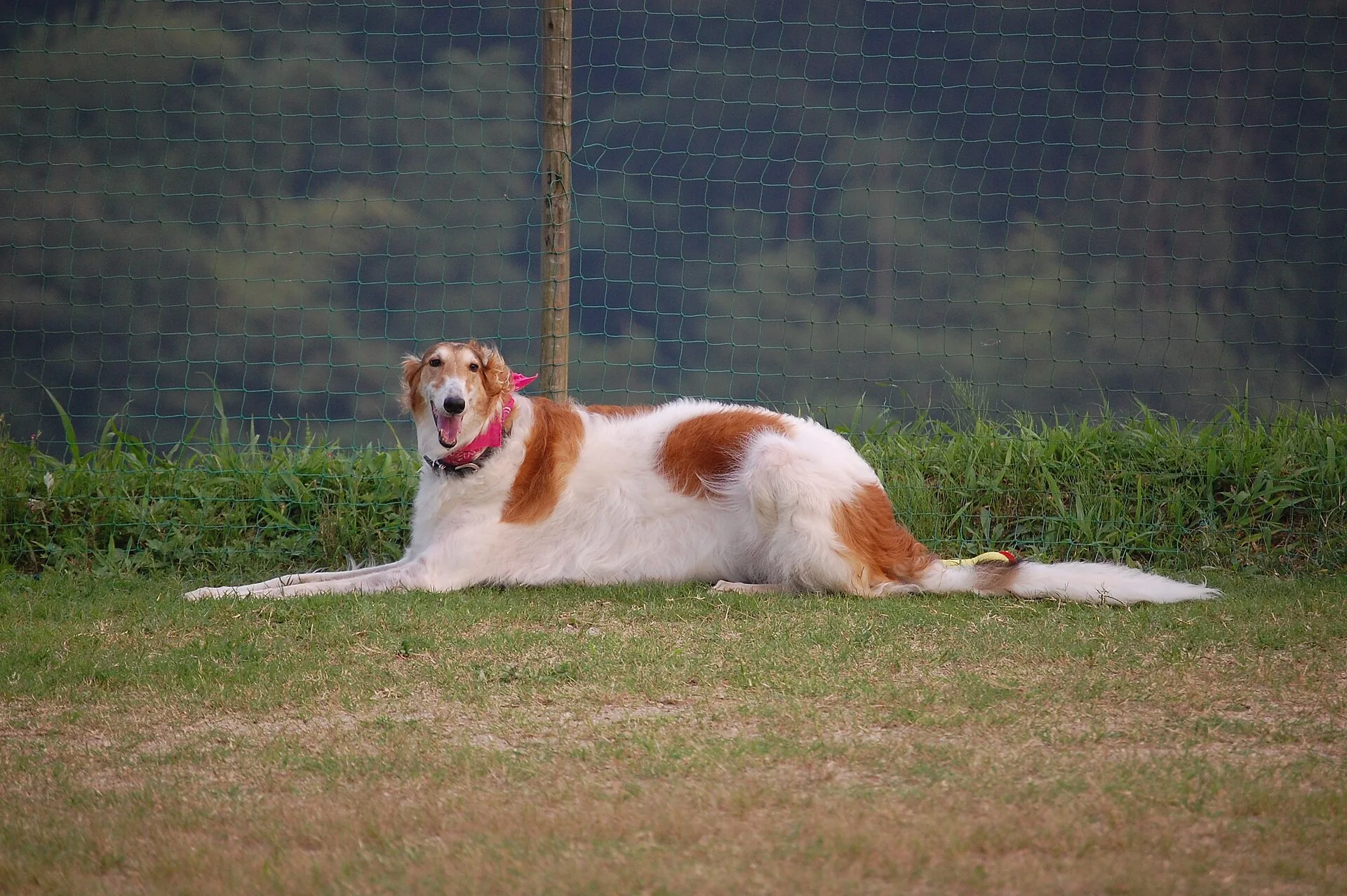
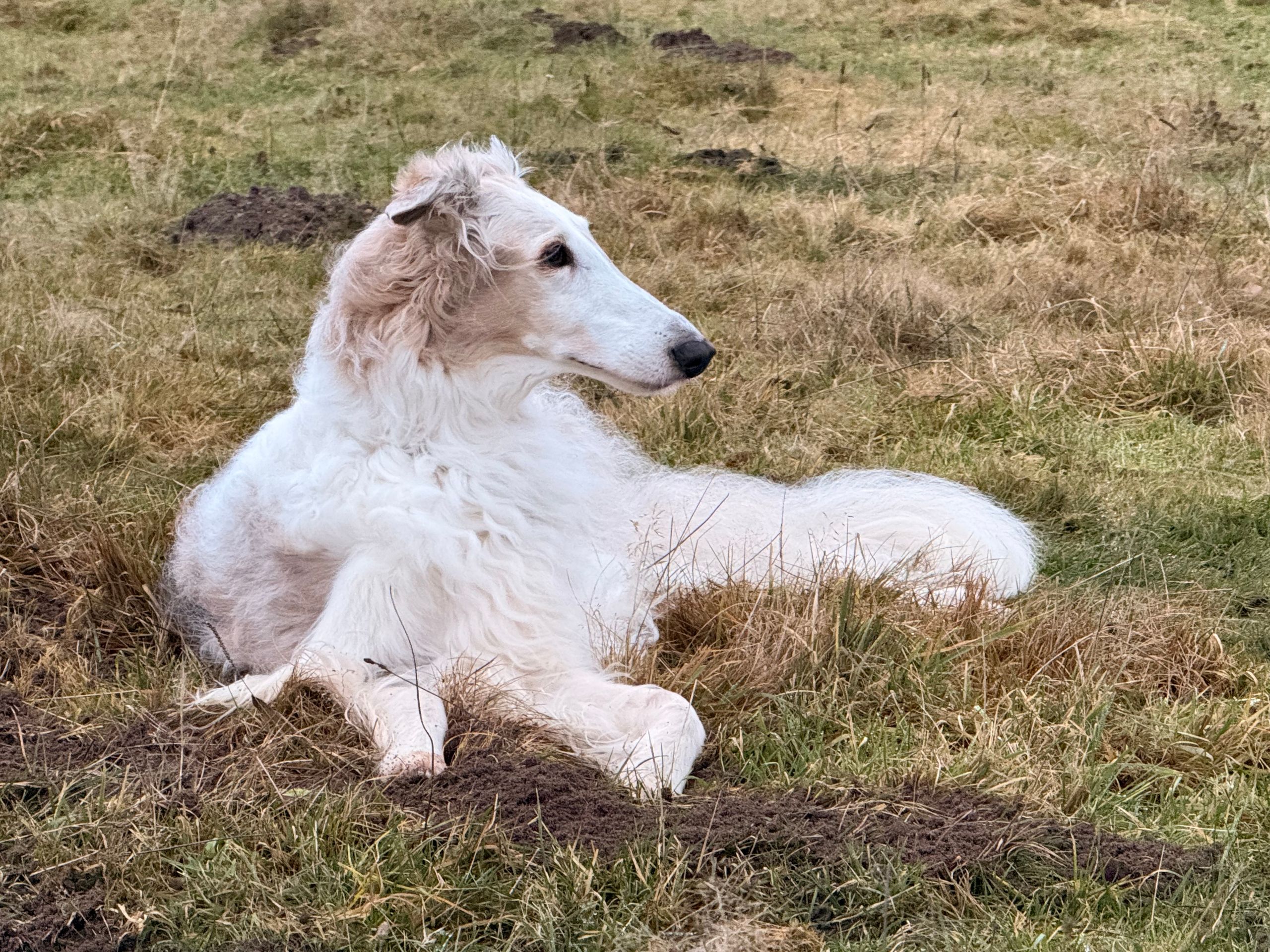
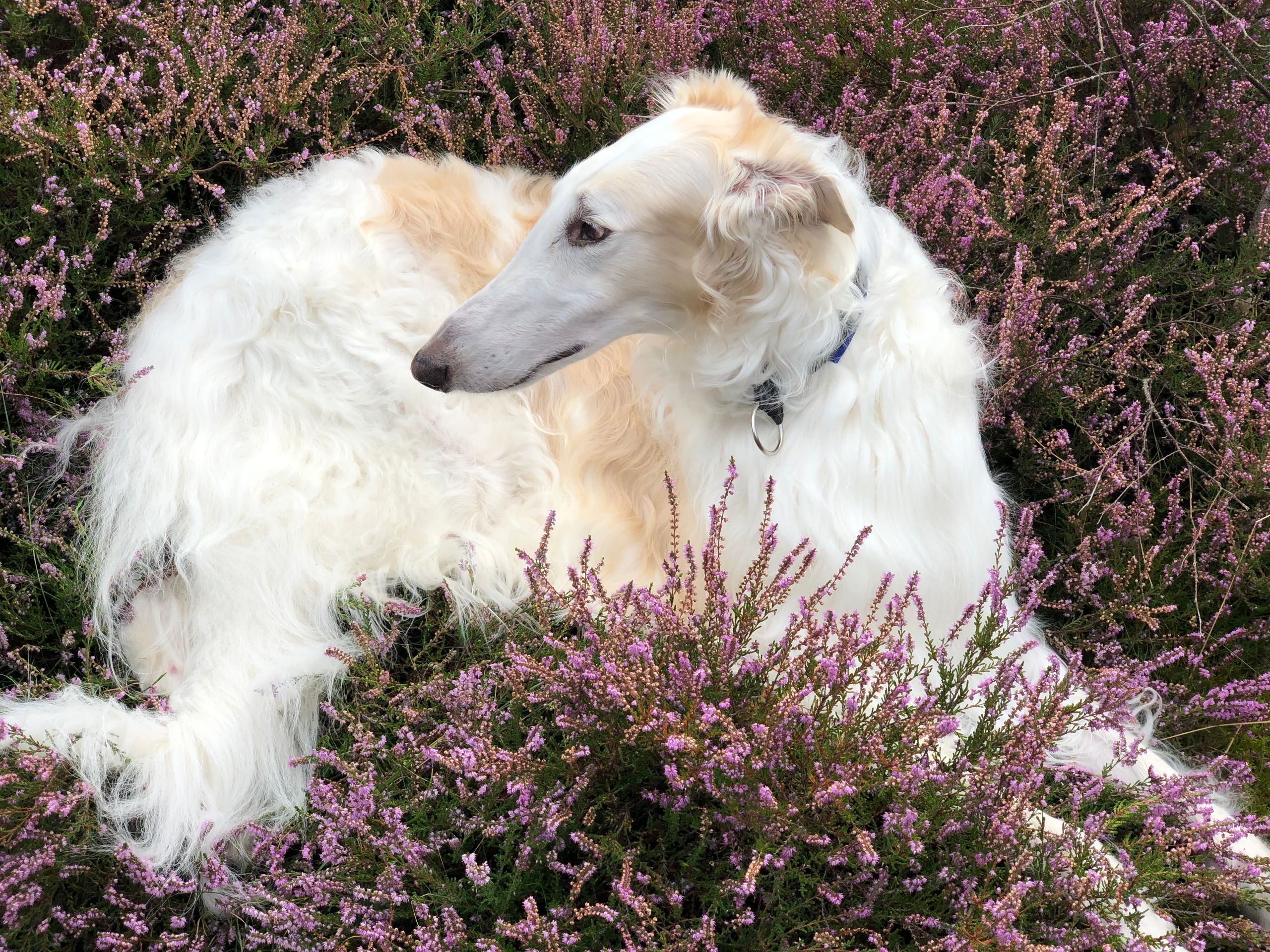
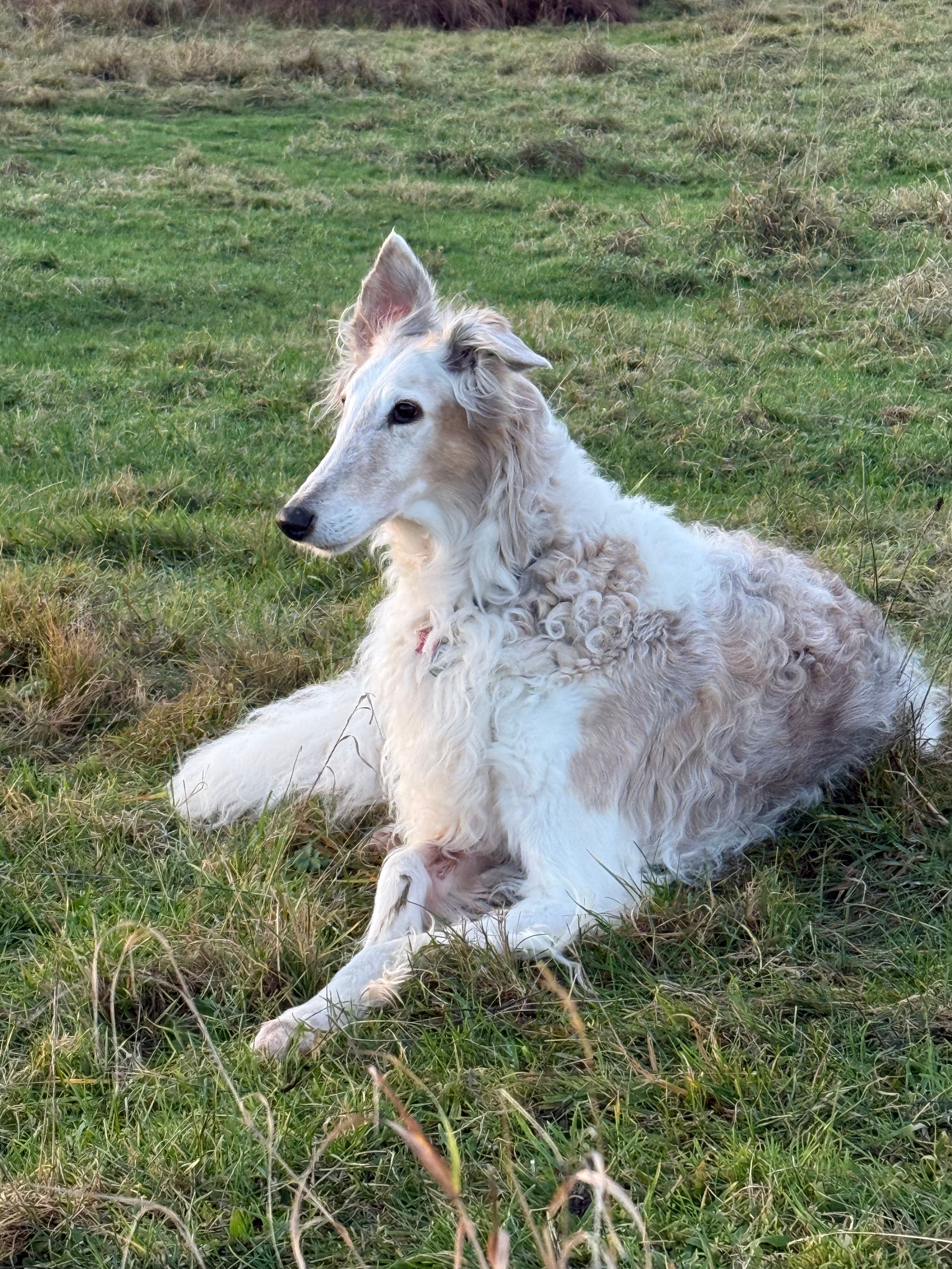
The standard describes a long, supple, silky and light coat, wavy or forming large curls, with feathering on the neck, chest, legs and tail and a shorter coat on the head. White and pale shadings through to grey and red are permitted, whereas brown, blue and isabella are excluded. Brush two or three times a week, and daily during the heavy shed, to prevent mats behind the ears, on the chest and on the trousers. Bathing is occasional.
Feeding and weight
Borzois are deep chested, so feed two or three smaller meals a day rather than one large one, and avoid vigorous exercise for an hour either side. A good quality complete diet suits most, and many do better lean than heavy. Discourage gulping, and ask your vet about bloat risk. Keep puppies slim, because steady growth is kinder to developing joints than rapid gain.
Work out a starting calorie figure and food weight with the calorie calculator. Not sure this is the right breed? Take the quiz.
Health
Every breed carries predispositions. These are the conditions most often discussed for the Borzoi, not a prediction for any individual dog.
- Gastric dilatation-volvulus (bloat)
- Dilated cardiomyopathy
- Sensitivity to some anaesthetics
- Hypothyroidism
- Osteosarcoma (bone cancer) in older dogs
What to ask the breeder. Ask for heart screening for both parents, hip and thyroid results, and the ages and causes of death of close relatives.
Choosing a puppy
Choose a breeder who health tests the parents and can tell you how long the relatives lived. Borzoi puppies are lanky and fragile in the first year, so avoid stairs, slippery floors and long forced walks. Socialise them to traffic, lifts, trams and other dogs early, and begin gentle lead training before the dog is too strong to handle. Fit a well made collar and keep a close eye on the diet.
In Luxembourg the national kennel club is the Fédération Cynologique Luxembourgeoise (FCL), a member of the FCI. Many owners also buy from breeders in Germany, France or Belgium; a puppy coming from another EU country must be microchipped and vaccinated against rabies, which in practice means it cannot travel before about fifteen weeks of age. Where to get a dog in Luxembourg.
The older Borzoi
Borzois often age gracefully but life expectancy is shorter than for smaller breeds, and the later years need care. Provide a thick, supportive bed and non slip flooring, keep walks regular but gentle, and watch for stiffness, weight loss or lumps. Annual health checks, including the heart, are sensible. Many old Borzois still enjoy a slow stroll and a warm place to sleep.
A realistic day
A realistic weekday for a working household in Luxembourg City, with a midday visit. Adjust it to your dog, not the other way round.
A steady forty minute lead walk in a quiet park, followed by breakfast.
Settle on a thick bed while you leave for work.
A walker takes the dog out for a calm thirty minute stroll and a drink.
A longer walk, with a safe sprint if a fenced field is available.
A short final outing, then a long sleep on the sofa.
A Borzoi in Luxembourg
A Borzoi can be a surprisingly calm flat dog, sleeping most of the day, but it needs room to stretch. A flat with a lift and a spot to lie down suits it better than a house with a small garden, so long as the daily walks happen. Watch for slippery stairs and polished floors.
Luxembourg City has plenty of walking space, such as the Pétrusse valley and the Bambësch, but few places where a sighthound can safely gallop. The roads and wildlife near the Grünewald call for a long line so a securely fenced private field is worth seeking out. Summers can reach the 30s, so exercise early or late and provide shade.
Every dog in Luxembourg must be identified, declared to the commune and covered by liability insurance. How registration works.
When you travel
A sitter must know that a Borzoi will chase anything small and fast, so never let the dog off the lead outside a fenced space. Keep to the normal meal schedule with smaller portions, avoid hard play after eating, and learn the signs of bloat: a swollen belly, retching and restlessness. Provide a soft bed and warn the sitter that cats and small pets are at risk.
PAWLY's holiday and overnight care takes place in your home, so your dog keeps its own bed and routine.
Myths and facts
MythBorzois need huge amounts of running.
FactThey need regular chances to sprint, but an hour a day plus a calm home suits most adults.
MythThey are aloof and unfriendly.
FactThey are reserved, not cold. Most are gentle and quietly affectionate with their own people.
MythA Borzoi will come back when called.
FactSight triggers a chase that overrides training. Safe, fenced space matters more than a perfect recall.
Is it the right dog for you?
Suits
- Calm households with space for a large dog
- Owners who can reach fenced running areas
- People who value a quiet, gentle companion
- Experienced owners who like independent dogs
Think twice if
- You keep cats or small pets
- You want a dog that walks off lead
- You live in a tiny flat
- You expect eager obedience
Questions owners ask
Is a Borzoi a good flat dog?
Often yes, as it is quiet and sleeps a great deal. It needs space to lie down, safe sprinting opportunities and daily walks. Slippery floors and narrow stairs are the practical concerns.
Can a Borzoi walk off lead?
Only in securely fenced areas. The breed hunts by sight and will chase at speed, so even a well trained dog should be kept on a lead or long line near roads and wildlife.
Are Borzois good with children?
Usually gentle and tolerant, but their size and speed need respect. Supervise play with small children and teach them to stay calm around a very tall dog. Recall rarely beats instinct.
How big does a Borzoi get?
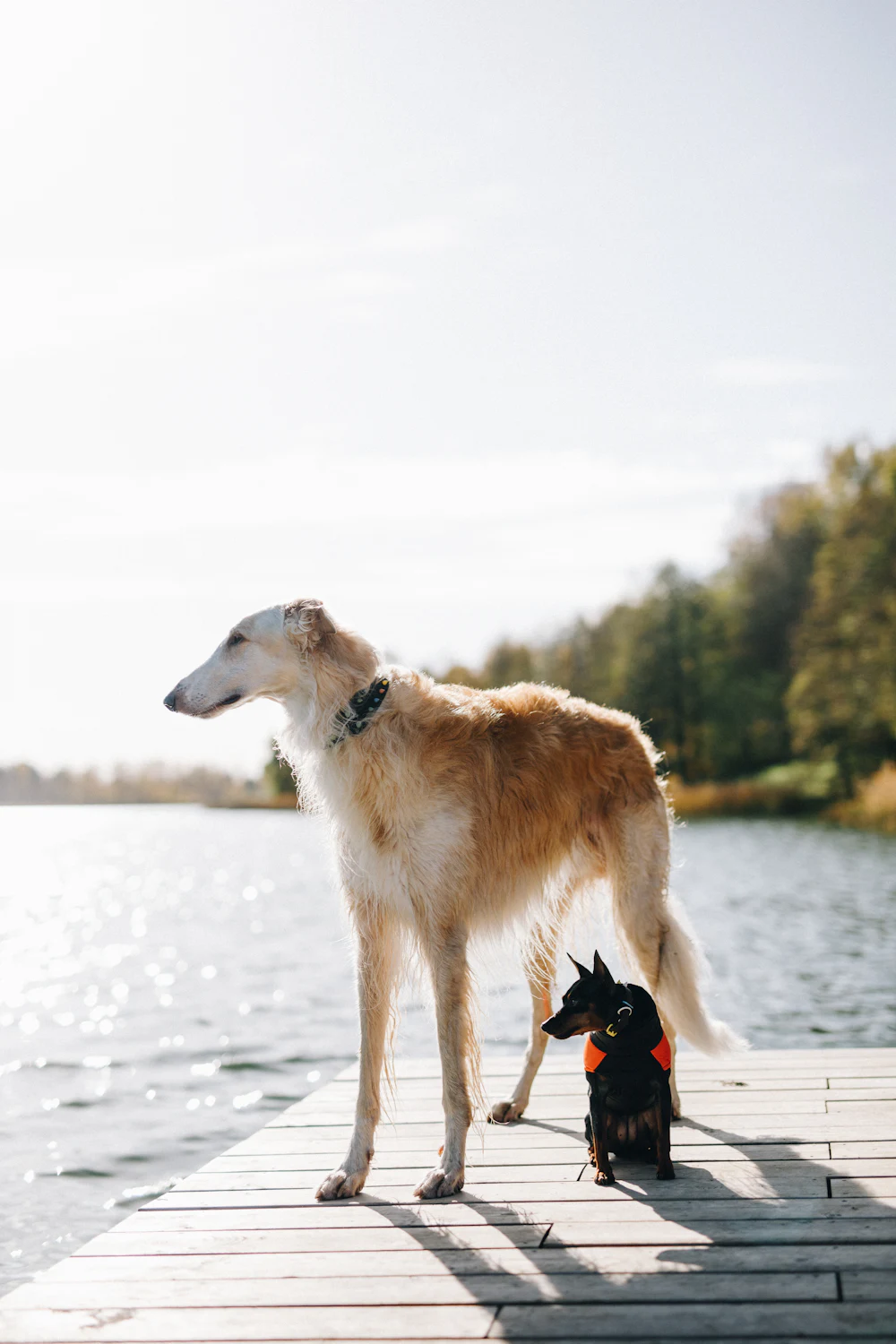
According to the FCI standard, males stand 75 to 85 cm at the withers and females 68 to 78 cm. Weight is not specified, but most adults are lean, long legged and quite heavy for their frame. Expect a long, narrow dog that needs a firm bed.
Sources
Photo: Pexels (Pexels License) · Photo: Pexels (Pexels License) · Photo: ROVER_JP, CC BY-SA 2.0, via Wikimedia Commons · Photo: Unsplash (Unsplash License) · Photo: Pexels (Pexels License)
General information for dog owners in Luxembourg, not veterinary or legal advice. Official facts (origin, size, group, history and temperament as described by the breed standard) follow the FCI standard; health and care sections reflect breed-club and veterinary guidance and are typical ranges rather than rules. For your own dog, ask your vet, the breed club or your commune. How this guide is written and checked. Last reviewed 8 October 2026.
Need someone for your Borzoi?
PAWLY offers an individual 45-minute walk or a home visit at your dog's pace, the same walker every time, and a written report with photos after every visit, across Luxembourg City.
Read next: the journal, for the Borzoi
All articles
Feeding, portions and how to tell if your dog is the right weight
Large dogs suffer more from extra weight; this is how to judge the right one.

Building a recall you can actually rely on
Sighthounds chase at speed and often cannot be recalled; the Borzoi needs a realistic plan.

Dog first aid: the six emergencies and what to do first
Bloat is an emergency in deep-chested breeds like the Borzoi; this covers what cannot wait.
Similar breeds
All 198 breeds
Afghan Hound
A mountain hunter dressed for the catwalk, dignified and aloof indoors, astonishingly fast the moment something moves on the horizon.
EnergyGroomingFlat life
Saluki
An ancient desert hunter of great speed and stamina, gentle and reserved at home, and utterly single-minded once it spots something running.
EnergyGroomingFlat life
Irish Wolfhound
The tallest of the sighthounds, a rough-coated giant that is gentle, quiet and courteous at home, and still fast when it chooses to run.
EnergyGroomingFlat life

