


History
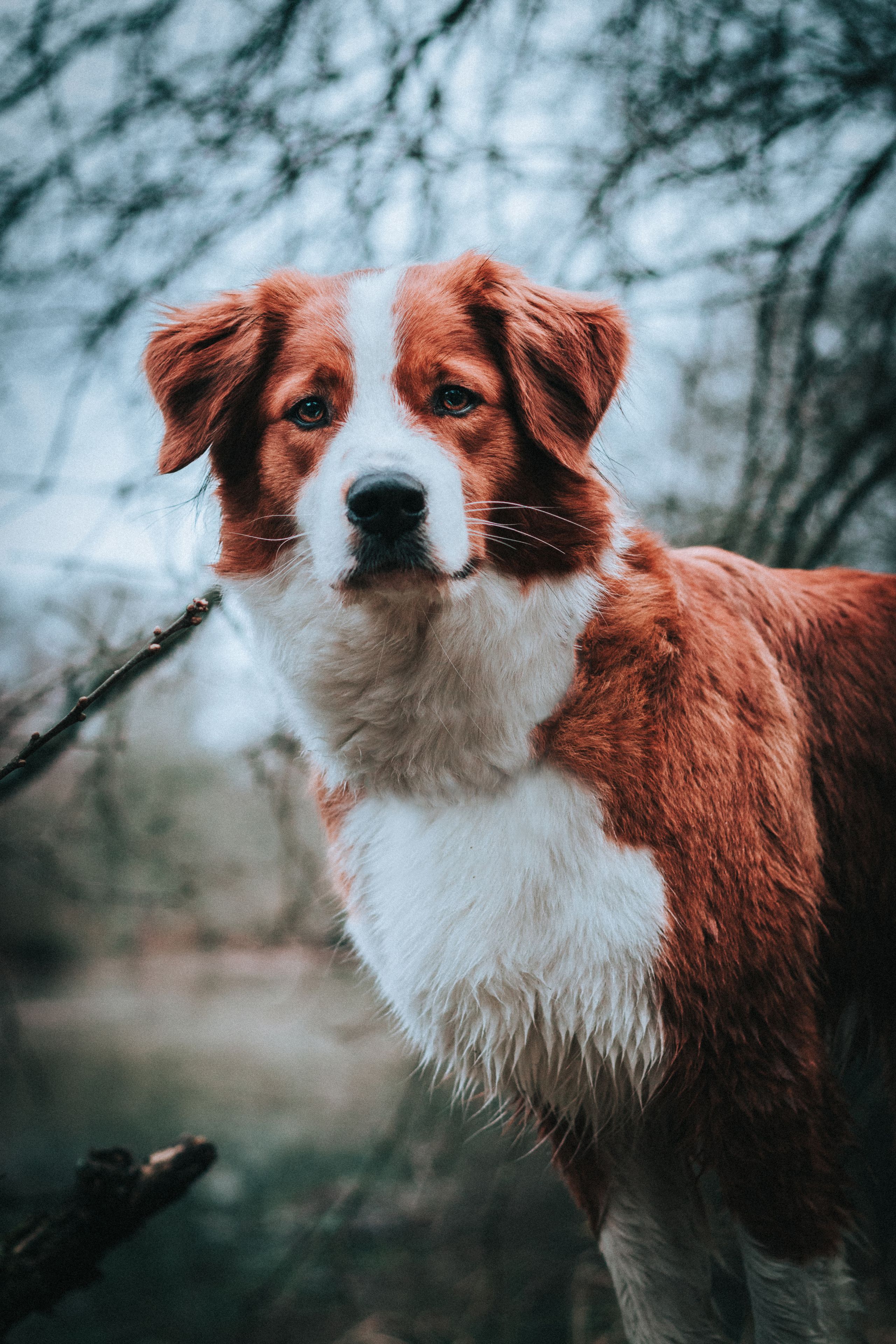
The Epagneul Breton, known in English as the Brittany, takes its name from the region of north-western France where it developed. The FCI standard calls it probably one of the oldest spaniel-type dogs, improved at the beginning of the 20th century through various outcrosses, and notes that it is numerically the leading French sporting breed. Its first standard was adopted on 7 June 1908 at Loudéac by a club devoted to the naturally short-tailed Brittany Spaniel.
Although called a spaniel in French, the Brittany works as a pointer. The FCI places it in Group 7 among the continental pointing dogs of spaniel type, with working trial, and describes its use as a pointing dog for all game on any terrain. A good Brittany is expected to search widely, hold a point steadily and retrieve, making it a versatile partner for hunters who want one dog for many tasks.
Temperament
The standard describes a dog that adapts to any environment, sociable, with an intelligent and attentive expression and a balanced mind. In practice that means a friendly, people-oriented dog with very little hardness, quick to learn and eager to be included. Most Brittanys greet strangers warmly and are rarely suited to guarding anything.
The other side is energy. This is a working gundog in a medium-sized body, and an under-exercised Brittany turns restless, vocal or destructive. They are sensitive to tone and can become anxious with rough handling. Many are soft and affectionate at home once their needs are met, curling up beside their owners after a proper run, but they are rarely content to watch life pass from the sofa all day.
Children and other pets
Brittanys are generally excellent with children, cheerful and tolerant, and their medium size is manageable for most families. Very young puppies can be mouthy and bouncy, so supervise with toddlers. They usually get on well with other dogs. Small pets are a different question: the breed is bred to find and point birds, and many will show strong interest in cats, rabbits and poultry. Early, careful introductions help, but do not assume a Brittany will ignore small animals.
Exercise and the daily walk
An adult Brittany needs at least an hour and a half to two hours of activity a day, with some of it at speed. Running in open, safe areas, retrieving games and scent work suit the breed best. A long, varied walk combined with a training session tires a Brittany more than a longer but monotonous route on the same pavements.
Recall can be good, but the hunting drive is strong, and a bird or the scent of game will test any training. Use a long line in unfenced countryside until you know your dog. Canicross, field trials and gundog training classes give the breed a purpose. As with all growing dogs, keep puppy exercise moderate and avoid repetitive jumping until the skeleton has matured.
Training
Brittanys are among the most trainable gundogs, responsive and keen to please, but they are soft. Reward-based methods, short sessions and plenty of variety get the best results. Harsh corrections tend to produce a worried dog that shuts down rather than a better-behaved one.
Priorities are recall, a stop whistle or cue, loose-lead walking and calm settling indoors. Teaching the dog to switch off is as important as teaching it to work. Because the breed points naturally, many owners enjoy simple pointing and retrieving exercises even without hunting. Socialise widely as a puppy with traffic, lifts and city noise, as a sensitive dog benefits from early, positive experiences.
Coat and grooming
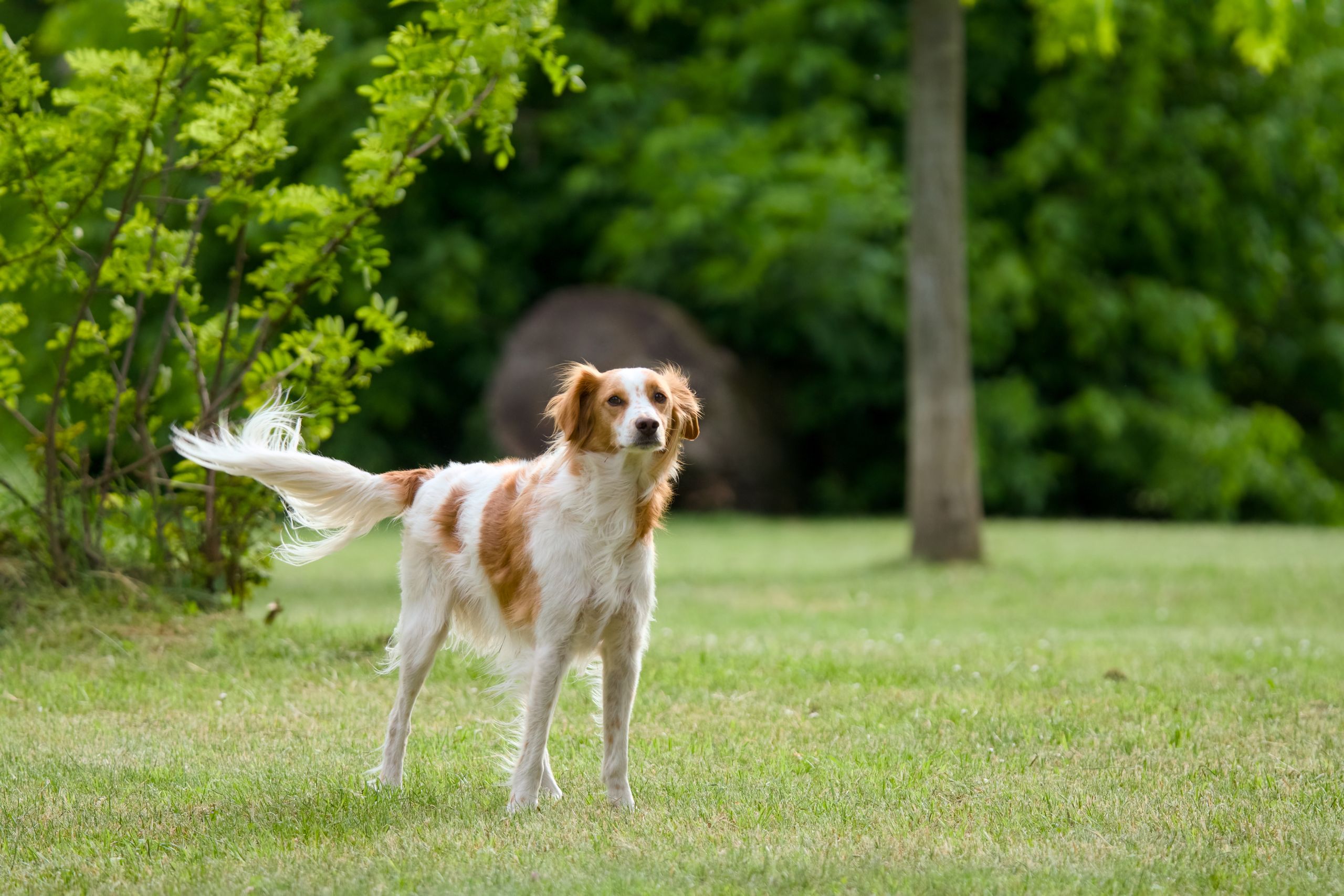
The FCI describes the coat as fine but not silky, lying flat or with a hint of wave, never curly, short on the head and front of the legs and with feathering on the hind limbs. A brush once or twice a week removes dead hair and burrs after countryside walks. Shedding is moderate. Check ears and paws after forest outings. Permitted colours are white and orange, white and black, and white and liver with irregular patches, also roan or tricolour with tan markings; self-coloured coats are not permitted.
Feeding and weight
Feed a complete diet matched to activity level, as needs vary considerably between a working dog in the hunting season and a city companion in winter. Split the daily ration into two meals. Monitor body condition by feeling for the ribs rather than relying on the packet guide. Use part of the ration for training rewards, which suits this food-motivated, eager breed.
Work out a starting calorie figure and food weight with the calorie calculator. Not sure this is the right breed? Take the quiz.
Health
Every breed carries predispositions. These are the conditions most often discussed for the Brittany, not a prediction for any individual dog.
- Hip dysplasia
- Epilepsy
- Hypothyroidism (underactive thyroid)
- Ear infections (otitis externa)
- Eye conditions such as cataract
What to ask the breeder. Ask for official hip scores for both parents and recent eye examinations, and ask whether there is any epilepsy in the line.
Choosing a puppy
Brittany puppies are bright, busy and fast learners, which is good news and bad news. Begin training from the first day, keeping sessions short and fun. Channel the instinct to carry objects into retrieving games rather than shoe theft. Short outings on varied ground, positive meetings with people and dogs, and calm exposure to trams and lifts build a confident adult. Teach the puppy to rest in a crate or pen so that it learns to switch off.
In Luxembourg the national kennel club is the Fédération Cynologique Luxembourgeoise (FCL), a member of the FCI. Many owners also buy from breeders in Germany, France or Belgium; a puppy coming from another EU country must be microchipped and vaccinated against rabies, which in practice means it cannot travel before about fifteen weeks of age. Where to get a dog in Luxembourg.
The older Brittany
Many Brittanys stay lively well into their teens. As they age, replace long runs with steady walks and sniffing games, keep them lean to protect joints, and watch for changes in hearing and eyesight. Mental work matters as much as ever. Regular vet checks catch thyroid and joint problems early. A warm coat in winter may help an older, thinner dog.
A realistic day
A realistic weekday for a working household in Luxembourg City, with a midday visit. Adjust it to your dog, not the other way round.
A brisk 45-minute walk with a short retrieving game, followed by breakfast.
Owner leaves; the dog rests in a quiet room with a chew.
Midday visit: an hour out, mixing a fast walk, sniffing and a few training exercises.
Evening run or long-line session in a park or forest edge; dinner after cooling down.
Short calm walk around the block, then sleep.
A Brittany in Luxembourg
Luxembourg City is good country for a Brittany. The Grünewald and Bambësch forests offer long, varied walks, and the Pétrusse valley gives quicker access from the centre. Wildlife is abundant, so a long line is wise until recall is proven. Free buses and trams make it easy to reach green space at weekends. Summer heat in the 30s °C means moving activity to early morning and evening and carrying water.
A flat works if the exercise is truly provided every day; a bored Brittany may bark, which neighbours will notice. A medium-sized dog is easy to manage in a lift. Meet the standard obligations: microchip, declaration to the commune, third-party liability insurance and the annual dog tax. For gundog training, the Fédération Cynologique Luxembourgeoise can point you towards affiliated clubs.
Every dog in Luxembourg must be identified, declared to the commune and covered by liability insurance. How registration works.
When you travel
A sitter needs to provide real exercise twice a day, not just a toilet break, and should keep the dog on a lead or long line in open areas unless recall has been demonstrated. Leave a list of cues and favourite games. Ask the sitter to check ears and paws after walks and to watch for restlessness, which usually means the dog needs more activity or more company.
PAWLY's holiday and overnight care takes place in your home, so your dog keeps its own bed and routine.
Myths and facts
MythThe Brittany is a spaniel, so it flushes game like a springer.
FactDespite the French name, the FCI classifies it as a pointing dog. It searches, holds a point and retrieves.
MythA medium-sized dog needs only medium exercise.
FactThe Brittany has a working gundog's stamina and needs substantial daily activity.
MythAll Brittanys are born without tails.
FactMany are born with naturally short tails or tailless, but not all, as the FCI standard explains.
Is it the right dog for you?
Suits
- Active owners who run, hike or hunt
- Families with older children and time for walks
- People wanting a trainable, affectionate gundog
- Owners interested in dog sports
Think twice if
- You have cats, rabbits or poultry at home
- Your days leave little time for exercise
- You want a calm dog that is happy with short walks
- You prefer firm, correction-based training
Questions owners ask
Is a Brittany a good first dog?
Often yes, for an active first-time owner. The breed is friendly, keen to learn and medium-sized. The challenge is energy rather than temperament, so be honest about how much exercise you can provide every day, including in bad weather.
Can a Brittany be off lead in the forest?
Some can, after careful recall training, but the hunting drive is strong and the Luxembourg forests hold plenty of deer and birds. Use a long line until the dog returns reliably even when game is present, and keep it on lead near roads.
Does a Brittany shed a lot?
Shedding is moderate. A weekly brush keeps loose hair under control and removes burrs and seeds after countryside walks. The coat is relatively easy compared with setters or long-coated spaniels.
Can a Brittany be left alone during the working day?
Not for a full day without a break. A Brittany left alone too long tends to become restless or noisy. A midday walk or visit makes a large difference to its behaviour and wellbeing.
Sources
Photo: Pexels (Pexels License) · Photo: Pexels (Pexels License) · Photo: Unsplash (Unsplash License) · Photo: Pexels (Pexels License) · Photo: Pexels (Pexels License)
General information for dog owners in Luxembourg, not veterinary or legal advice. Official facts (origin, size, group, history and temperament as described by the breed standard) follow the FCI standard; health and care sections reflect breed-club and veterinary guidance and are typical ranges rather than rules. For your own dog, ask your vet, the breed club or your commune. How this guide is written and checked. Last reviewed 8 October 2026.
Need someone for your Brittany?
PAWLY offers an individual 45-minute walk or a home visit at your dog's pace, the same walker every time, and a written report with photos after every visit, across Luxembourg City.
Read next: the journal, for the Brittany
All articles
Working breeds in a city flat: the honest version
High-drive dogs like the Brittany can live in a flat, but it takes a plan.

Ears: the three signs that mean an appointment
Ear trouble is common in the Brittany; these are the three signs that mean an appointment.

Building a recall you can actually rely on
Scent and movement can cancel a recall; this is the method for the Brittany.
Similar breeds
All 198 breeds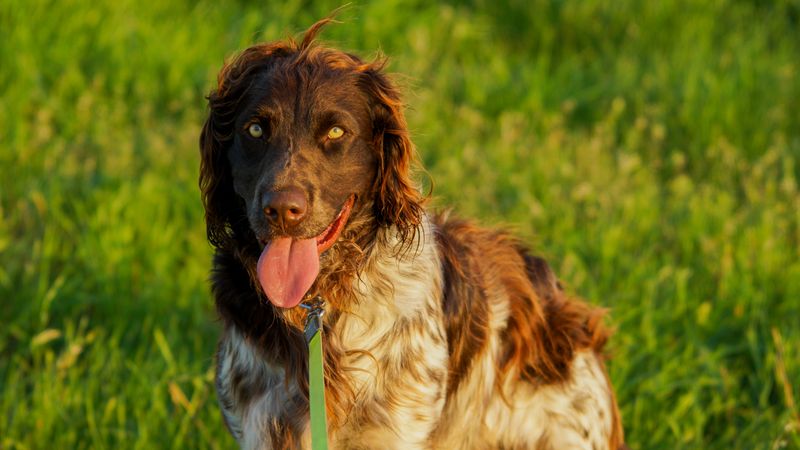
Small Münsterländer
A brown-and-white German gundog with a spaniel's charm and a pointer's focus, happiest when its nose and brain are both employed.
EnergyGroomingFlat life
Welsh Springer Spaniel
The red-and-white spaniel of Wales: a tireless, affectionate worker that is often overlooked and never dull.
EnergyGroomingFlat life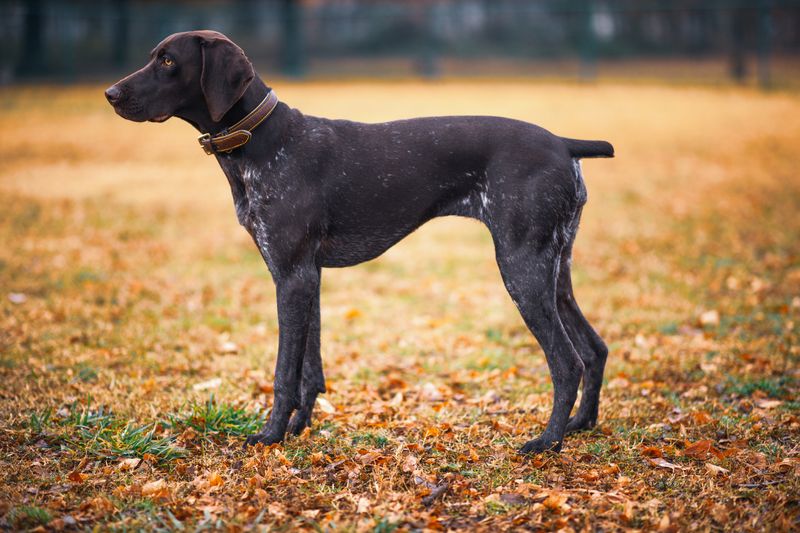
German Shorthaired Pointer
A versatile German hunting dog built for strength, endurance and speed, affectionate on the sofa and tireless outdoors when given a job.
EnergyGroomingFlat life

