History
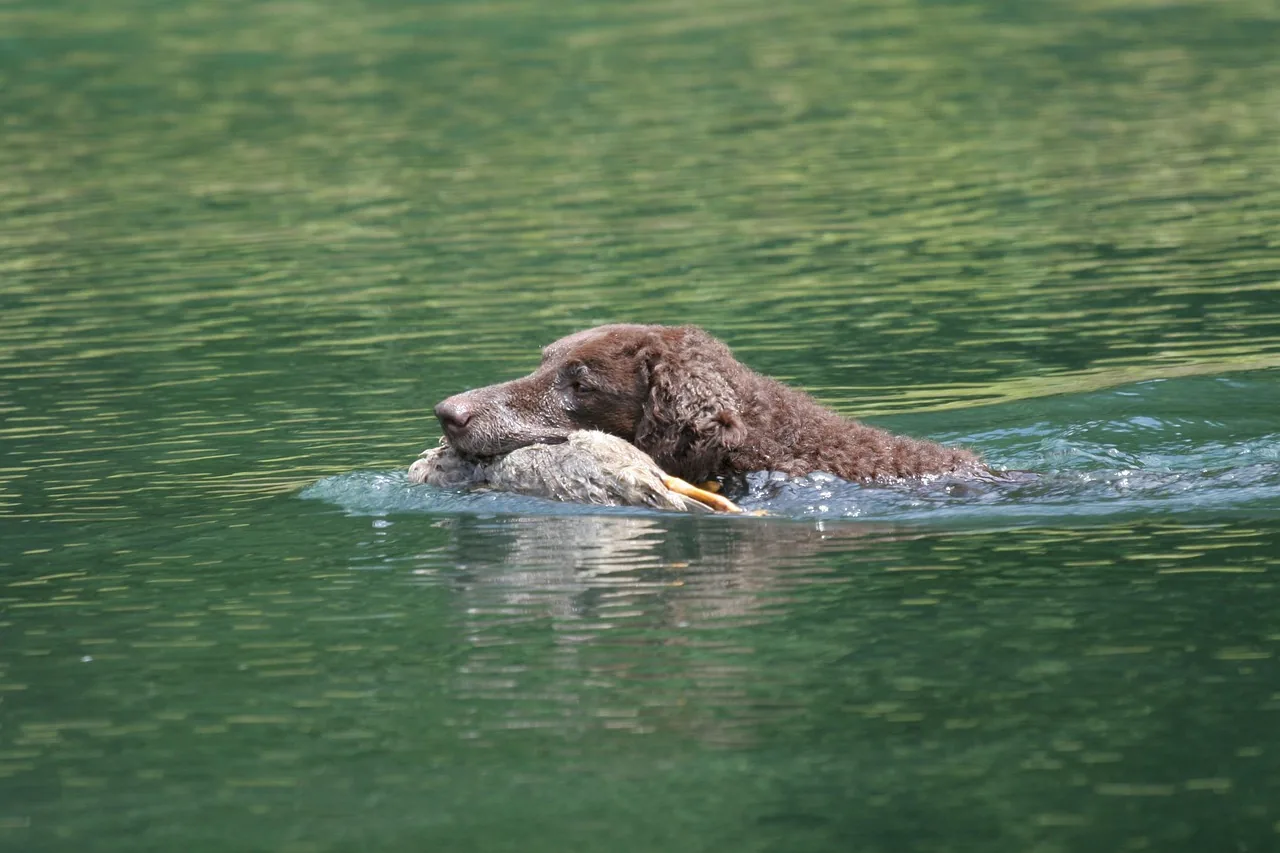
The Curly-Coated Retriever is generally regarded as one of the oldest of the British retrieving breeds. It developed in England as a wildfowler's and gamekeeper's dog, valued for retrieving from cold water and thick cover, and its ancestry is usually said to include old English water dogs and the St John's water dog brought from Newfoundland. Gamekeepers and wildfowlers prized it as a hardy dog that would work all day in rough, cold conditions. Like much early gundog history, the details are not recorded with certainty.
Its tight curls are not a fashion but a working feature: they shed water and protect the skin from brambles and reeds. The FCI places the breed in Group 8, Section 1 with the other retrievers, under a standard published in 2009 with Great Britain as the country of origin. Popularity later passed to the Labrador and Golden Retriever, and today the Curly is an uncommon breed kept by a dedicated following of hunters and enthusiasts.
Temperament
The FCI standard describes the breed as intelligent, steady and reliable, bold, friendly, self-confident and independent, and adds that it may seem aloof. That last phrase is the key difference from a Labrador. A Curly is affectionate with its own people but often polite rather than gushing with strangers, and it tends to think for itself before acting.
In the house most adults are calm and settled, especially once exercised, and they are usually quiet dogs. They mature slowly, however, and a young Curly can be boisterous, mouthy and inventive for two or three years. Many make watchful, sensible companions who will notice an unusual visitor without being guard dogs. Owners who enjoy a dog with its own opinions often find them deeply rewarding.
Children and other pets
With children the breed is generally tolerant and kind, though an adolescent Curly is large and bouncy enough to knock over a toddler, so supervision and calm manners matter. Older children who will join in walks, swimming and retrieve games often form a strong bond with one. Most live well with other dogs when raised together, and many accept a family cat. Birds and small animals outdoors will interest them, since this is a hunting breed.
Exercise and the daily walk
A working retriever needs real exercise: around one and a half to two hours a day for a healthy adult, including time off the lead in a safe place, swimming where allowed, and retrieve games that use the nose and brain. Long walks in the Grünewald or Bambësch forest suit the breed well, and a Curly will happily go out in rain that sends other dogs home.
Without enough work, a bored Curly will find its own projects, often involving the bins, the garden or the sofa cushions. Structured activities such as gundog training, scent work or dummy retrieving give it a job. Young dogs should not be over-exercised on hard surfaces while their joints are developing, and, like other deep-chested breeds, it is wise not to exercise hard just before or after a large meal.
Training
Curlies are clever and learn quickly, but they bore easily with repetition and are more independent than the popular retrievers. Short, varied sessions with food and play rewards work best, and asking for the same retrieve ten times in a row is a good way to lose the dog's interest. Consistency and patience pay off, as this breed is a slow maturer.
A reliable recall is essential before allowing off-lead freedom near water, roads or wildlife. Gundog-style training, even for a family pet, channels the breed's instincts in a useful way. Early socialisation helps prevent the natural reserve with strangers from turning into suspicion, and teaching a calm 'settle' indoors is worth as much as any trick.
Coat and grooming
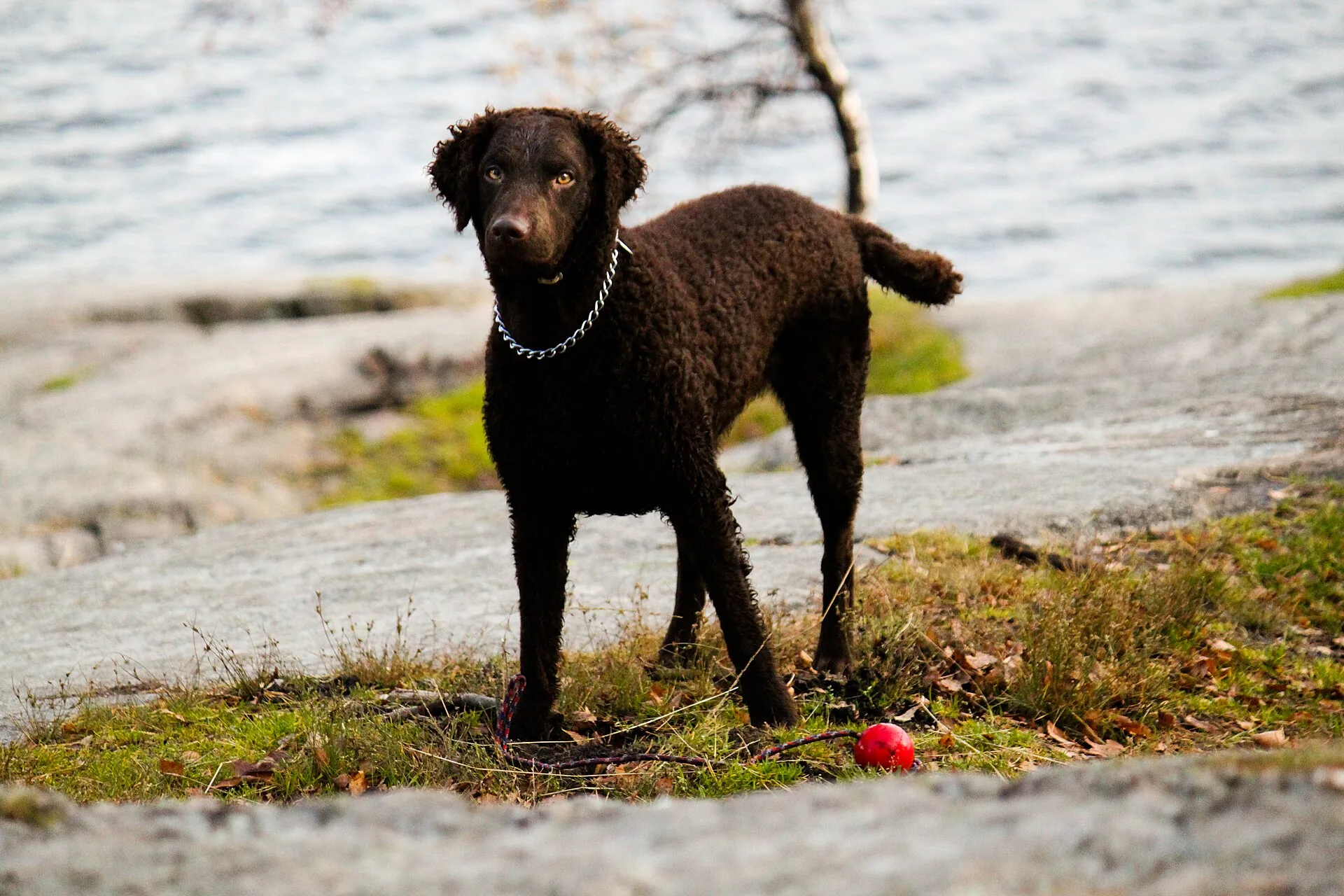
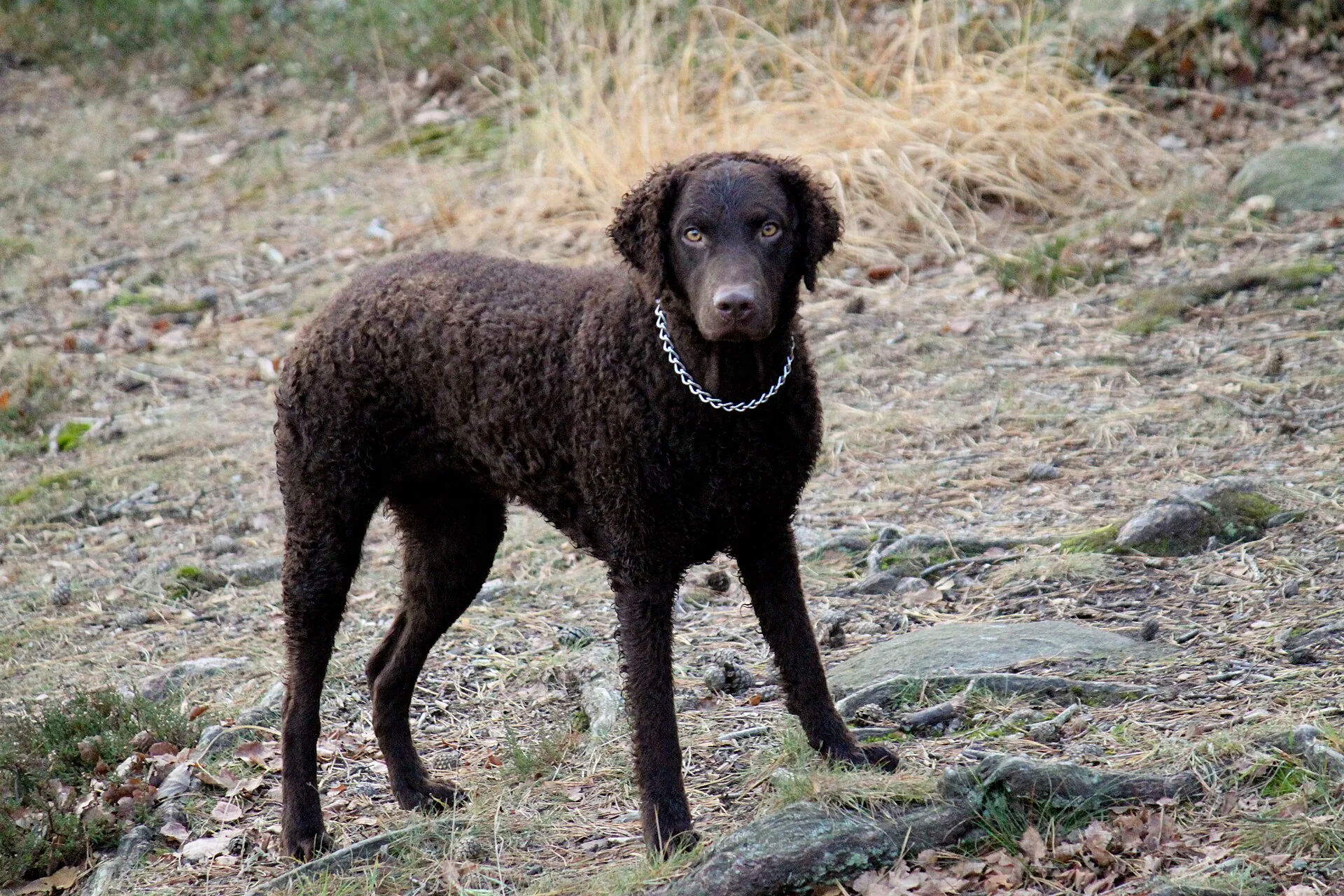
According to the FCI standard, the body coat is a thick mass of small, tight, crisp curls lying close to the skin from the back of the head to the tip of the tail, without undercoat or bare patches, while the hair elsewhere is smooth. Brushing breaks up the curls and causes frizz, so care is mostly a damp hand or a wipe after walks, occasional bathing and trimming of any stray hair. The coat sheds seasonally. Some lines show patchy hair loss. Permitted colours are black or liver.
Feeding and weight
An active Curly needs a good quality complete food suited to a large working breed, with the amount adjusted to the season and how much it actually works. Two meals a day are better than one large one for a deep-chested dog, and a rest before and after eating is sensible. Keep an eye on condition under the coat, as the curls can hide weight gain. Puppies should grow steadily rather than fast.
Work out a starting calorie figure and food weight with the calorie calculator. Not sure this is the right breed? Take the quiz.
Health
Every breed carries predispositions. These are the conditions most often discussed for the Curly-Coated Retriever, not a prediction for any individual dog.
- Hip and elbow dysplasia
- Glycogen storage disease type IIIa (GSD IIIa), for which a DNA test exists
- Exercise-induced collapse (EIC), for which a DNA test exists
- Follicular dysplasia (patchy coat loss)
- Inherited eye disease, including progressive retinal atrophy
- Gastric dilatation-volvulus (bloat)
What to ask the breeder. Ask to see hip and elbow scores for both parents, a current eye examination, and DNA results for GSD IIIa and exercise-induced collapse.
Choosing a puppy
Curly puppies are bold, busy and chewy, and they stay puppyish for a long time. Expect two or three years before the adult dog fully settles. Start with gentle exposure to traffic, trams, lifts and visitors, as well as plenty of calm handling. Keep exercise moderate and avoid repetitive jumping or long runs on pavements while joints are growing. The adult coat develops over the first year or so, and puppy curls may look loose at first.
In Luxembourg the national kennel club is the Fédération Cynologique Luxembourgeoise (FCL), a member of the FCI. Many owners also buy from breeders in Germany, France or Belgium; a puppy coming from another EU country must be microchipped and vaccinated against rabies, which in practice means it cannot travel before about fifteen weeks of age. Where to get a dog in Luxembourg.
The older Curly-Coated Retriever
Older Curlies usually keep their love of water and retrieving, but walks should become steadier and shorter, with more sniffing and less sprinting. Watch for stiffness after exercise, weight gain and lumps, and keep up regular veterinary checks. Swimming in safe, calm water can be kind exercise for ageing joints. A warm, dry bed matters more as the years go on.
A realistic day
A realistic weekday for a working household in Luxembourg City, with a midday visit. Adjust it to your dog, not the other way round.
Garden or street toilet break, then a calm breakfast followed by a rest.
A brisk 45-minute walk through Bambësch forest with retrieve games off the lead in a safe area.
Midday visit: a 30-minute walk with some scent work or dummy retrieves, then fresh water and a chew.
Longer evening outing, a short training session, then a towel-down and dinner after a rest.
Quiet last walk around the block and lights out.
A Curly-Coated Retriever in Luxembourg
A Curly can live in a flat, but it is a large, active dog, and it is far easier with a ground-floor home or a garden and an owner who enjoys long outdoor walks. Muddy forest paths in the Grünewald and Bambësch are its natural element. The coat copes very well with Luxembourg's grey, wet months and dries faster than a feathered gundog's.
Summer is the harder season: a black or liver coat absorbs heat, so walks belong in the early morning and evening, with water always to hand. Where swimming is permitted it is an excellent way to burn energy in warm weather. In town, neighbours are rarely troubled by noise, as Curlies are seldom barkers. Standard Luxembourg rules apply: microchip, commune declaration, liability insurance and annual dog tax.
Every dog in Luxembourg must be identified, declared to the commune and covered by liability insurance. How registration works.
When you travel
A sitter needs to provide real exercise, not just garden breaks, or the dog will become restless. Explain the recall cues, any places where the dog must stay on lead, and the rule about resting around meals. The coat should be wiped rather than brushed after walks. A Curly may be reserved with a new person at first, so an introductory meeting before the owner leaves is helpful.
PAWLY's holiday and overnight care takes place in your home, so your dog keeps its own bed and routine.
Myths and facts
MythA Curly is just a Labrador with curls.
FactIt is more independent, often more reserved with strangers and slower to mature than a Labrador.
MythThe coat needs lots of brushing.
FactBrushing actually ruins the curls. Most care involves wetting, wiping and occasional trimming.
MythRetrievers are always easy first dogs.
FactThe Curly can be a great first dog for an active, patient owner, but it is not a simple choice for a sedentary home.
Is it the right dog for you?
Suits
- Active owners who walk in all weathers
- People interested in gundog or scent work
- Households with older children
- Homes with a garden or easy access to forest
Think twice if
- You want a dog that loves every stranger
- You live in a small upper-floor flat with little time
- You need a calm adult dog within a year
- Your days leave little time for long walks
Questions owners ask
Does the Curly-Coated Retriever shed?
Yes, it sheds, mostly seasonally, although less visibly than many double-coated breeds because it has no undercoat. Loose hair is easiest to remove with a damp hand or rubber glove. It is not a hypoallergenic breed, despite the curls.
How is it different from a Flat-Coated Retriever?
Both are British retrievers of similar origin, but the Curly is taller, has tight curls instead of a flat feathered coat, and is usually more independent and reserved. Flat-coats tend to be more outgoing with everyone they meet.
Can a Curly live in a Luxembourg City flat?
It is possible with an owner who commits to long daily walks and weekend outings, plus a midday visit on working days. A large, young Curly confined to a small flat without enough exercise will be frustrated. Ground-floor homes with a garden are easier.
Is the breed good with other dogs?
Most Curlies are sociable with dogs they know and polite with strangers, especially when well socialised as puppies. Some adult males can be less tolerant of other entire males. Early, positive meetings in parks help a great deal.
Sources
Photo: Mattias Agar, CC BY-SA 2.0, via Wikimedia Commons · Photo: Mattias Agar, CC BY-SA 2.0, via Wikimedia Commons · Photo: Mattias Agar, CC BY-SA 2.0, via Wikimedia Commons · Photo: Mattias Agar, CC BY-SA 2.0, via Wikimedia Commons · Photo: Pixabay (Pixabay Content License)
General information for dog owners in Luxembourg, not veterinary or legal advice. Official facts (origin, size, group, history and temperament as described by the breed standard) follow the FCI standard; health and care sections reflect breed-club and veterinary guidance and are typical ranges rather than rules. For your own dog, ask your vet, the breed club or your commune. How this guide is written and checked. Last reviewed 8 October 2026.
Need someone for your Curly-Coated Retriever?
PAWLY offers an individual 45-minute walk or a home visit at your dog's pace, the same walker every time, and a written report with photos after every visit, across Luxembourg City.
Read next: the journal, for the Curly-Coated Retriever
All articles
Feeding, portions and how to tell if your dog is the right weight
Large dogs suffer more from extra weight; this is how to judge the right one.

Dog first aid: the six emergencies and what to do first
Bloat is an emergency in deep-chested breeds like the Curly-Coated Retriever; this covers what cannot wait.

What actually tires a dog indoors
Walks alone rarely tire a busy breed like the Curly-Coated Retriever; this covers what works indoors.
Similar breeds
All 198 breeds
Flat-Coated Retriever
A black or liver gundog with a permanently wagging tail, an adolescence that lasts for years and a talent for carrying things.
EnergyGroomingFlat life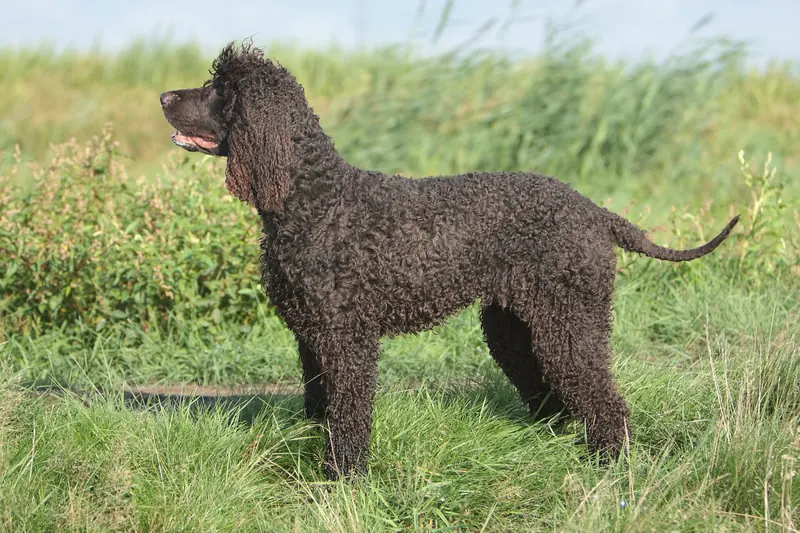
Irish Water Spaniel
The tallest of the spaniels: a curly, liver-coloured water dog with a rat tail, a clown's humour and a reserved heart.
EnergyGroomingFlat life
Labrador Retriever
The most popular family dog in Europe for good reasons, and with one well-known weakness: food.
EnergyGroomingFlat life

