
History
For the FCI, the Keeshond is not a separate breed but the largest variety of the German Spitz, listed under standard No. 97 as the Wolfspitz or Keeshond. Germany is the country of origin. The standard describes the German Spitz family as descendants of the Stone Age peat dog and the later lake-dwelling Spitz, and calls it the oldest breed of dog in Central Europe. The same standard covers the Giant, Medium, Miniature and Toy Spitz, the last of these better known as the Pomeranian.
The Wolfspitz variety is always grey-shaded. Its other name, Keeshond, is Dutch, and the grey Spitz has long been associated with the Netherlands, where it was a familiar dog on farms and river barges. Today it is kept almost entirely as a companion and watchdog, which is the utilisation the FCI standard gives: watch and companion dog. The breed sits in Group 5, Section 4, European Spitz. The current standard is dated 3 September 2024.
Temperament
The standard describes the Wolfspitz or Keeshond as always attentive, lively and extraordinarily attached to its owner, very teachable and easy to train. It adds two traits that shape daily life: a natural distrust of strangers and a lack of hunting instinct. Together these make an excellent watchdog that stays close to home and rarely wanders off after game. Most Keeshonden are cheerful, sociable dogs within the family, quick to read moods and keen to be involved.
The flip side is voice. A Keeshond takes guard duty seriously and will announce visitors, delivery drivers and footsteps on the landing. With early training and enough company it learns to give a few barks and stop, but it is not a silent breed. It also dislikes being shut out of family life. Left alone for long days, many become vocal or restless, and the breed generally does best where someone is home for part of the day or a walker breaks up the hours.
Children and other pets
Keeshonden are known for being patient, playful and affectionate with children, and their sturdy medium size makes them more robust than smaller Spitz. They should still be supervised with toddlers, who tend to grab the tempting ruff. Because the breed has little hunting instinct, it usually lives peacefully with cats and other pets, especially when raised with them. Most are friendly with other dogs, though a reserved first greeting with strange dogs and people is normal.
Exercise and the daily walk
A Keeshond is not a marathon dog, but it is active and enjoys a good walk. Around an hour a day split between two or three outings suits most adults, plus some play or training. The breed likes routine and variety in equal measure: a regular morning loop and a more interesting evening walk through the woods or along a river.
Because the breed has little interest in chasing game, many Keeshonden can be trusted off lead in safe areas once recall is solid, which makes walks relaxing. Mental work matters as much as distance. Scent games, trick training, agility or simply learning new words keep this quick mind occupied. The heavy coat is excellent in cold and rain but a burden in heat, so summer exercise must be kept to the coolest hours.
Training
The standard calls the breed very teachable and easy to train, and most owners agree. Keeshonden learn quickly with food rewards, play and praise, and they enjoy working with their people. Harsh corrections backfire with this sensitive dog. Keep sessions short and upbeat, and finish while the dog still wants more.
Barking needs a plan from the first week. Reward quiet, teach a cue for settling after the dog has alerted, and avoid shouting, which sounds like joining in. Socialise widely so that natural reserve with strangers does not harden into suspicion. Teach the puppy to be calm while alone in short, gradually lengthening periods, since this breed is prone to missing its people.
Coat and grooming
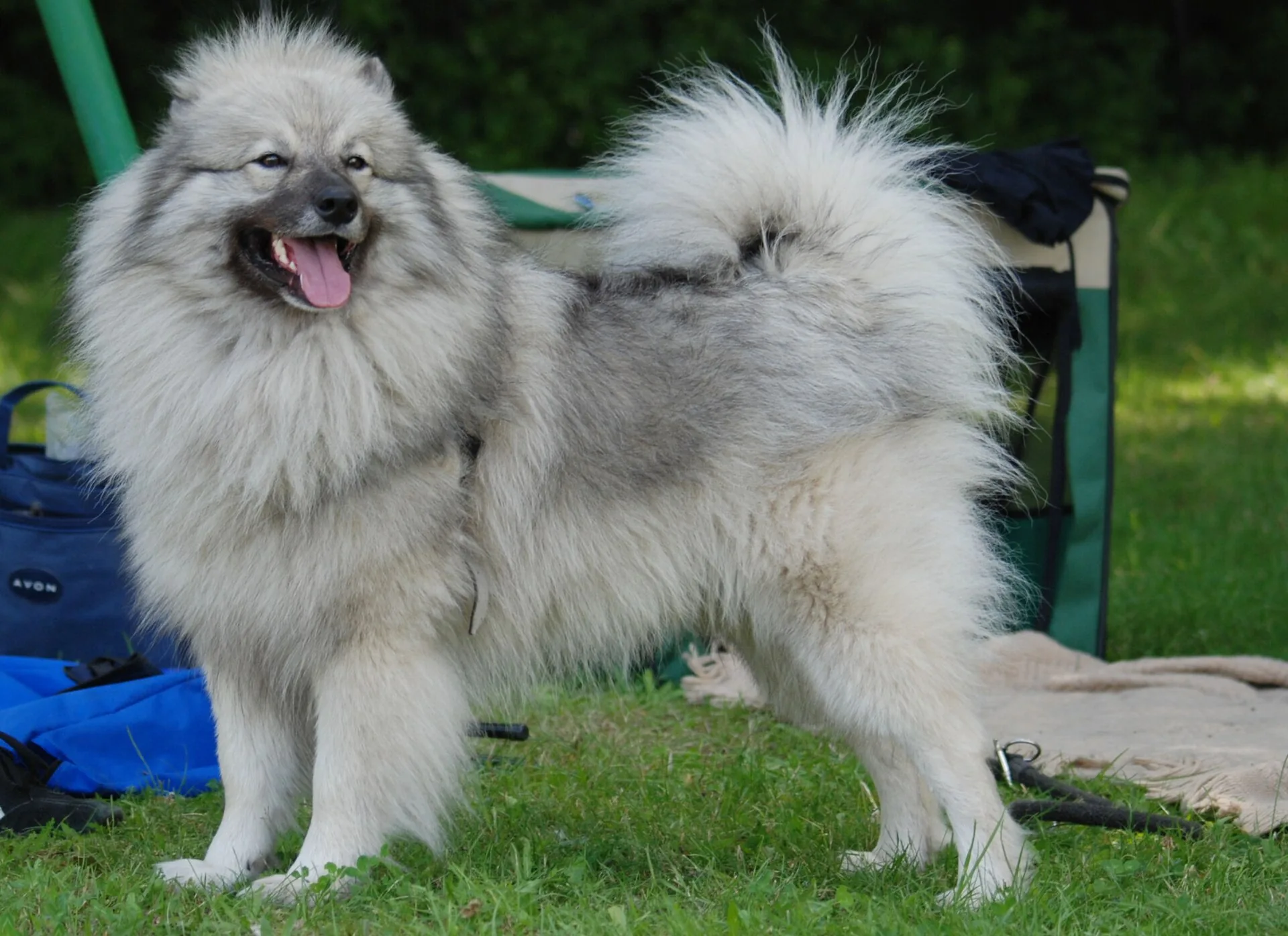
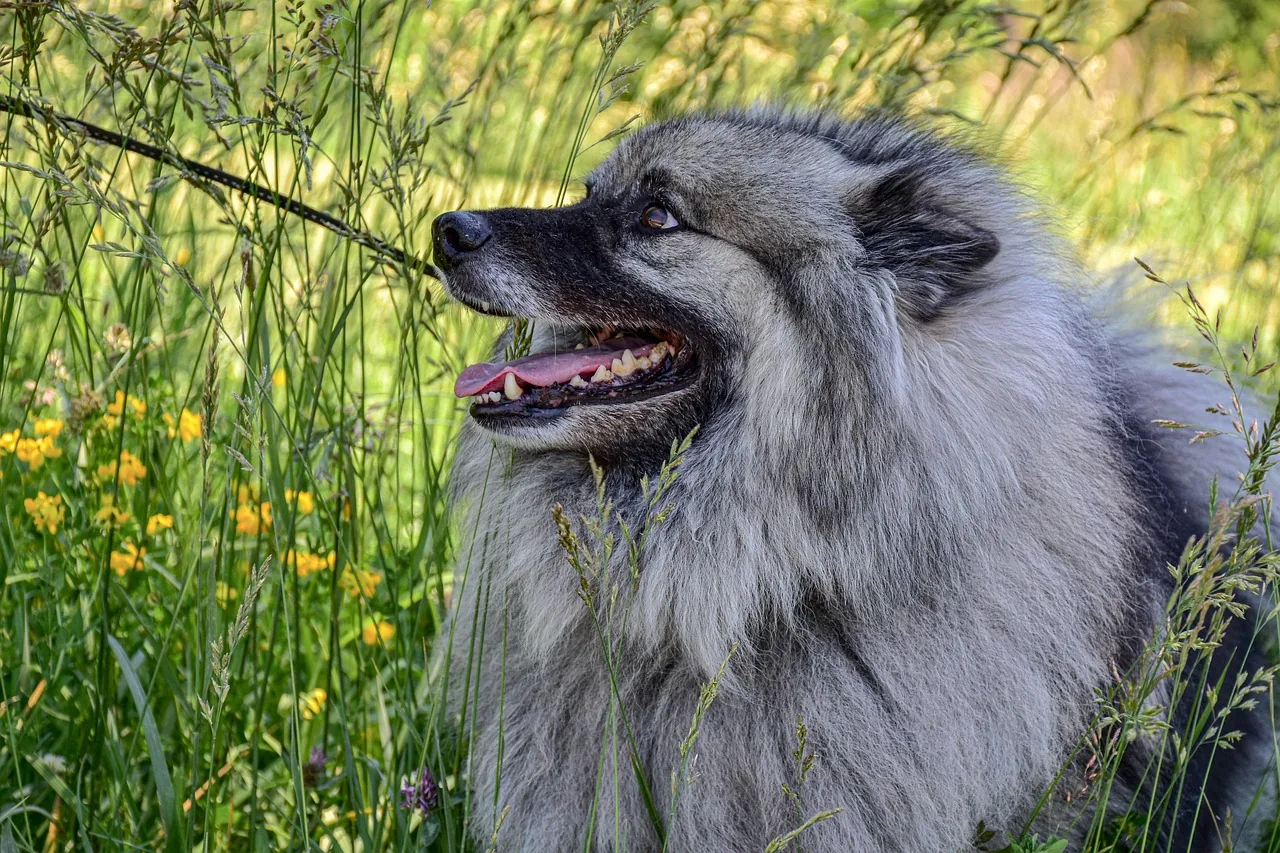
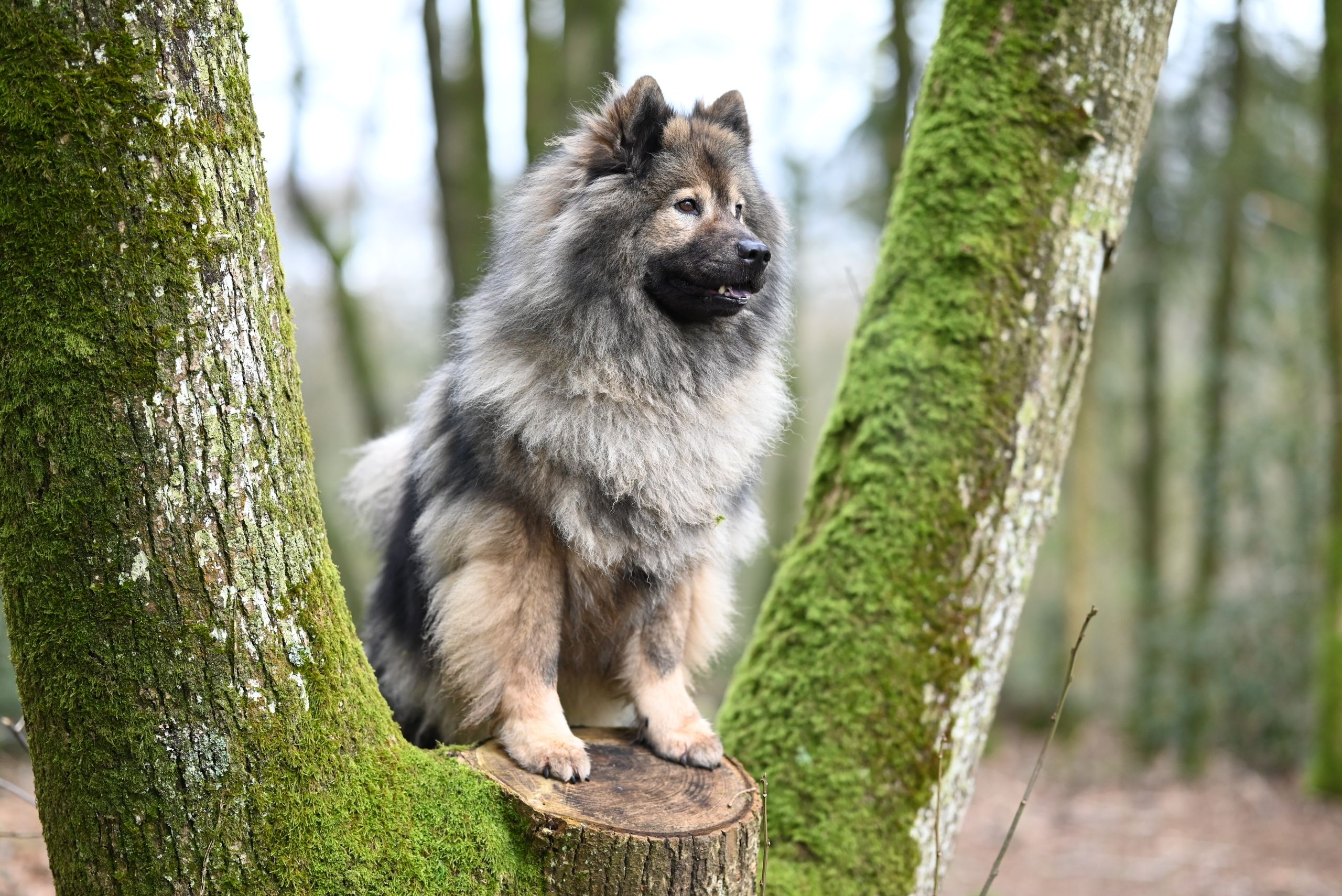
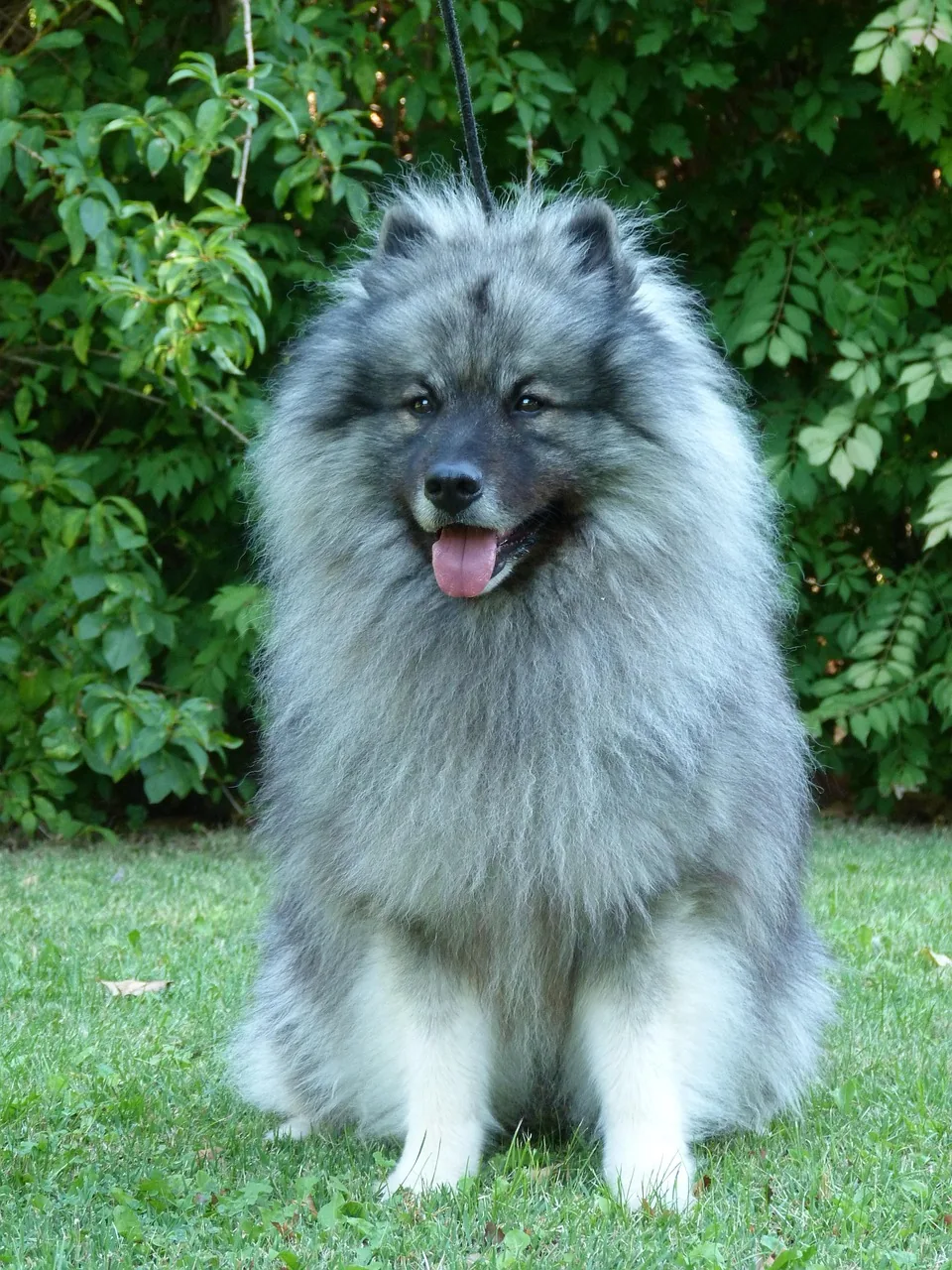
The Keeshond wears a double coat: a long, straight, stand-off outer coat over a short, thick, cotton-wool-like undercoat, with a big mane, feathered legs and a bushy tail. The FCI standard allows one colour, grey-shaded: silver-grey with black hair tips, dark muzzle and ears, and the characteristic spectacles, a fine dark line from the outer corner of each eye towards the ear. Brush to the skin two or three times a week with a pin brush and comb. The breed moults heavily, typically once or twice a year, and should never be shaved.
Feeding and weight
Most Keeshonden do well on a complete, good-quality diet in two measured meals. The breed enjoys its food and gains weight easily, and the thick coat hides extra kilos, so check ribs and waist by hand every few weeks. Training treats should come out of the daily allowance. Avoid heavy exercise just after meals, keep fresh water available and adjust portions down for older or less active dogs.
Work out a starting calorie figure and food weight with the calorie calculator. Not sure this is the right breed? Take the quiz.
Health
Every breed carries predispositions. These are the conditions most often discussed for the Keeshond, not a prediction for any individual dog.
- Primary hyperparathyroidism (a DNA test is available)
- Hip dysplasia
- Patellar luxation (slipping kneecaps)
- Hypothyroidism (underactive thyroid)
- Epilepsy
What to ask the breeder. Ask for hip scores for both parents, a recent patella check, and the DNA result for primary hyperparathyroidism, and ask whether epilepsy has occurred in the close family.
Choosing a puppy
Keeshond puppies are bold, sociable little bears that learn fast. Start barking management, alone-time practice and grooming handling in the first weeks, since all three shape the adult dog. Keep exercise gentle and avoid stairs in bulk while joints grow; carry the puppy in and out of the building where possible. Meet plenty of calm strangers so the breed's natural reserve stays polite. Puppy classes are well worth it for this social, trainable dog.
In Luxembourg the national kennel club is the Fédération Cynologique Luxembourgeoise (FCL), a member of the FCI. Many owners also buy from breeders in Germany, France or Belgium; a puppy coming from another EU country must be microchipped and vaccinated against rabies, which in practice means it cannot travel before about fifteen weeks of age. Where to get a dog in Luxembourg.
The older Keeshond
Keeshonden often stay playful into old age. Expect walks to slow and the dog to sleep more. Watch for weight gain, which the coat hides, and for stiffness after rest. Older dogs feel heat even more, so summer care becomes stricter. Regular blood tests at senior check-ups can pick up thyroid or calcium problems early. Keep brushing gentle but regular, since an older dog's coat mats more easily.
A realistic day
A realistic weekday for a working household in Luxembourg City, with a midday visit. Adjust it to your dog, not the other way round.
Morning walk of 25 to 30 minutes, with a pause at the park for a sniff and a few recall games.
Breakfast, then a stuffed chew toy while the household leaves; radio on low to soften building noise.
PAWLY midday visit: a relaxed 40-minute walk, fresh water and a few minutes of brushing.
Longer evening walk, perhaps through Parc Merl or along the Pétrusse, followed by dinner.
Short last outing, then a cool spot on the floor, which many Keeshonden prefer to a soft bed.
A Keeshond in Luxembourg
In a Luxembourg City flat a Keeshond is easy company, provided the barking is managed. Hallways, lifts and shared landings are full of sounds that this watchful breed will want to report, so teaching calm in the building early pays off with neighbours. The breed's size makes lifts and buses straightforward, and with free public transport a weekend walk in the Grünewald or the Bambësch is easy to reach. Every dog must be microchipped, declared to the commune, insured and registered for the annual dog tax.
The real Luxembourg test is summer. When temperatures reach the 30s °C, the heavy coat makes midday walks risky. Walk at dawn and after sunset, choose shaded routes such as the Pétrusse valley, and offer cool floors and water at home. Grey November evenings, on the other hand, suit the breed perfectly: rain rolls off the outer coat, and a quick towel-down is usually enough.
Every dog in Luxembourg must be identified, declared to the commune and covered by liability insurance. How registration works.
When you travel
A sitter should know that a Keeshond bonds closely and may sulk or bark at first when its people leave. Keep the daily routine identical, including walk times and meal amounts. Brushing at least twice a week prevents mats behind the ears and in the trousers. In warm weather the sitter must walk early and late only. Give clear instructions about the door, since the dog will announce every visitor.
PAWLY's holiday and overnight care takes place in your home, so your dog keeps its own bed and routine.
Myths and facts
MythThe Keeshond is a Dutch breed.
FactThe name is Dutch and the breed is closely associated with the Netherlands, but the FCI lists it as the Wolfspitz variety of the German Spitz, with Germany as country of origin.
MythShaving keeps a Keeshond cool in summer.
FactThe double coat insulates against heat as well as cold. Shaving can damage regrowth. Shade, timing and water are what keep the dog cool.
MythA watchdog breed must be aggressive.
FactThe standard asks for distrust of strangers, not aggression. A good Keeshond alerts, then accepts welcome guests politely.
Is it the right dog for you?
Suits
- Families with children who want a sturdy, friendly companion
- Homes with cats, given the breed's low hunting drive
- Owners who enjoy training and regular brushing
- Households where someone is around for part of the day
Think twice if
- Think twice if neighbours are sensitive to barking
- Think twice if the dog would be alone all day
- Think twice if you dislike dog hair on clothes and furniture
- Think twice if your flat gets very hot in summer
Questions owners ask
Is the Keeshond the same as a German Spitz?
Yes, for the FCI. The Wolfspitz or Keeshond is the largest variety within the German Spitz standard, which also includes the Giant, Medium, Miniature and Toy Spitz. Some other kennel clubs list the Keeshond separately, but the FCI and the Luxembourg kennel club follow the single standard.
Do Keeshonden bark a lot?
They are natural watchdogs and will bark at visitors and noises. With early training, enough exercise and company, most learn to alert briefly and then settle. A Keeshond left alone for long hours, though, often becomes noisy, so plan for midday company.
How much grooming does the coat need?
A thorough brushing to the skin two or three times a week, more during the heavy moult. Pay attention behind the ears, under the legs and in the trousers, where mats form first. Bathing is only needed occasionally. Shaving is not advised.
Can a Keeshond live with a cat?
Usually very well. The FCI standard describes the breed as lacking hunting instinct, and most Keeshonden raised with cats treat them as household members. Introductions should still be calm and supervised, especially with an adult dog that has never lived with a cat.
Sources
Photo: Lilly M, CC BY-SA 3.0, via Wikimedia Commons · Photo: Pexels (Pexels License) · Photo: Pixabay (Pixabay Content License) · Photo: Pixabay (Pixabay Content License)
General information for dog owners in Luxembourg, not veterinary or legal advice. Official facts (origin, size, group, history and temperament as described by the breed standard) follow the FCI standard; health and care sections reflect breed-club and veterinary guidance and are typical ranges rather than rules. For your own dog, ask your vet, the breed club or your commune. How this guide is written and checked. Last reviewed 8 October 2026.
Need someone for your Keeshond?
PAWLY offers an individual 45-minute walk or a home visit at your dog's pace, the same walker every time, and a written report with photos after every visit, across Luxembourg City.
Read next: the journal, for the Keeshond
All articles
Dogs in hot weather: the Luxembourg summer guide
The Keeshond carries a heavy coat or a heavy frame, which makes a Luxembourg summer the hard season.

Building a recall you can actually rely on
Scent and movement can cancel a recall; this is the method for the Keeshond.

Grooming and coat care through the Luxembourg year
The Keeshond has a coat that needs a routine that holds through the Luxembourg seasons.
Similar breeds
All 198 breeds
German Spitz
One of Central Europe's oldest breeds, a fox-faced, ruff-necked house guard that announces every visitor with great sincerity.
EnergyGroomingFlat life
Eurasier
A calm, watchful family spitz that wants to be wherever its people are, and sulks quietly when it is not.
EnergyGroomingFlat life
Samoyed
The smiling white spitz of the Arctic: friendly, talkative and covered in fur.
EnergyGroomingFlat life

