

History
The Pharaoh Hound is the national dog of Malta, where it is called Kelb tal-Fenek, the rabbit dog, and it is still used to hunt rabbits at night. The FCI lists Malta as the country of origin, with patronage held by Great Britain, and describes the utilisation as an alert, keen hunter, hunting by scent and sight and using its ears to a marked degree when working close. That combination of senses is unusual in a dog of this build.
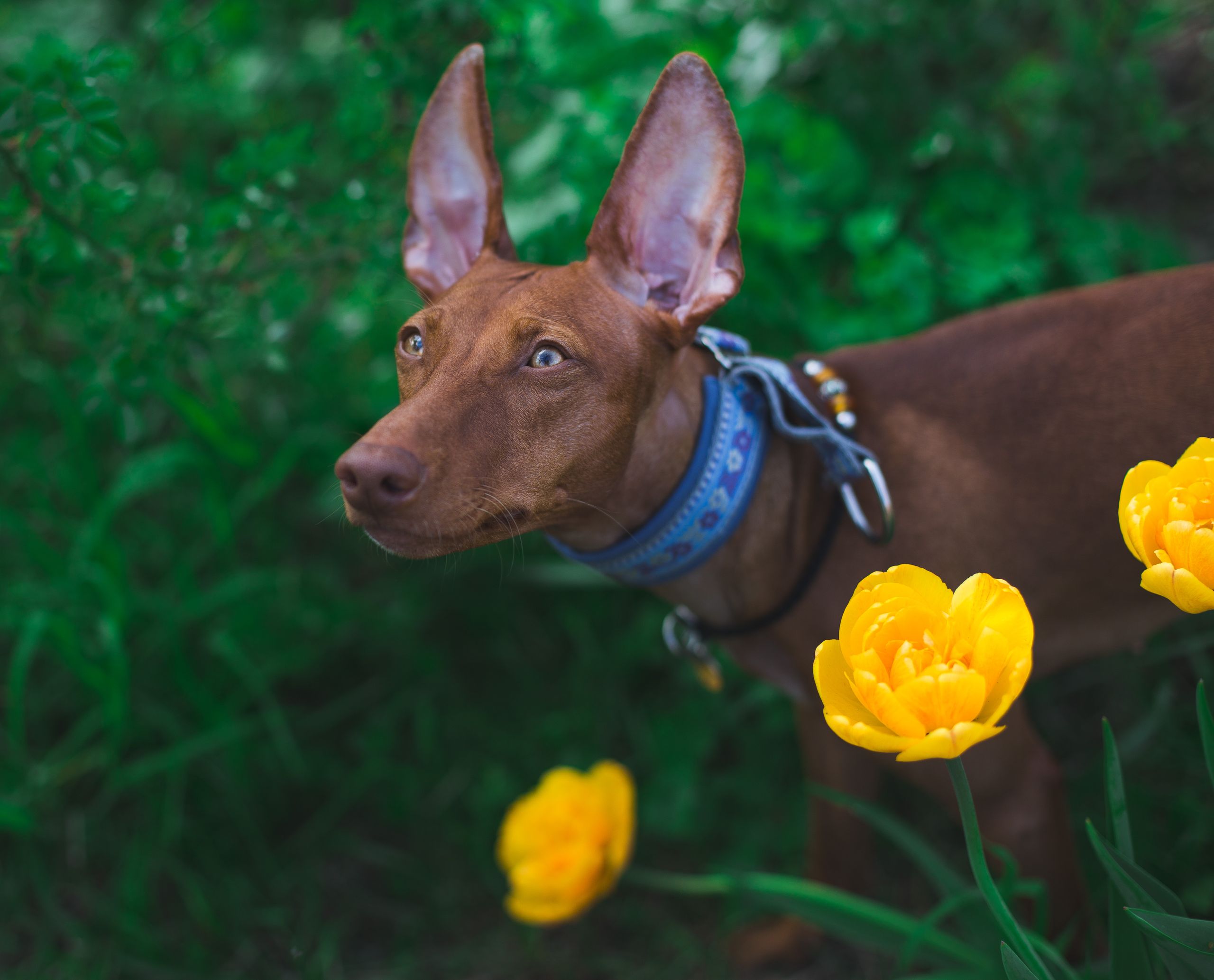
The name comes from a resemblance to dogs in ancient Egyptian art, but genetic studies have not shown that the breed descends from ancient Egyptian dogs, so the name is better read as romance than as pedigree. The breed was recognised in Britain in the twentieth century. The FCI places it in Group 5, Section 6, the primitive type, and the standard describes a medium-sized dog with noble bearing, refined lines, graceful but powerful, with exceptional speed and free movement.
Temperament
The standard describes the Pharaoh Hound as alert, intelligent, friendly, affectionate and playful. In practice it is also sensitive and a little mischievous, devoted to its own people and often reserved with strangers. The FCI treats aggressive or excessively shy temperament as disqualifying, and a sound Pharaoh Hound is poised rather than nervous, content to watch a new visitor before deciding whether to approach.
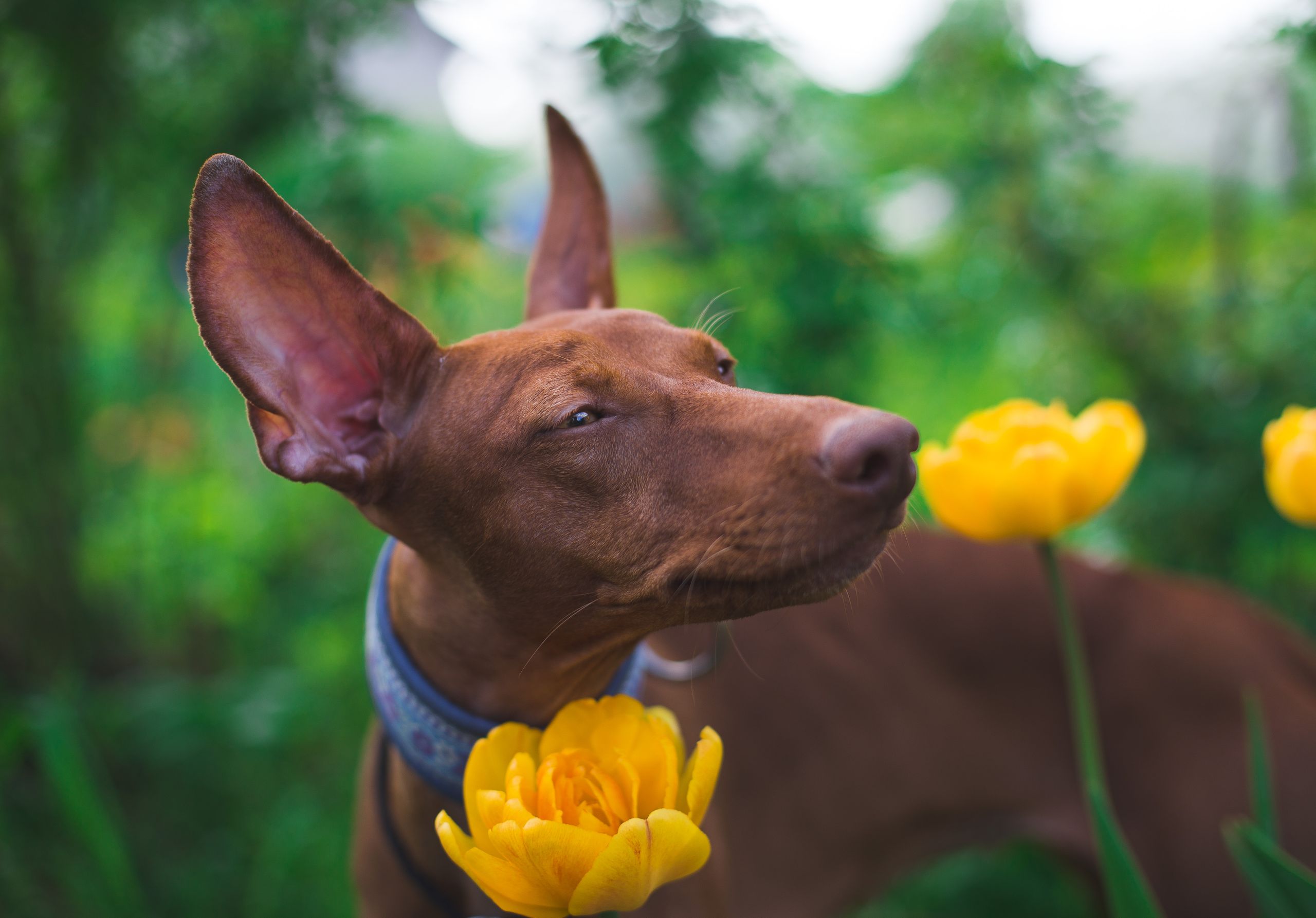
The breed's party trick is the blush: when a Pharaoh Hound is happy or excited the ears and nose turn pink. It cannot be done on command, and it is a charming sign that the dog is enjoying itself. Indoors the breed is calm and clean, often curled in a warm spot, and the transition from sprinting to sleeping is almost instant. Outdoors it is a hunter that notices every movement.
Children and other pets
A Pharaoh Hound is good with considerate children who respect a sensitive dog, and less suited to rough, noisy play. Its prey drive means cats and small pets that run are at risk, although a puppy raised alongside a cat may accept the household one. With other dogs it usually gets on well, particularly when raised together, and it enjoys the company of other hounds that play at its speed.
Exercise and the daily walk
A Pharaoh Hound needs about an hour and a half a day, including a chance to run safely. The breed is athletic and fast, and it hunts by sight and scent, so an open field is no place for an unfenced off-lead run. A secure, well-fenced area is invaluable, and a hound that sees a rabbit or a hare may vanish before you finish saying its name.
Brisk lead walks, a safe sprint, a game of chase with a lure and a bit of training fill the day. Between the bursts the dog will happily sleep for hours. Because the coat is short and the skin thin, wet or cold weather is unpleasant, and a coat in winter will help. Warm up gently before hard running and avoid exercise straight after meals.
Training
Pharaoh Hounds are intelligent, sensitive and independent, and they respond to gentle, reward-based training. Harsh methods damage trust and produce a dog that simply refuses to cooperate. Short, varied sessions work better than repetition, and a hound that is allowed to think it was its own idea usually does best. Use high-value treats and give the dog frequent breaks.
Recall is not reliable once prey is sighted. Use a long line or a fenced space, and teach a calm lead walk and settled behaviour at home. Socialise gently and widely, because reserve with strangers can harden into wariness if the dog is not given positive experiences. Teach the dog to accept handling, a coat, a harness and a calm lift ride, and keep the routine consistent.
Coat and grooming
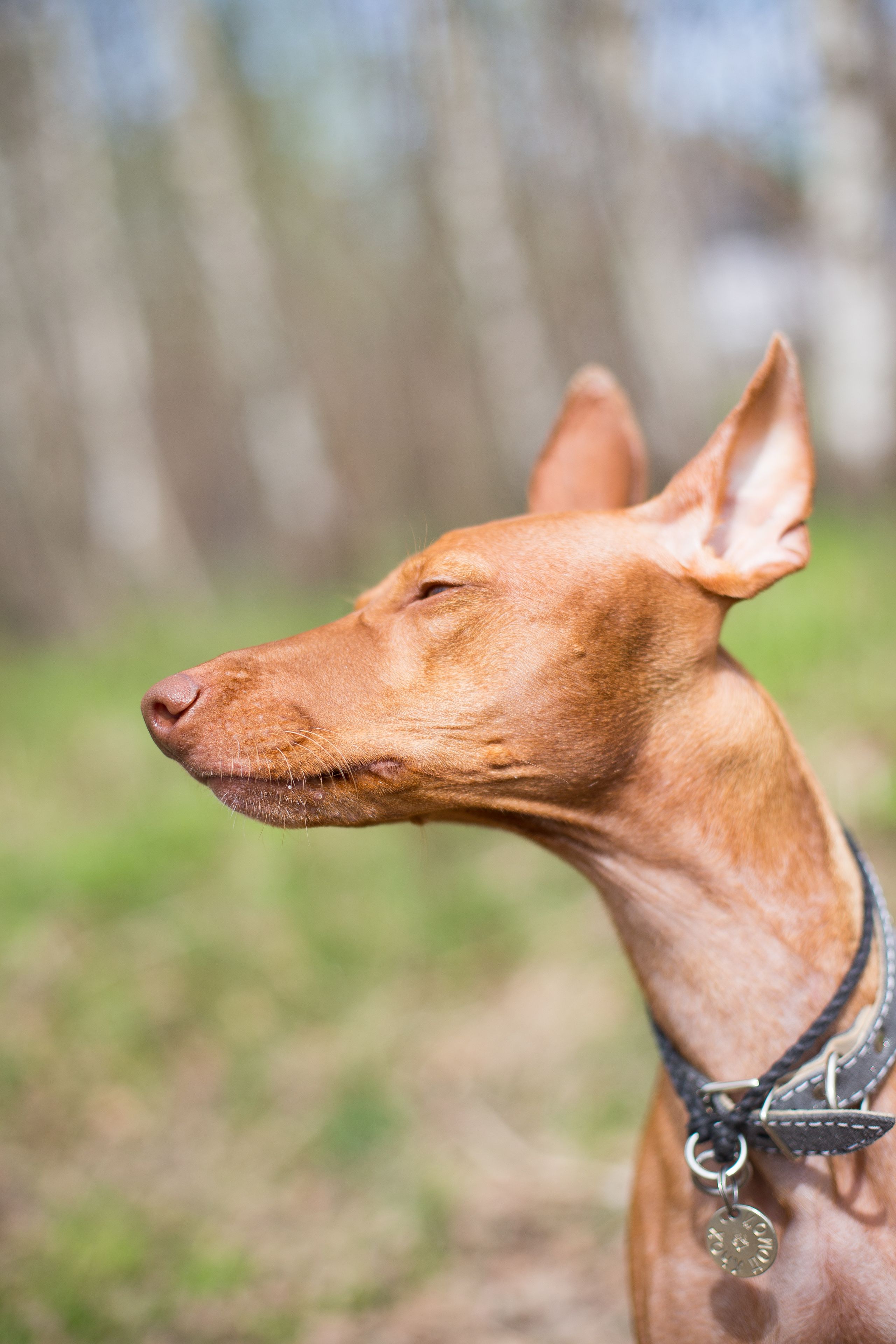
The FCI describes a short, glossy coat, ranging from fine and close to slightly harsh, with no feathering. It is easy to keep: a weekly rub with a rubber mitt or soft brush removes loose hair and brings up the shine. Thin skin and short hair mean the dog feels the cold and is easily scratched, so a coat helps in winter. The standard asks for tan or rich tan, with a white tail tip, white chest, white on the toes and a slim white blaze.
Feeding and weight
Pharaoh Hounds are lean, athletic dogs with a good appetite. Feed measured meals of a complete food suited to age and activity, and keep the dog lean so that the ribs can be felt. Avoid hard exercise around mealtimes, and consider two smaller meals a day. Fresh water should always be available, and a vet can advise on weight, since a thin coat shows condition quickly.
Work out a starting calorie figure and food weight with the calorie calculator. Not sure this is the right breed? Take the quiz.
Health
Every breed carries predispositions. These are the conditions most often discussed for the Pharaoh Hound, not a prediction for any individual dog.
- Sensitivity to some anaesthetics and insecticides
- Dental problems
- Skin injuries because of thin skin
- Hip dysplasia in some dogs
- Sensitivity to the cold
What to ask the breeder. Ask for hip and dental results for the parents, and about health and longevity in the lines. Ask also whether the breeder has experience of the breed's sensitivity to anaesthetics.
Choosing a puppy
Ask about health testing and longevity in the lines, and meet the parents, noting whether they are poised and friendly rather than nervous. Puppies are athletic and curious, so puppy-proof the home and prevent big jumps while the bones develop. Socialise gently and widely with people, dogs, lifts and trams, and begin lead and harness training early, since an adolescent hound that has never learned to walk calmly is a handful.
In Luxembourg the national kennel club is the Fédération Cynologique Luxembourgeoise (FCL), a member of the FCI. Many owners also buy from breeders in Germany, France or Belgium; a puppy coming from another EU country must be microchipped and vaccinated against rabies, which in practice means it cannot travel before about fifteen weeks of age. Where to get a dog in Luxembourg.
The older Pharaoh Hound
Watch for stiffness, dental problems and cold sensitivity. Tell any vet that the dog is a sighthound-type breed before any anaesthetic. Keep up dental care, provide a warm, padded bed away from draughts, and shorten the fast running as the joints age. Older Pharaoh Hounds still enjoy a steady lead walk and a patch of sun, and a coat in winter helps comfort.
A realistic day
A realistic weekday for a working household in Luxembourg City, with a midday visit. Adjust it to your dog, not the other way round.
A brisk walk on a lead before work.
Breakfast, then a settle on a warm bed.
Midday visit with a short walk and a drink.
Longer outing with a safe sprint in a fenced area.
Final walk, then a coat in cold weather.
A Pharaoh Hound in Luxembourg
A Pharaoh Hound can be a calm flat dog, sleeping for hours, if its exercise and running are met. It needs a fenced space, because off-lead freedom near roads is dangerous, and city parks are rarely secure enough for a hound that can cover a field in seconds. Use the lift, keep floors non-slip, and expect a dog that watches the street from the window with interest.
Winters can be cold and damp for a short-coated dog, so buy a good coat. In summer, with temperatures reaching the 30s, walk early or late and avoid hot pavements. The Bambësch and the Grünewald offer long lead walks on soft ground, and buses and trams are free nationwide. Register and microchip the dog, take out third-party liability insurance and expect an annual dog tax.
Every dog in Luxembourg must be identified, declared to the commune and covered by liability insurance. How registration works.
When you travel
Pharaoh Hounds can be reserved with strangers, so introduce the sitter beforehand and let the dog take its time. Use a secure harness and lead, never rely on recall, and double-check gates and doors, since a hound can bolt after prey. Keep the dog warm, give measured meals and tell the vet about any anaesthetic sensitivity.
PAWLY's holiday and overnight care takes place in your home, so your dog keeps its own bed and routine.
Myths and facts
MythPharaoh Hounds are ancient Egyptian dogs.
FactThe name is romantic, but DNA studies have not shown that the breed descends from ancient Egyptian dogs.
MythThey blush on command.
FactThe blush is involuntary, and appears when the dog is excited or happy.
MythA fast dog needs a huge garden.
FactIt needs a safe place for brief sprints and regular walks. Many sleep happily for hours in a flat afterwards.
Is it the right dog for you?
Suits
- Active owners with a safe place to run
- Calm households
- People who enjoy a sensitive, expressive dog
- Owners comfortable with a lead-only dog
Think twice if
- Homes with small pets
- People who want an off-lead walking companion
- Owners who dislike a cold-sensitive dog
- Households with rough, noisy play
Questions owners ask
Does a Pharaoh Hound really blush?
Yes. The ears and nose turn pink when the dog is excited or happy. It is involuntary and is one of the breed's best known traits.
Is a Pharaoh Hound good in a flat?
It can be, if it gets safe running time and plenty of company. Indoors the breed is calm and clean, but it needs a secure place for exercise and a warm bed.
Can a Pharaoh Hound be let off the lead?
Only in a secure, fenced area. The standard describes a keen hunter that hunts by sight and scent, and recall fails once prey is sighted. A long line is a sensible compromise elsewhere.
How tall is a Pharaoh Hound?
The FCI gives 56 to 63.5 cm for males and 53 to 61 cm for females, and no weight. Most adults are lean, graceful dogs with a tan coat and white markings.
Sources
Photo: Pexels (Pexels License) · Photo: Pexels (Pexels License) · Photo: Pexels (Pexels License)
General information for dog owners in Luxembourg, not veterinary or legal advice. Official facts (origin, size, group, history and temperament as described by the breed standard) follow the FCI standard; health and care sections reflect breed-club and veterinary guidance and are typical ranges rather than rules. For your own dog, ask your vet, the breed club or your commune. How this guide is written and checked. Last reviewed 8 October 2026.
Need someone for your Pharaoh Hound?
PAWLY offers an individual 45-minute walk or a home visit at your dog's pace, the same walker every time, and a written report with photos after every visit, across Luxembourg City.
Read next: the journal, for the Pharaoh Hound
All articles
Building a recall you can actually rely on
Scent and movement can cancel a recall; this is the method for the Pharaoh Hound.
The dog that is afraid of people
The Pharaoh Hound is often reserved with strangers; early, patient handling of that matters.

The itchy dog: working through it in the right order
Skin trouble is among the conditions discussed for the Pharaoh Hound; this is the order to work through it.
Similar breeds
All 198 breeds
Rhodesian Ridgeback
The African lion dog: dignified, independent and athletic, with the ridge of hair along its back that gives it its name.
EnergyGroomingFlat life
Whippet
A sprinter who sleeps most of the day: one of the best city dogs you have never considered.
EnergyGroomingFlat life
Basenji
A small hunting dog from Central Africa that yodels rather than barks, grooms itself like a cat and thinks for itself at every turn.
EnergyGroomingFlat life

