


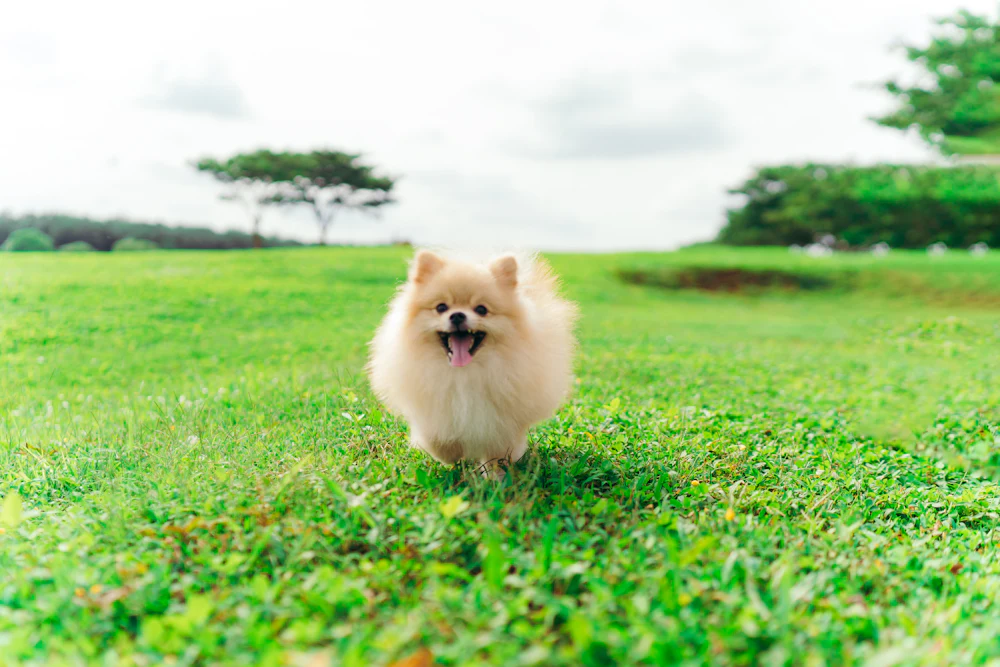
History
The Pomeranian descends from the larger spitz-type dogs of the Pomeranian region on the Baltic coast. The FCI standard, which is titled German Spitz and covers the Toy or Pomeranian variety as the smallest of the group, traces the whole family back to the prehistoric Peat Dog and the Lake Dwelling Spitz, and calls it the oldest breed of dog in Central Europe. Germany is the country of origin, and the classification is Group 5, Section 4, the European Spitz.
Queen Victoria did a great deal to popularise the smaller type after bringing a little dog called Marco back from Florence in 1888, and the breed has been bred ever smaller since. The modern FCI standard gives the Toy Spitz a height of 21 cm with a tolerance of 3 cm and states a watch and companion purpose. Some other kennel clubs treat the Pomeranian as a separate breed, but the FCI treats it as a variety of the German Spitz.
Temperament
The FCI describes the Toy Spitz as always attentive, lively and extraordinarily attached to its owner, very teachable and easy to train, with a companionable and cheerful character that makes it suitable for house and apartment. It is neither timid nor aggressive. The standard adds a fox-like head with alert eyes and small, pointed, closely set ears, which give the breed a cheeky look, and the cheeky character often matches.
Pomeranians are bright, extroverted and alert. They make keen watchdogs, which in an apartment means they announce everything, from the lift to a delivery on the landing. They are affectionate, playful and attached to their people, and many believe they are much bigger than they are, which is where trouble starts around large dogs. Early socialisation, training and calm handling keep that confidence charming rather than pushy.
Children and other pets
Poms are better suited to adults and older children. A small dog can be injured by a clumsy hug or a dropped lift, and the breed can snap when frightened. They can be bossy with other dogs and should be protected from rough play with big ones. With cats and other small pets they are usually fine if introduced early. Supervise children, and teach them to sit on the floor and let the dog approach.
Exercise and the daily walk
Short walks and indoor games cover most of a Pomeranian's needs, around half an hour to three-quarters of an hour a day, but they enjoy exploring and should not be treated as ornaments. Two or three outings, a little play and a few training games usually suffice. Healthy adults can manage a longer weekend walk if it is paced for short legs.
They can overheat in summer because of the coat, so walk early or late and carry water. They are fragile around large dogs and over rough ground, so choose the walking spot with care, and use a harness rather than a collar to protect the neck and windpipe. Avoid letting them jump from heights, which can injure small legs.
Training
Pomeranians are bright and eager, and they respond well to reward-based training, which suits the standard's description of a very teachable dog. Start early with a quiet cue and with calm responses to noises in the corridor, because the breed is a natural alarm system. Reward the moment of silence, not the bark, and thank the dog for its warning before asking for quiet.
They enjoy tricks and games, and short sessions keep them engaged. Handle the coat, feet and teeth from puppyhood so grooming and dental care become routine. House training can take time in small breeds with small bladders, so be patient and consistent. Teach a reliable recall and a polite lead walk, and keep the dog's self-confidence in proportion to its size.
Coat and grooming
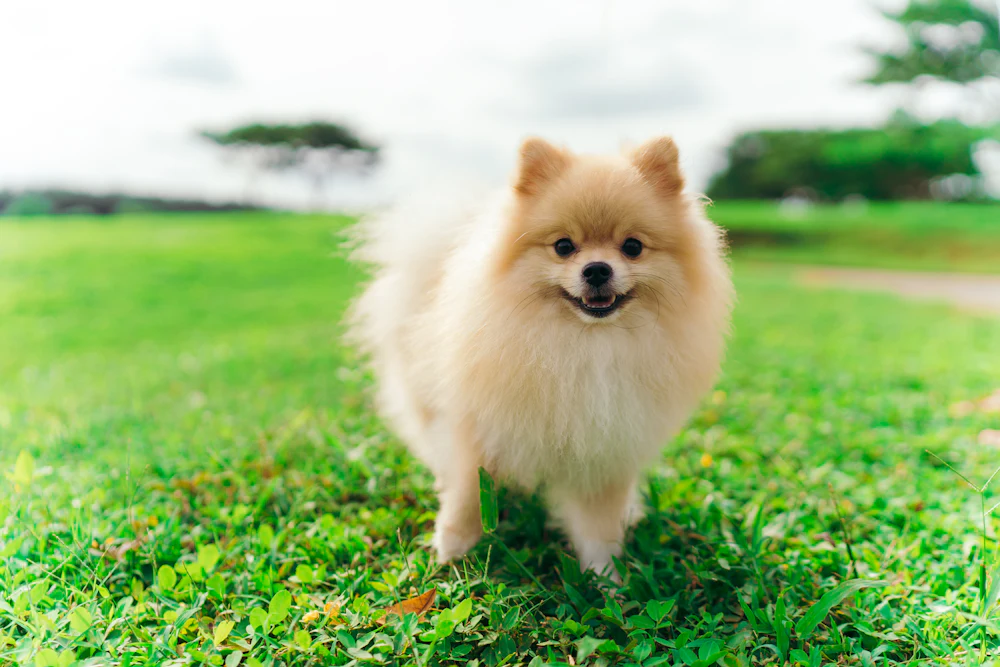
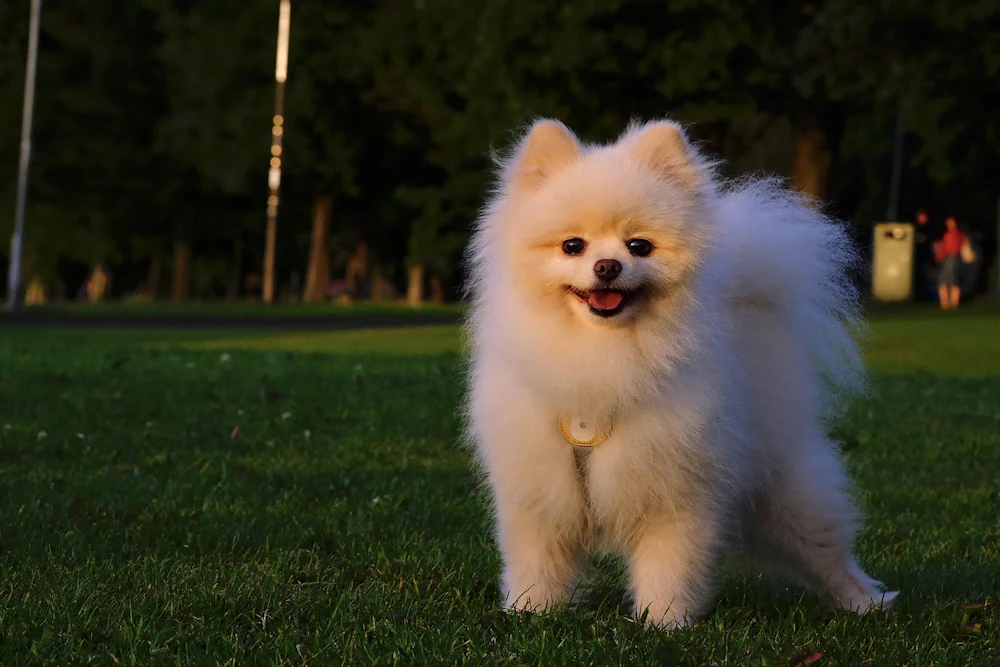
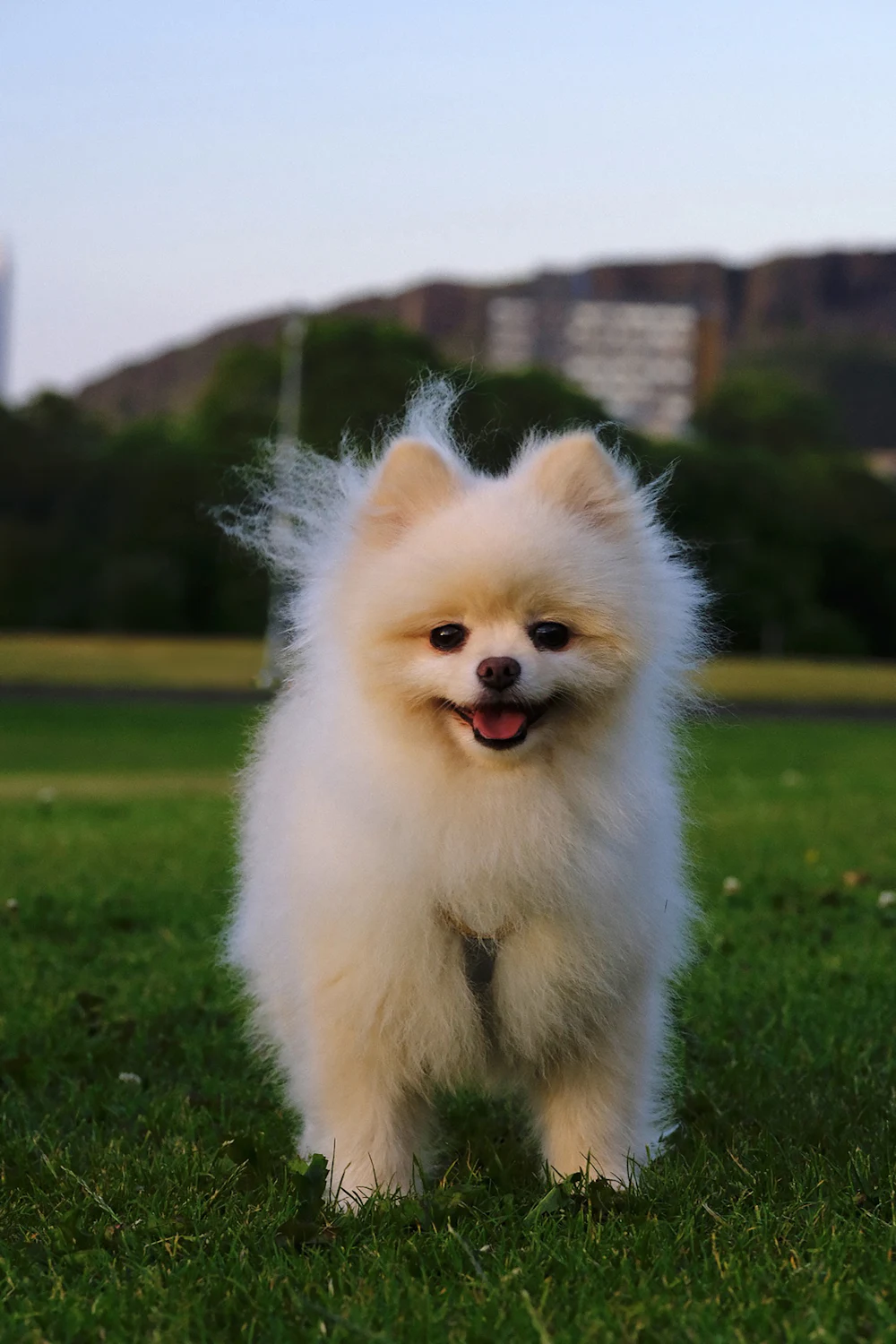
The FCI describes a double coat with a long, straight, firm outer coat over a short, thick, cotton-wool-like undercoat, forming a mane-like collar and a bushy tail carried over the back. It is not wavy, curly or shaggy. Brush several times a week, down to the skin, and expect heavy seasonal shedding. Do not shave a Pomeranian, since the coat may grow back patchily or not at all. Permitted colours include white, black, brown, orange, grey-shaded, cream and patched.
Feeding and weight
Small, measured meals and good dental care. Poms easily become overweight, which also makes tracheal problems worse, and a thick coat can hide extra weight, so check the ribs by touch. Choose a complete food of a size suitable for small mouths, avoid sharing scraps and use tiny treats in training. A little tooth brushing most days or dental chews help prevent the dental disease common in toy breeds.
Work out a starting calorie figure and food weight with the calorie calculator. Not sure this is the right breed? Take the quiz.
Health
Every breed carries predispositions. These are the conditions most often discussed for the Pomeranian, not a prediction for any individual dog.
- Patellar luxation (slipping kneecaps)
- Tracheal collapse
- Dental disease
- Alopecia X (coat loss)
- Heart conditions, including patent ductus arteriosus
What to ask the breeder. Ask for patella checks and a heart examination for the parents. Ask also about tracheal problems and coat loss in the lines.
Choosing a puppy
Ask for patella and heart checks of the parents. Choose a breeder who prioritises temperament and health over the smallest possible size, and who has raised the puppies in the house with noise, people and handling. Keep a young puppy off high furniture, guard it from falls and from boisterous large dogs, and begin brushing, tooth cleaning and quiet training at once.
In Luxembourg the national kennel club is the Fédération Cynologique Luxembourgeoise (FCL), a member of the FCI. Many owners also buy from breeders in Germany, France or Belgium; a puppy coming from another EU country must be microchipped and vaccinated against rabies, which in practice means it cannot travel before about fifteen weeks of age. Where to get a dog in Luxembourg.
The older Pomeranian
Watch teeth, the trachea and any coat loss. Many Poms live well into their teens with good care. Regular dental treatment, a lean body and a harness rather than a collar protect an ageing dog, and soft bedding and ramps spare the joints. Cough, breathlessness or tiring on walks deserves a vet visit, since heart and windpipe problems can develop gradually.
A realistic day
A realistic weekday for a working household in Luxembourg City, with a midday visit. Adjust it to your dog, not the other way round.
A short, brisk walk and a toilet break.
Breakfast, measured, with a quick brush.
Midday company, a toilet break and a few tricks.
Evening walk and play, with a harness and water.
Brush, a little tooth care and bed.
A Pomeranian in Luxembourg
A Pomeranian suits a flat well, small enough for the lift and content with short outings, provided the barking is managed early. Teach a quiet cue and reward calm responses to noises in the stairwell, because thin walls and a vocal dog are a poor combination. Carry the dog through crowded places and on busy pavements, since a very small dog is easily overlooked.
In the Pétrusse valley, Parc Merl or the Municipal Park, a Pom has plenty to explore, and buses and trams are free nationwide. Summers reaching the 30s are hard on the thick coat, so walk early or late and keep the flat cool. Do not shave the dog for the heat. Microchip, register with the commune, insure the dog for third-party liability and expect an annual dog tax.
Every dog in Luxembourg must be identified, declared to the commune and covered by liability insurance. How registration works.
When you travel
Poms travel easily in a carrier. With a sitter, keep brushing going and give warnings about barking at noises in the building. Provide measured meals, a harness and a note of the dog's signals, and ask the sitter to keep the dog away from large, boisterous dogs. Keep the flat cool in summer, and leave the vet's number.
PAWLY's holiday and overnight care takes place in your home, so your dog keeps its own bed and routine.
Myths and facts
MythA Pom's coat can be shaved for summer.
FactShaving can cause the coat to grow back poorly or not at all, and it does not help with heat.
MythPomeranians are fragile ornaments.
FactThey are lively little spitz dogs that enjoy walks and games, as long as big dogs play gently.
MythPomeranians are a different breed from German Spitz everywhere.
FactThe FCI treats the Pomeranian as the smallest variety of the German Spitz, though some other kennel clubs list it separately.
Is it the right dog for you?
Suits
- Apartment dwellers
- Adults and older children
- Owners who enjoy grooming
- People who want a lively, trainable companion
Think twice if
- Toddlers
- Very thin-walled buildings
- Owners wanting low grooming
- Homes with large, rough dogs
Questions owners ask
Do Pomeranians bark a lot?
Many do. They are alert watchdogs and announce every noise. Training a quiet cue early, giving the dog enough to do and rewarding calm responses helps a great deal.
Pomeranian or German Spitz?
The FCI treats the Pomeranian as the smallest German Spitz variety, in the same standard. Some other kennel clubs treat it as a separate breed, but the dogs are closely related.
Can a Pomeranian be shaved in summer?
It is not advised. The double coat insulates against heat, and shaving can leave the coat patchy or not growing back. Brush out the undercoat, keep the flat cool and walk early or late.
How big is a Pomeranian?
The FCI gives 21 cm at the withers with a tolerance of 3 cm, and no fixed weight. Most adults are tiny, around 2 to 3.5 kg, and very light, so they need gentle handling.
Sources
Photo: Unsplash (Unsplash License) · Photo: Unsplash (Unsplash License) · Photo: Unsplash (Unsplash License) · Photo: Unsplash (Unsplash License) · Photo: Unsplash (Unsplash License)
General information for dog owners in Luxembourg, not veterinary or legal advice. Official facts (origin, size, group, history and temperament as described by the breed standard) follow the FCI standard; health and care sections reflect breed-club and veterinary guidance and are typical ranges rather than rules. For your own dog, ask your vet, the breed club or your commune. How this guide is written and checked. Last reviewed 8 October 2026.
Need someone for your Pomeranian?
PAWLY offers an individual 45-minute walk or a home visit at your dog's pace, the same walker every time, and a written report with photos after every visit, across Luxembourg City.
Read next: the journal, for the Pomeranian
All articles
Teeth: the problem owners find least interesting and vets see most
Teeth are a known weak point in the Pomeranian; this is the routine that helps.

Building a recall you can actually rely on
Scent and movement can cancel a recall; this is the method for the Pomeranian.

Grooming and coat care through the Luxembourg year
The Pomeranian has a coat that needs a routine that holds through the Luxembourg seasons.
Similar breeds
All 198 breeds
Samoyed
The smiling white spitz of the Arctic: friendly, talkative and covered in fur.
EnergyGroomingFlat life
Chihuahua
The smallest pedigree dog in the world, with an apple-shaped head, a big personality and a courage that far outruns its size.
EnergyGroomingFlat life
Eurasier
A calm, watchful family spitz that wants to be wherever its people are, and sulks quietly when it is not.
EnergyGroomingFlat life

