


History
The Staffordshire Bull Terrier comes from the English Midlands and the Black Country, where working families crossed bulldogs with terriers to produce a dog with a bulldog's courage and a terrier's speed. Such dogs were used for bull-baiting and, after that was banned in 1835, for illegal dog fighting. It is a history the breed has spent a long time living down, and one that still colours how strangers judge a dog they have never met.
The Kennel Club recognised the breed in 1935, and it has since become a widely kept companion in Britain. The FCI standard, published on 24 June 1987 with Great Britain as the country of origin, places it in Group 3, Section 3, the bull type terriers. It describes a smooth-coated, well-balanced dog of great strength for its size, muscular, active and agile, standing 14 to 16 inches at the withers.
Temperament
The FCI standard asks for indomitable courage and tenacity, and in the same breath for a highly intelligent and affectionate dog, particularly with children. It calls the breed bold, fearless and totally reliable. In daily life that translates into a dog that wants to be physically close to its people, leans against legs, joins sofas uninvited and greets a returning owner with its whole body.
The other side of that courage is that a Staffie may not back down from another dog. Many live happily with canine friends, but tolerance varies by individual and often falls with maturity, particularly towards dogs of the same sex. Good socialisation as a puppy, careful introductions and a handler who reads body language early all matter far more than the breed label.
Children and other pets
Staffies are famous for their affection towards children in their own family, and many enjoy a lively household. Their strength and enthusiasm mean toddlers should always be supervised, as with any sturdy dog. Tolerance of other dogs depends on the individual and needs careful management, and cats and small pets are best introduced slowly, if at all, in a young dog.
Exercise and the daily walk
Plan on an hour to an hour and a half a day, split between walks and real play. Staffies are strong, compact athletes that enjoy fetch, tug games with rules and a good sniff in the woods. A bored young Staffie will find its own entertainment, usually involving furniture, so mental work such as food puzzles counts as exercise too.
Pulling is the main issue on lead, because the dog is very strong for its size and very keen. Teach loose-lead walking from the first week and keep sessions varied. In summer, walk early or late, as a muscular dog can overheat quickly.
Training
Staffies are clever, people-oriented and keen on food and toys, so they train well with rewards. Short, cheerful sessions work best, and they respond poorly to harshness. Loose-lead walking matters because of their strength, and calm behaviour around other dogs should be taught early and maintained throughout life.
Because of Luxembourg's law and public perception, a Staffie that walks calmly, ignores other dogs and is comfortable wearing a muzzle has an easier life. Muzzle training, done gradually and positively with treats, is worth doing even if you rarely need it. It also helps in an emergency at the vet.
Coat and grooming
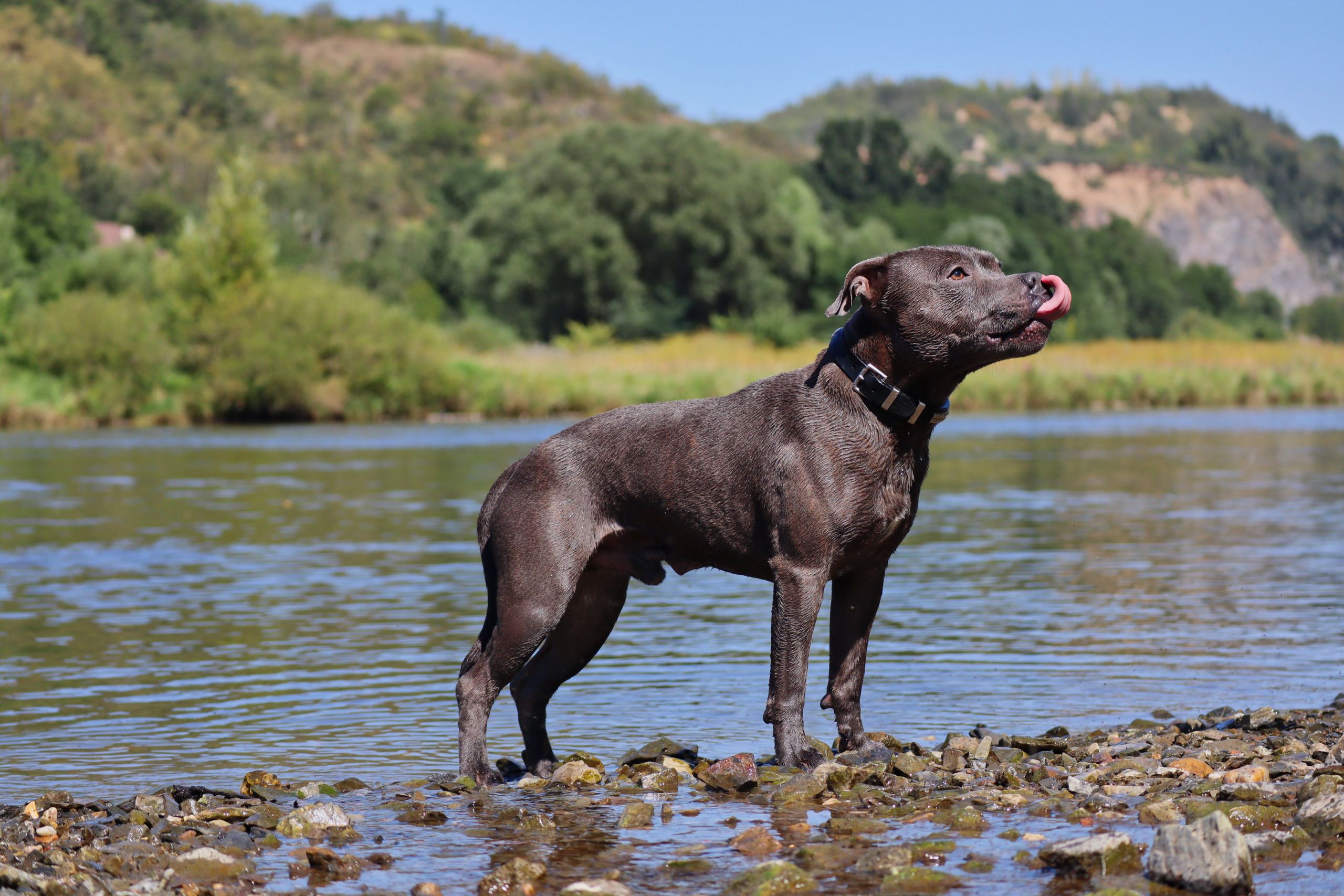
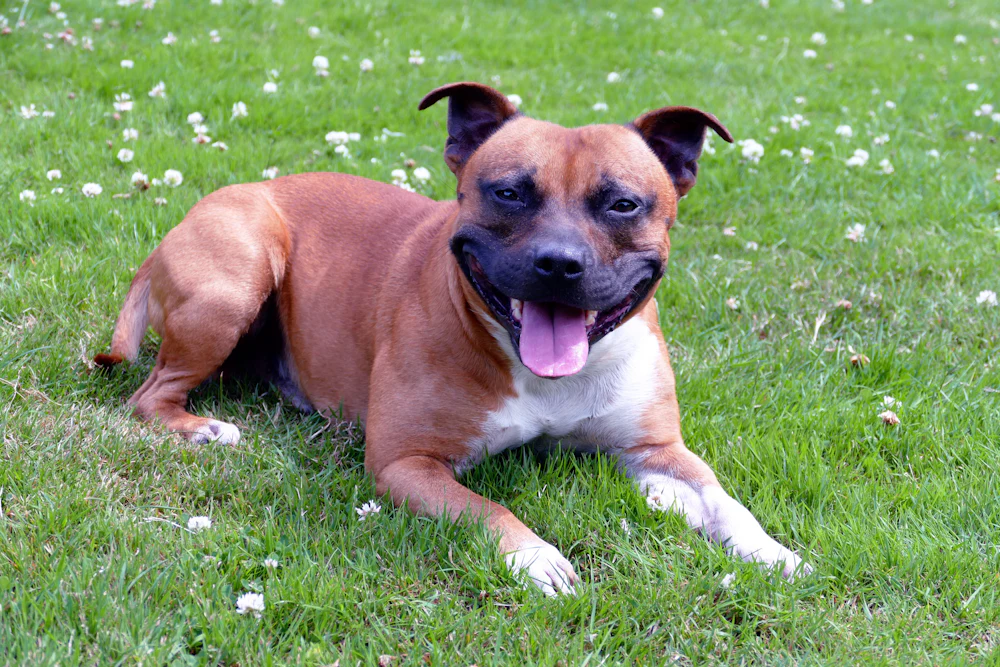
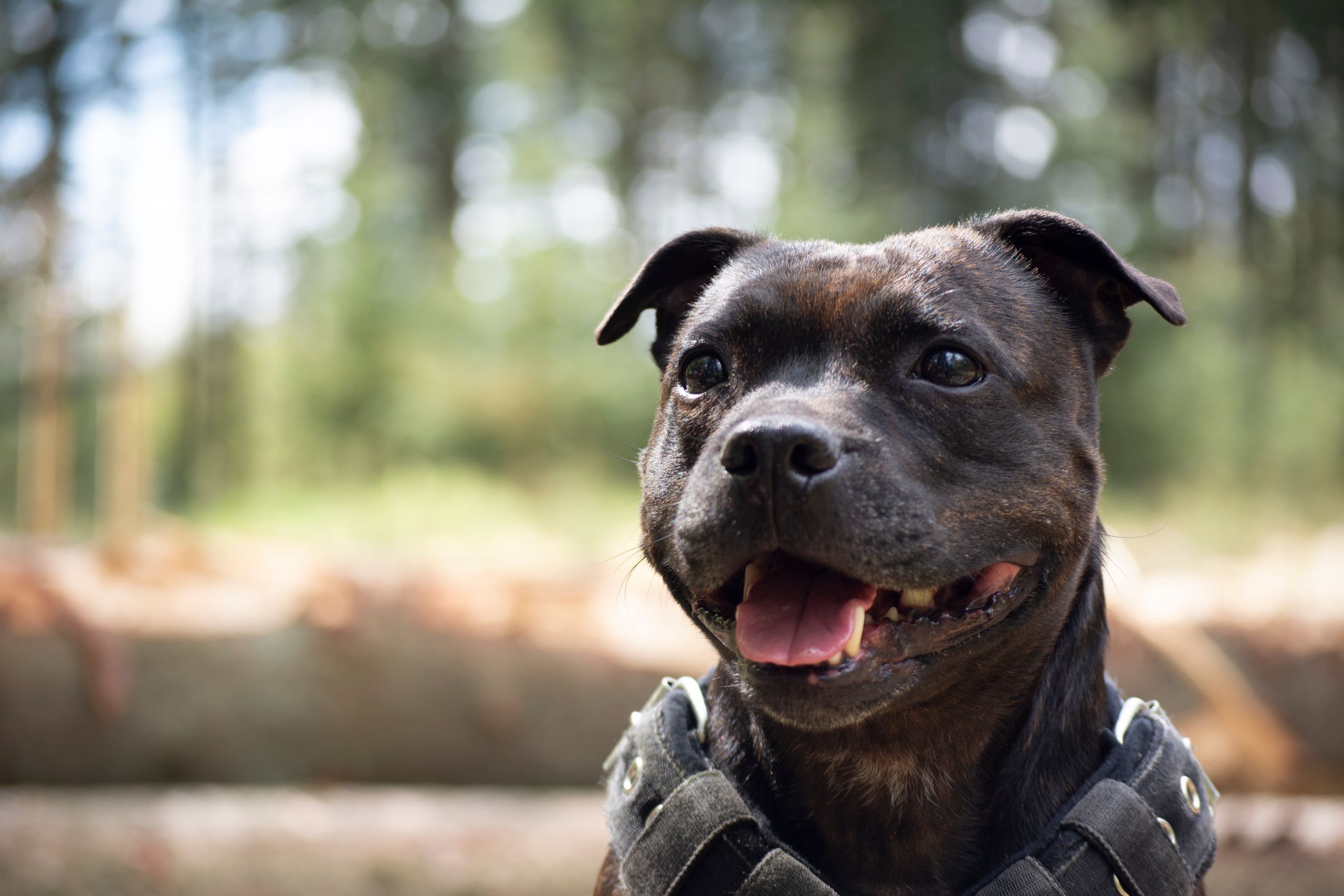
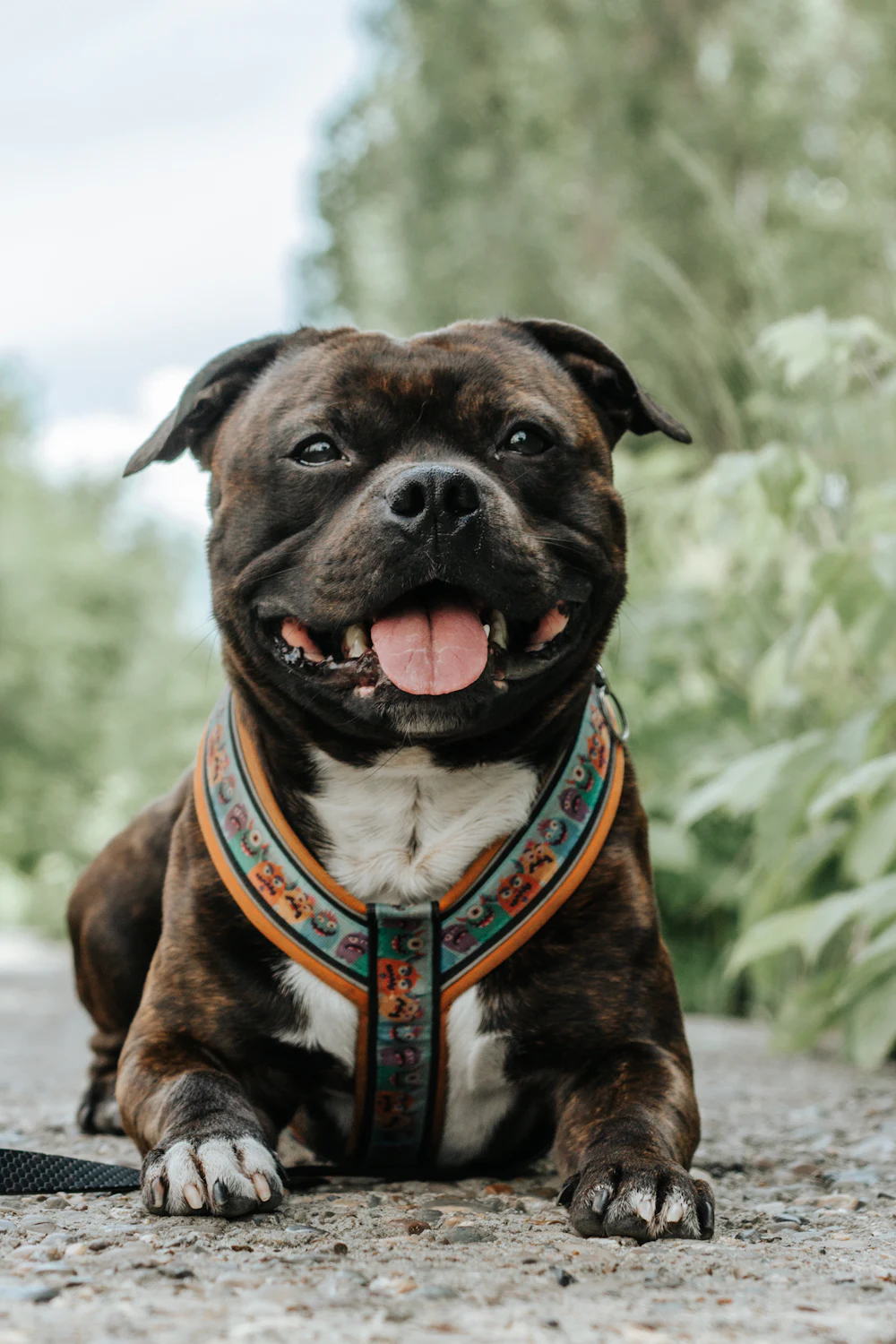
The coat is smooth, short and close, and needs little more than a weekly rub with a rubber mitt or soft brush to lift loose hair. Shedding is light but constant, and short hairs weave into upholstery. The FCI standard accepts red, fawn, white, black, blue or any of these with white, and any shade of brindle; black and tan or liver are highly undesirable. Wipe the skin folds around the face if needed, and check the ears and nails regularly.
Feeding and weight
Staffies can become heavy quickly, and a stocky dog hides extra weight well, so keep your dog lean and muscular and check the waist from above. Measure meals and use part of the daily ration for training. Some individuals have skin allergies that respond to careful diet management, which is a job for your vet rather than for random changes of food.
Work out a starting calorie figure and food weight with the calorie calculator. Not sure this is the right breed? Take the quiz.
Health
Every breed carries predispositions. These are the conditions most often discussed for the Staffordshire Bull Terrier, not a prediction for any individual dog.
- L-2-hydroxyglutaric aciduria (L-2-HGA, DNA test)
- Hereditary cataract (DNA test)
- Persistent hyperplastic primary vitreous (eye examination)
- Skin allergies
- Hip dysplasia
What to ask the breeder. DNA test results for L-2-HGA and hereditary cataract, eye examination results and hip scores for both parents.
Choosing a puppy
In Luxembourg, the training certificate and ministerial authorisation must come before you acquire the dog, so start the paperwork first and choose the puppy second. Ask the breeder for L-2-HGA and hereditary cataract DNA results, eye examination certificates and hip scores. Meet the mother and, if possible, the father, and see how they behave with strangers and other dogs.
In Luxembourg the national kennel club is the Fédération Cynologique Luxembourgeoise (FCL), a member of the FCI. Many owners also buy from breeders in Germany, France or Belgium; a puppy coming from another EU country must be microchipped and vaccinated against rabies, which in practice means it cannot travel before about fifteen weeks of age. Where to get a dog in Luxembourg.
The older Staffordshire Bull Terrier
Many Staffies stay playful well into old age, which can hide a slowing body. Watch for lumps, skin problems, cloudy eyes and stiffness after rest. Shorter, more frequent walks protect the joints, and keeping the dog lean is the best single thing you can do. Provide a warm, supportive bed, since short-coated older dogs feel the cold.
A realistic day
A realistic weekday for a working household in Luxembourg City, with a midday visit. Adjust it to your dog, not the other way round.
Walk with an owner or qualified handler, with some training on loose-lead manners.
Breakfast, then a chew while the household gets ready.
Midday walk and a short game in the park.
Longer walk with play, tug or scent games.
Final calm walk and a check of the harness and muzzle kit.
A Staffordshire Bull Terrier in Luxembourg
The Staffordshire Bull Terrier is named in Luxembourg's law of 9 May 2008 on dogs susceptible to being dangerous, alongside the American Staffordshire terrier, the Mastiff, the Tosa and dogs of similar morphology. In practice that means a training certificate and ministerial authorisation before you acquire the dog. Read the current requirements carefully, and check your third-party liability insurance explicitly, since every dog in Luxembourg must be insured, microchipped and declared to the commune.
Day to day, a Staffie suits flat life well if it gets its exercise, and it is a good size for a lift. The Pétrusse valley, Parc Merl and the Bambësch forest all give good walking. Expect curious looks on the bus and tram, which are free nationwide, so calm manners and a relaxed handler count. PAWLY can only walk a listed dog if the handler holds the required qualification, so ask us before booking.
Every dog in Luxembourg must be identified, declared to the commune and covered by liability insurance. How registration works.
Luxembourg dog law. This breed is named in the law of 9 May 2008 on dogs, which requires a training certificate and a ministerial authorisation before you acquire the dog. Read the rules before you commit.
When you travel
Check this before arranging any care while you are away, and give the carer your vet's details, written feeding instructions and the muzzle if you use one. A sitter living in the home often suits this affectionate breed better than a kennel.
PAWLY's holiday and overnight care takes place in your home, so your dog keeps its own bed and routine.
Myths and facts
MythStaffies have locking jaws.
FactNo dog has a locking jaw. Staffies have strong jaw muscles and a determined grip, nothing more.
MythStaffies are naturally aggressive to people.
FactThe FCI standard describes a dog that is affectionate and totally reliable, particularly with children. Tolerance of other dogs varies and needs training.
MythA Staffie is just a small pit bull.
FactThe Staffordshire Bull Terrier and the American Staffordshire terrier are separate breeds, though both are named in Luxembourg's law.
Is it the right dog for you?
Suits
- Owners prepared for the legal obligations
- Active families who enjoy a physical, playful dog
- People wanting an affectionate, sturdy companion
- Homes where a qualified handler is always available
Think twice if
- Anyone unwilling to complete the legal process
- Homes with other dogs and no plan for careful introductions
- Owners unable to guarantee a qualified handler for every walk
- People who dislike a dog that pulls and leans
Questions owners ask
Is the Staffordshire Bull Terrier banned in Luxembourg?
No, but it is named in the law of 9 May 2008, and owning one comes with specific obligations. A training certificate and ministerial authorisation must be in place before you acquire the dog.
Can anyone walk my Staffie?
No.Plan this before booking any walker or sitter.
Are Staffies good with children?
The FCI standard calls them affectionate, particularly with children, and many are wonderful family dogs. Supervise young children, because the dog is strong and enthusiastic, and teach children to respect its space.
Do Staffies get on with other dogs?
Some do, many do not as they mature, particularly with the same sex. Early socialisation helps, but plan for careful introductions and calm management in public rather than assuming every dog will be a friend.
Sources
Photo: Pexels (Pexels License) · Photo: Unsplash (Unsplash License) · Photo: Pexels (Pexels License) · Photo: Unsplash (Unsplash License)
General information for dog owners in Luxembourg, not veterinary or legal advice. Official facts (origin, size, group, history and temperament as described by the breed standard) follow the FCI standard; health and care sections reflect breed-club and veterinary guidance and are typical ranges rather than rules. For your own dog, ask your vet, the breed club or your commune. How this guide is written and checked. Last reviewed 8 October 2026.
Need someone for your Staffordshire Bull Terrier?
PAWLY offers an individual 45-minute walk or a home visit at your dog's pace, the same walker every time, and a written report with photos after every visit, across Luxembourg City.
Read next: the journal, for the Staffordshire Bull Terrier
All articles
Luxembourg's dangerous dog list: the breeds, the obligations, and the debate
The law of 9 May 2008 names the Staffordshire Bull Terrier; these are the obligations that follow.

Dog insurance in Luxembourg: the one you must have and the one you might want
Liability insurance is compulsory for every dog here, and matters more for a listed breed.

Building a recall you can actually rely on
Terriers follow scent and movement, so the Staffordshire Bull Terrier needs a recall built properly.
Similar breeds
All 198 breeds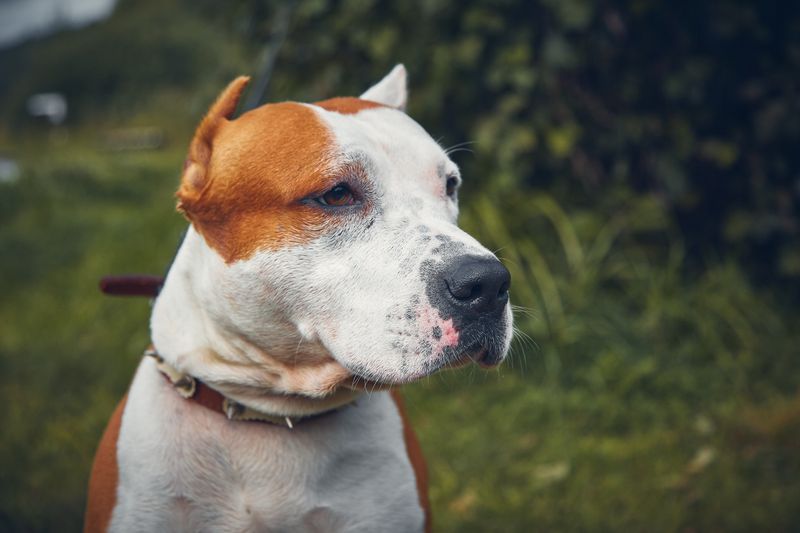
American Staffordshire Terrier
A strong, confident and affectionate dog, and in Luxembourg one of the four breeds named by law.
EnergyGroomingFlat life
Bull Terrier
Egg-headed, muscular and endlessly clownish: a bull terrier wants to be at the centre of the household and rarely accepts a quiet day.
EnergyGroomingFlat life
Boxer
A clown with a guardian's heart: playful, loyal and slow to grow up.
EnergyGroomingFlat life

